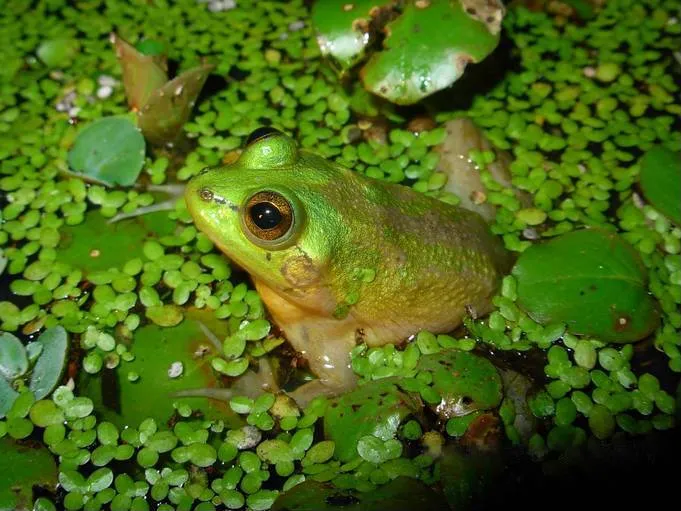
Pseudis paradoxa, the paradoxical frog, is a fully aquatic member of the tree frog family Hylidae, named for a life stage that runs backwards: its tadpole is far larger than the adult it becomes. The species lives across a wide stretch of tropical South America, including the Amazon Basin, the Guianas, Venezuela and Trinidad, with outlying populations in Colombia’s Magdalena River watershed, the Pantanal and northeastern Argentina.
Identification
Adults are modest in size, with a snout-vent length of 34-76 mm. The skin is green to brown, marked with dark green, olive or dark brownish stripes or mottling that varies considerably from one individual to the next. The toes carry an extra joint, giving the frog unusually strong feet that it uses to stir up muddy pond bottoms while searching for food.
The species’ defining trait, though, belongs to its larval stage rather than the adult. The tadpole grows to about 270 mm, the longest larva known in any frog and roughly three to four times the length of the adult it will become. During metamorphosis it shrinks dramatically, ending up at only about a quarter to a third of its former length — the “paradox” that gives the species its name.
Habitat and range
The frog occupies freshwater ponds, lakes and lagoons thick with aquatic vegetation across its South American range, from the Amazon Basin and the Guianas to Venezuela, Trinidad, Colombia’s Magdalena River watershed, the Pantanal and northeastern Argentina. Unlike most of its tree-frog relatives, it rarely leaves the water: adults stay active both day and night and always in or near water, relying on dense plant cover for shelter rather than climbing into vegetation above the surface.
Behaviour and breeding
Pseudis paradoxa hunts by feel as much as by sight, using its reinforced toes to disturb muddy bottoms and flush out prey. Adults eat a broad range of invertebrates, including flies, beetles, true bugs, plant-suckers, butterflies, moths, dragonflies and crabs, and will also take small frogs. The tadpoles feed differently, browsing mainly on algae while they grow to their exceptional size.
Breeding follows a simpler pattern than the frog’s dramatic larval stage: females lay eggs among water plants, which hatch into the giant tadpoles that make the species famous, before those tadpoles spend their growth shrinking down to adult proportions rather than expanding into them.
Beyond its odd growth pattern, the species has drawn interest from medical researchers: its skin produces a compound called pseudin-2, studied for antimicrobial properties and, in synthetic form, for its ability to stimulate insulin secretion from pancreatic cells without apparent cell toxicity, a line of research aimed at possible type 2 diabetes treatments rather than at the frog’s own biology.
Conservation
The IUCN category is shown in the facts box above. No major population-specific threat has been documented for Pseudis paradoxa, and its wide South American range across several major river systems and wetland systems keeps it clear of the pressures that concern more narrowly distributed relatives. Its reliance on ponds, lakes and lagoons with abundant plant growth means that, like most aquatic frogs, it is still sensitive to the drainage or pollution of the still and slow-moving waters it depends on, even without a documented decline severe enough to move it off Least Concern.
Similar species
Within the same family, Hyla arborea, the European tree frog, shows how differently Hylidae species can live: it is arboreal and largely terrestrial outside the breeding season, climbing among reeds and shrubs in Europe, while Pseudis paradoxa stays aquatic day and night across tropical South America and never develops the climbing habits of its European cousin.
A closer behavioural match, though from an unrelated family, is Xenopus laevis, the African clawed frog: both species spend essentially their whole adult lives in water. The two are still easy to tell apart. Xenopus laevis has a flattened body, clawed hind feet and no tongue, and it is native to Africa rather than South America. Pseudis paradoxa keeps a more ordinary frog-like body shape and toes built for stirring mud rather than clawed feet, and its giant, shrinking tadpole has no equivalent in Xenopus laevis’ life cycle.