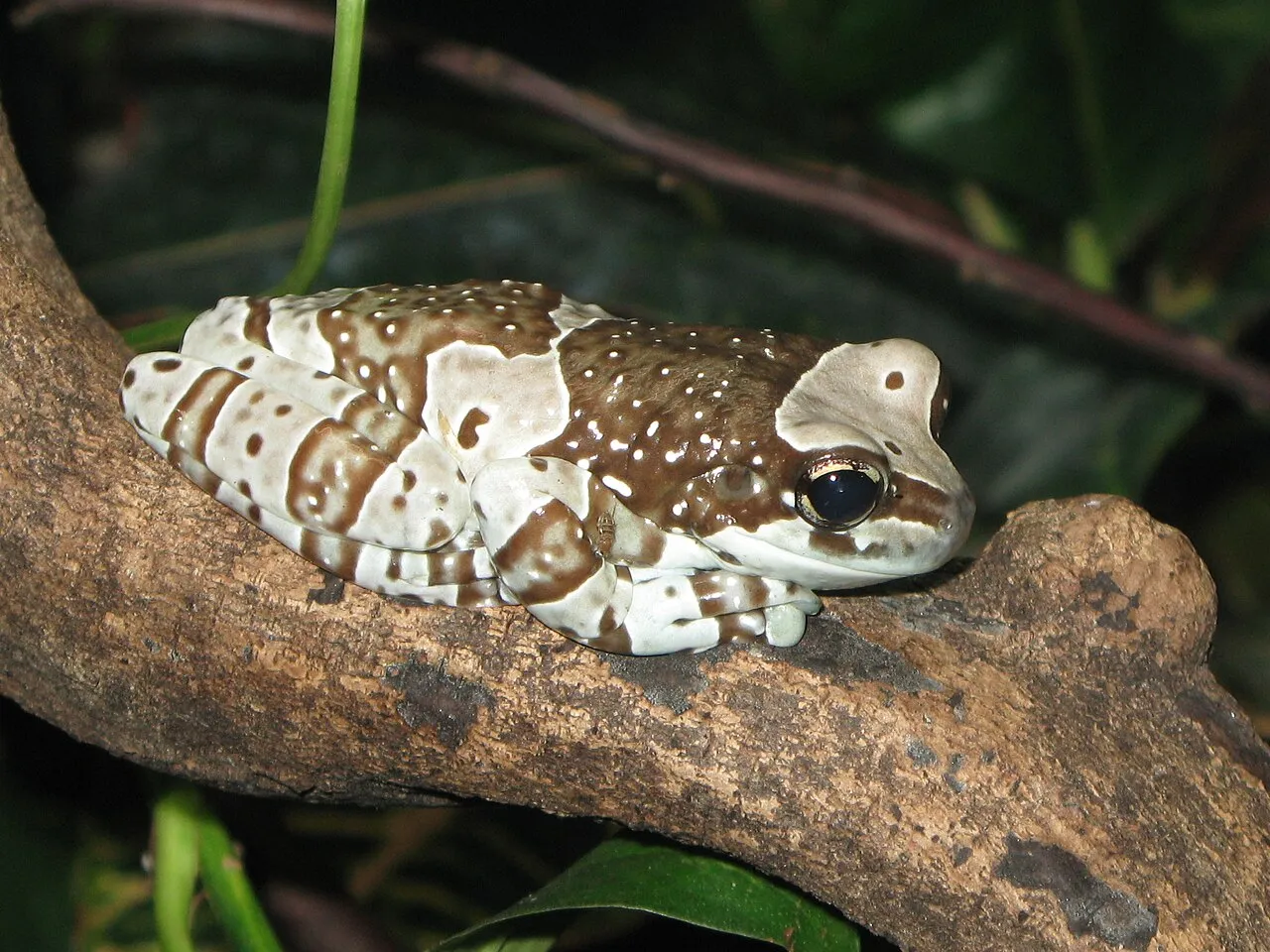
The Amazon milk frog, Trachycephalus resinifictrix, is a large tree frog of the Amazon basin also known as the mission golden-eyed tree frog or blue milk frog. It was first described along the Maracanã River in Brazil and today is recorded in the tropical rainforests of Brazil, Venezuela, Guyana, Colombia, Ecuador and Peru. Its common names come from a milky fluid the frog excretes when stressed, a defence shared across the group of frogs sometimes called milk frogs.
Identification
Adults reach a snout-vent length of about 64-102 mm (2.5-4.0 in), making this one of the larger hylid tree frogs in its range. The skin is light grey with brown or black banding, a pattern that grows subtler with age as juveniles show stronger contrast than adults, and develops a slightly bumpy texture as the frog matures. A distinctive feature is blood with a blue tint that shows through the skin, most visible around the mouth and on the toe pads. When handled or threatened, the frog secretes a milky white fluid from glands in its skin, the trait behind its most common English name.
Habitat and range
The species is arboreal, typically living in vegetation that overhangs permanent, slow-moving water within tropical rainforest, at ambient temperatures of roughly 21-30 degrees C. This habit keeps it close to the still or sluggish pools it needs for breeding while giving it cover in the forest canopy and understorey. Its range spans the Amazon basin from the type locality on Brazil’s Maracanã River across Venezuela, Guyana, Colombia, Ecuador and Peru, placing it among the hylids with the broadest geographic spread in the region.
Behaviour and breeding
As with other milk frogs, the Amazon milk frog spends most of its time off the ground, descending mainly to breed in the quiet water it favours. Its skin secretion serves as a defence against predators. Beyond its diet of insects and its preference for warm, humid conditions, open-access sources document little else about its breeding biology, and no unsourced detail fills that gap here.
Conservation
The facts box carries the species’ current IUCN Red List category, Least Concern, reflecting its wide distribution across six countries of the Amazon basin.
Similar species
Within its own range, the Amazon milk frog is most likely confused with other large, pale hylids such as Phyllomedusa bicolor, the giant leaf frog, which shares the Amazon basin but is told apart by its lime-green back, cream underside and leaf-nesting habit rather than grey-and-brown banding. The milky defensive secretion, blue-tinted blood visible at the mouth and toe pads, and bumpy, banded grey skin together distinguish T. resinifictrix from other tree frogs sharing its forests.