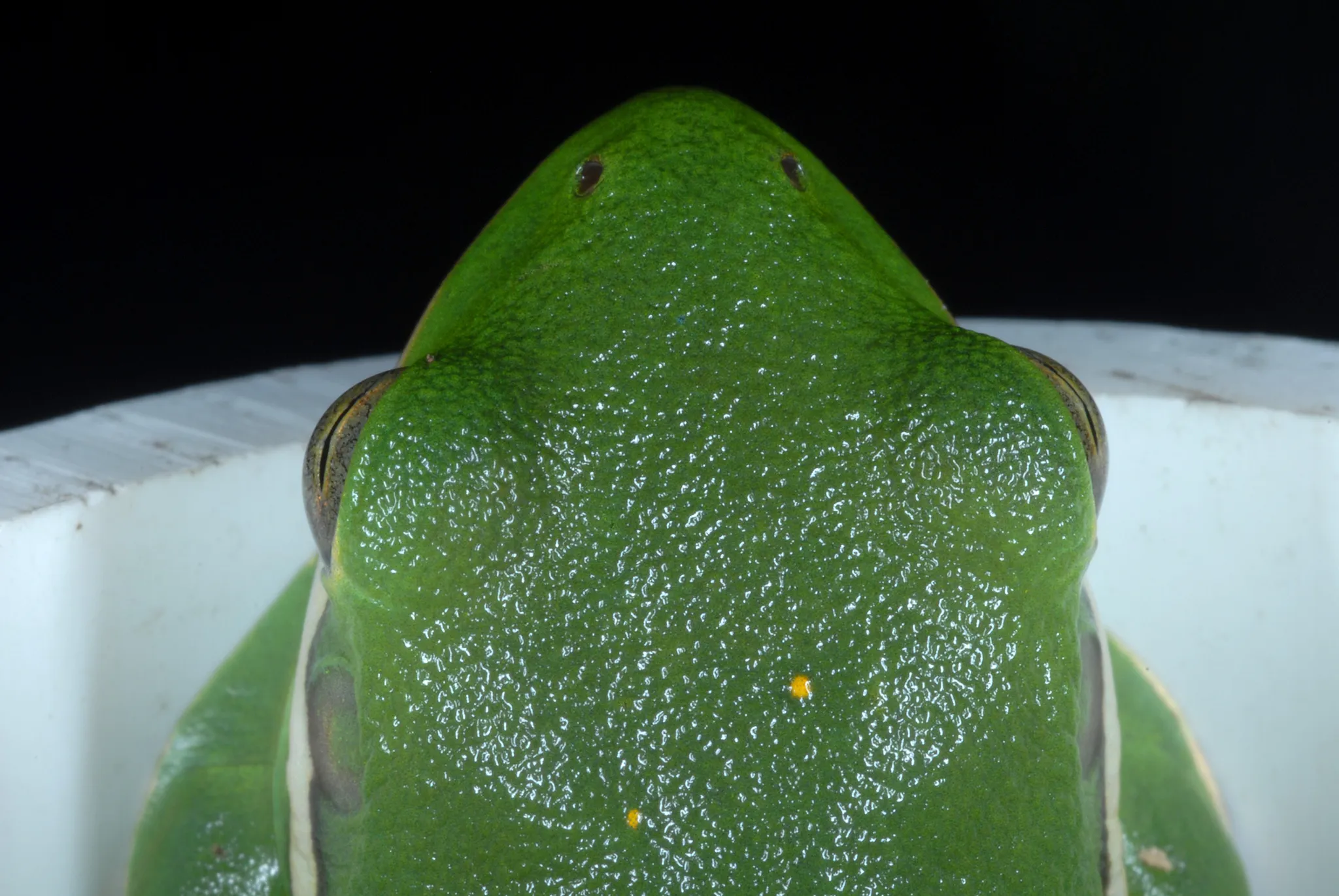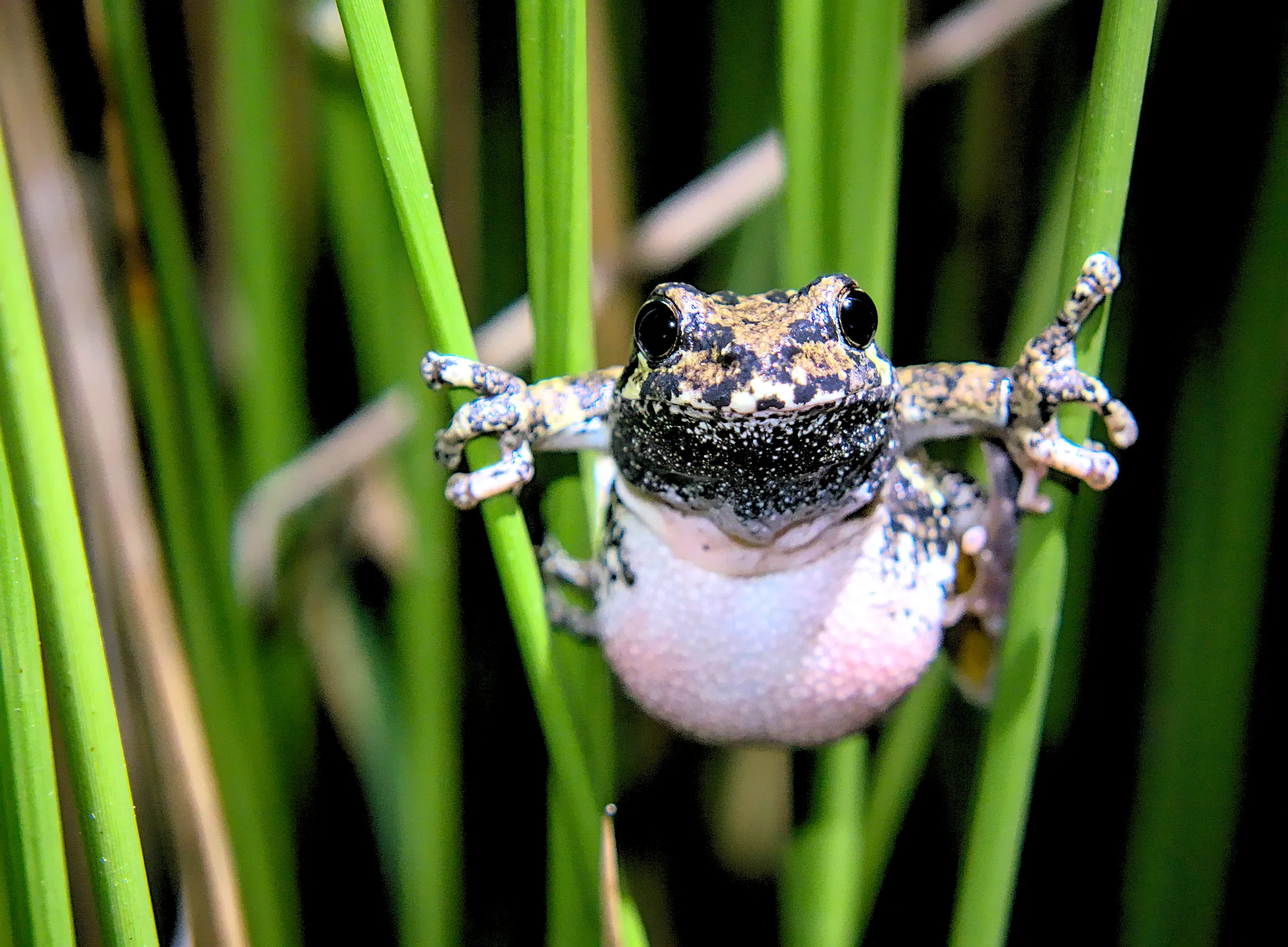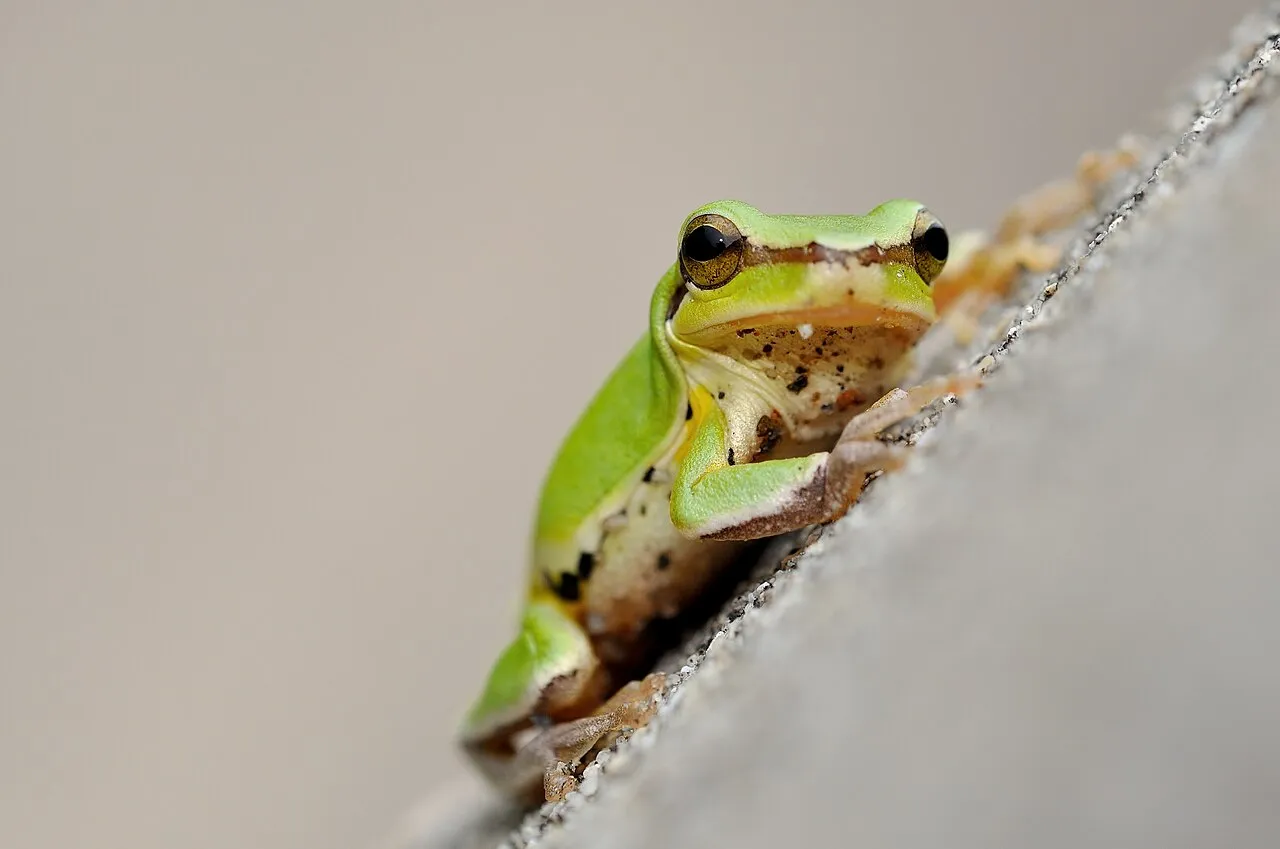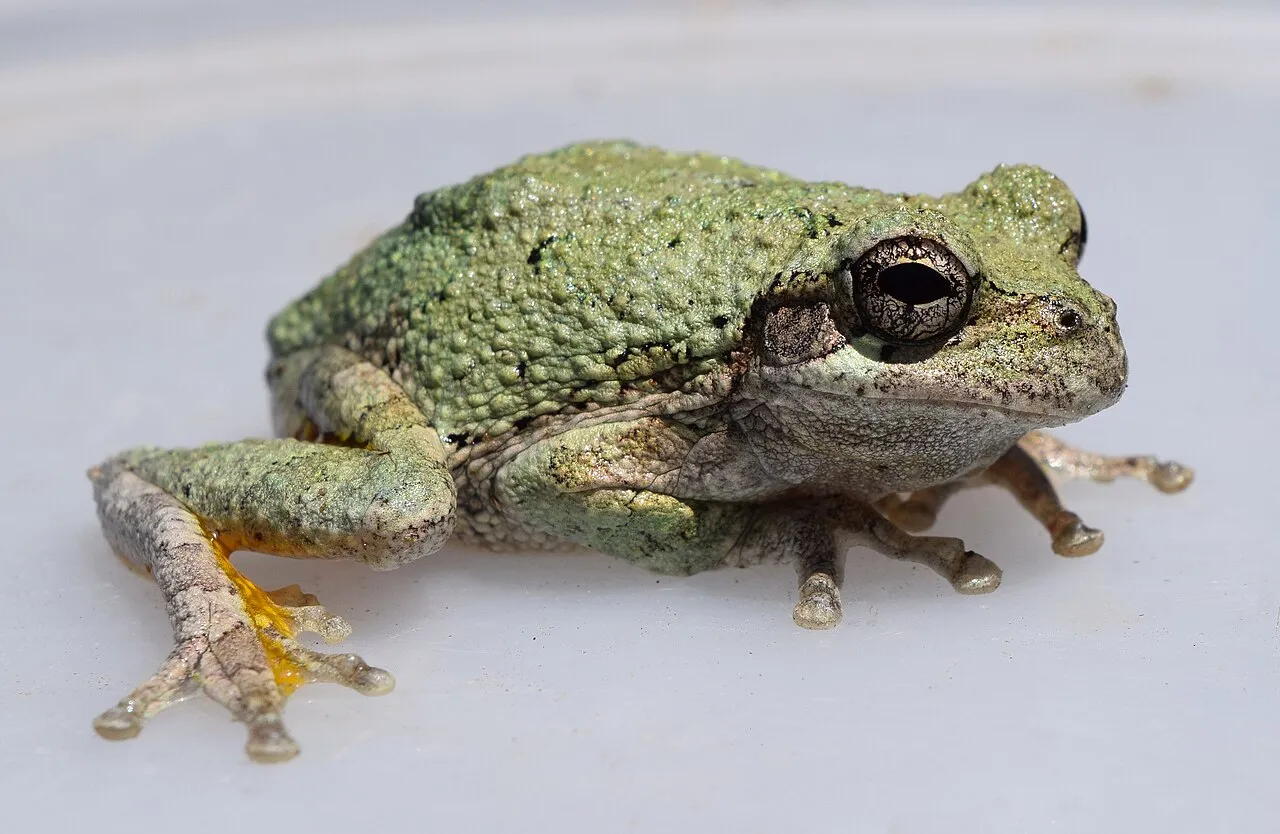
Dryophytes chrysoscelis, Cope’s gray treefrog, is a treefrog of the United States and Canada. Its toe pads are characteristic of the family Hylidae2. Edward Drinker Cope described the species in 1880, and the common name honors the famous naturalist3. The specific name comes from the Greek chrysos, gold, and scelis, leg. It is almost indistinguishable from the gray treefrog1, Dryophytes versicolor, and shares much of its geographic range.
Identification
Adults typically measure 3.2 to 5.1 cm, and the largest gray treefrog on record reached 6 cm2. The Virginia DWR gives a size of up to 2.4 inches3.
The back is rough and lightly sprinkled with warts, although smoother than most toads. Colour depends on substrate, season, and humidity: shades of gray with black blotches on the back are most common, and brown, green and pearl-gray frogs have been noted. Green shows most during the breeding season and in yearling frogs. Usually there is a white mark beneath the eye2.
Both gray treefrogs have black-marked bright orange to yellow patches on their hind legs. The pattern is normally hidden, but exposed when the frog leaps. Males have black or gray throats in the breeding season, while the throats of the females are lighter. The large toe pads produce mucous to adhere to surfaces2, smooth bark and man-made structures included. Its skin secretions contain toxins that may irritate the eyes, lips, mucous membranes and open cuts, and they may be irritating or toxic1 to the mouth. SREL recommends hand washing after handling4.
The tadpoles measure 3.2 cm to 3.8 cm and are light green to yellow, with heavy black dots scattered along the tail fin margin on a red or orange background. Both gray treefrogs share these larval traits, and the description is technically derived from H. versicolor. Young frogs are approximately 1.5 cm2 in snout to vent length.
Habitat and range
Together the two gray treefrogs inhabit a roughly rectangular range from southern Ontario and Maine west to central Texas, northwest to Manitoba, and south to northern Florida. Because they are physically indistinguishable, only their shared range had been fully determined by 2006, and Cope’s was generally more common in the western and southern quadrants2 of it. The species is most abundant in the southeast1, but it can be found as far north as Manitoba. SREL describes it as widespread across the Southeast, excluding peninsular Florida, and abundant in South Carolina and Georgia4, especially within the Piedmont and Mountain regions.
In Virginia and the Carolinas it is apparently the species of the lower elevation Piedmont and Coastal Plain1, where D. versicolor may be present only in the Appalachians. The Virginia DWR (2024) places it in forested habitats throughout the Coastal Plain and in portions of the southern Piedmont along the Fall Zone. It also occurs in far southwestern Virginia, south and west of the New River Valley, where it replaces the Gray Treefrog in the upper Tennessee River drainage3.
Cope’s gray treefrogs inhabit all elevations of wooded areas near temporary and permanent waters: swamps, ponds, lakes, old fields, thickly wooded suburbs, farm woodlots, and mixed or deciduous forests. In the Southeast it is most common in mature deciduous forests4. In summer they rest in damp rotten logs or hollow trees2, and in winter they hibernate on land under woody debris, logs, roots and leaf litter.
The species also exhibits freeze tolerance. It can survive temperatures as low as −8 °C, and in overwintering frogs 40-50% of total body water was frozen. It is one of a few freeze tolerant frogs that use glycerol1 as a cryoprotectant.
Behaviour and breeding
Gray treefrogs avoid predators by calling after dusk and being most active in the evening and night. They rarely leave the trees until the breeding season2.
In the Great Lakes region, choruses begin in late April to early May2, after the evening air temperature rises above 15°C. In the southeastern United States, Cope’s gray treefrog breeds and calls from May to August1. The Virginia DWR (2024) gives April-August3, in almost any slow moving or still body of water, buckets and pool covers included.
Males call from vegetation next to the shallow breeding sites, preferably in tree branches that overhang the water, and aggressively defend their territories with their voices. Individual calls reach sound pressure levels of 85 to 90 dB1. Satellite males do not call to save energy2; they lie in wait near a calling male and try to intercept females.
Each female visits the breeding site once per season to lay her eggs. A single egg mass may contain 1,000 to 2,000 eggs, and it soon breaks into loose clusters of 10 to 40 eggs2 that attach to plants or other structures in the pond. Females preferentially lay their eggs in water bodies that lack fish1 or other predatory vertebrates.
Depending on water temperature, the eggs hatch in three to seven days, and the tadpoles transform into froglets after six to eight weeks. Another account gives hatching in about five days1 and metamorphosis at about 45–65 days. Sexual maturity is reached by the age of 2 years2.
Tadpoles consume algae or underwater plants. After metamorphosis the frogs prey on most types of insects and their larvae, and moths, mites, spiders, plant lice, harvestmen and snails are also eaten. Like most frogs it is opportunistic and may also eat smaller frogs2, including other tree frogs.
Birds, snakes, other frogs and small mammals eat gray treefrogs. Bullfrogs and green frogs have been observed stalking calling males, and in the water giant waterbugs also attack Cope’s gray treefrog. One captive gray treefrog lived for over seven years2, but it was not identified as either species.
Conservation
The IUCN Red List (2022.2) rates the species least concern5. In 2006 it was not classified as endangered or of special concern, though habitat destruction and human pollutants were contributing to the overall decline of amphibians. It had no special status2 on the US federal list or under CITES. Studies suggest it could be more resilient to climate change1 in the long term, though populations may suffer short-term drawbacks. SREL rates it widespread and abundant4 and not legally protected in the Southeast.
Similar species
- Gray treefrog (Dryophytes versicolor): the male’s call is the main field difference, a trill that in Cope’s is faster and higher pitched, or faster, more “buzz-like”4 in SREL’s words. Warmer air raises the rate of the trill, and tape recordings may be necessary for positive identification. Cope’s is also reported to be slightly smaller, at 3.2–5.1 cm against 3.2–6.2 cm1, as well as more arboreal and more tolerant of dry conditions. The only other reliable test is microscopic examination of their chromosomes: Cope’s is a diploid, the gray treefrog a tetraploid2.
- Bird-voiced treefrog (Dryophytes avivoca): it lacks the gray treefrogs’ black-marked orange to yellow patches on the hind legs and is smaller, at 2.5–5 cm1.
- Spring peeper (Pseudacris crucifer): its call is similar, but several ‘peeps’ can be heard2 before and after the trill.
- American toad (Anaxyrus americanus): its call is similar to the gray treefrogs’, whose calls are short, only 0.5 to 3 seconds2.
- Pine woods and squirrel treefrogs (Dryophytes femoralis, Dryophytes squirellus): Cope’s may resemble them but is heavier-bodied4.