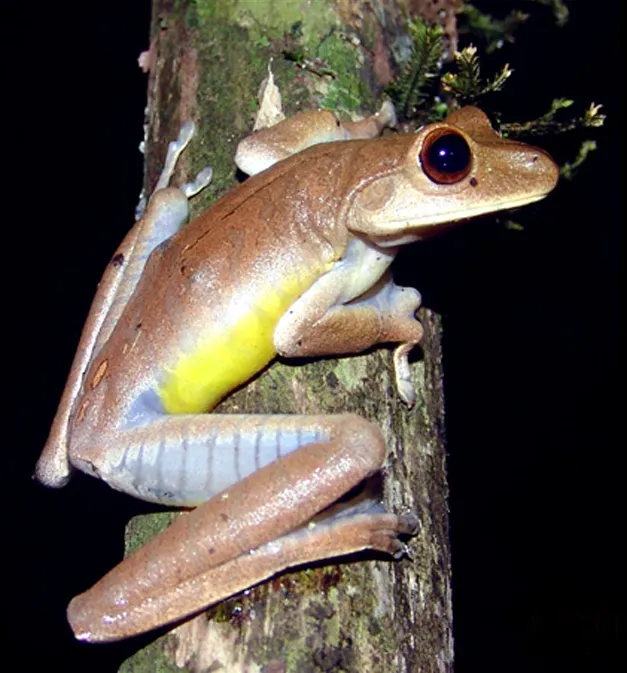
The blacksmith tree frog, Boana faber, also known as the smith frog, is a hylid treefrog found in eastern to southern Brazil, north-eastern Argentina and south-eastern Paraguay. It belongs to the family Hylidae, in the genus Boana — a large group of Neotropical treefrogs that, at the time this species was first described, was still placed under the older names Hyla and later Hypsiboas, both of which still turn up as synonyms in older records and photo captions (Wikidata).
Identification
No open-access source consulted for this profile gives a measured body length, weight or detailed colour description for B. faber, so this page does not state figures that cannot be checked. What is documented is the frog’s taxonomic placement and its alternative common names, smith frog in English and sapo-martelo (“hammer frog”) in Portuguese (Wikidata). The photograph on this page, taken against a plain background, shows an individual with mottled brown and tan skin. Readers wanting to confirm identification in the field should cross-check against a verified photograph, such as the one on this page, alongside a regional field guide, since colour pattern alone can vary between individuals in many treefrog species and is not a substitute for a confirmed record.
Habitat and range
B. faber lives in tropical humid forests, including forest edges, at elevations of 150–800 m above sea level, across its range in eastern and southern Brazil and into the neighbouring corners of Argentina and Paraguay. That elevation band keeps it out of both the immediate coast and the high interior plateaus, concentrating it in the mid-altitude belt of forest formations where humidity stays high year-round. Its use of forest edges as well as closed-canopy interior sets it apart from hylids that need unbroken primary forest, and helps explain why it continues to turn up across such a broad stretch of three countries rather than being confined to a single isolated block of habitat.
Behaviour and breeding
The species breeds in temporary and permanent pools — including artificial ones — and in slow-moving streams, where the frogs build nests. This nest-building habit sets it apart from most other treefrogs in its range, which simply lay eggs in open water or attach them to leaves and vegetation; the source consulted for this page does not detail how the nests are built, so this page does not describe their material or shape beyond noting that they exist.
Conservation
The species’ facts box carries its current IUCN Red List category, Least Concern (Wikidata). Wikipedia describes it as an abundant species throughout its range, present in several protected areas, which supports that listing. The main pressure on the species is habitat loss: clear-cutting of forest remains a threat, although the frog tolerates selectively logged and second-growth forest, meaning it can persist in landscapes that have been partly altered as long as some tree cover and breeding pools remain. That tolerance, combined with its use of artificial pools for breeding, likely gives B. faber more resilience to small-scale habitat disturbance than frogs that depend on a single, undisturbed water source. The presence of protected-area populations across its range also spreads the risk, so that logging or development pressure in any one part of its distribution is less likely to threaten the species as a whole.
Similar species
Boana is a large genus of Neotropical treefrogs, and several of its members overlap with B. faber across eastern and southern Brazil; without sourced measurements or colour descriptions for this species, a reliable field comparison to its genus-mates cannot be made here. The surest way to distinguish B. faber in the field remains its nest-building behaviour at the water’s edge, a habit not shared by every treefrog sharing its range.