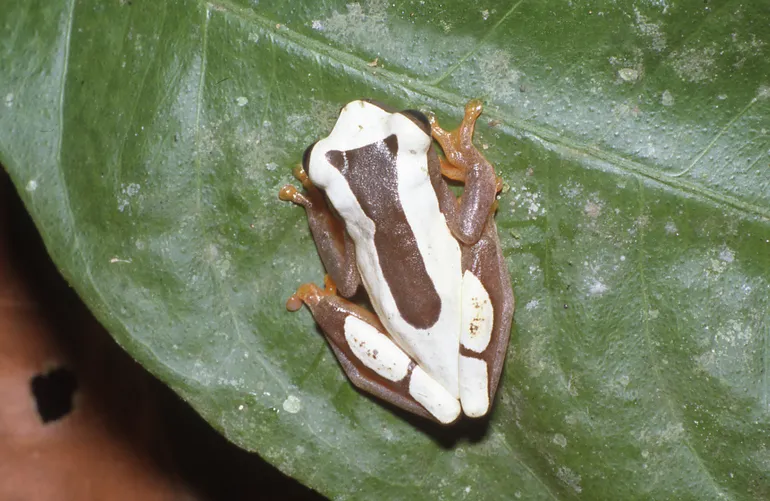
Bereis’ Treefrog, Dendropsophus leucophyllatus, is a hylid found across the Amazon Basin of South America — Bolivia, Brazil, Colombia, Ecuador, French Guiana, Guyana, Peru and Suriname, and possibly Venezuela. It belongs to the family Hylidae and the species-rich genus Dendropsophus. A 2017 revision of the species complex places the nominate form, D. leucophyllatus in the strict sense, in northern Brazilian Amazonia, Suriname, Guyana and French Guiana, from sea level to about 400 m elevation. Earlier records across the wider Amazon Basin reflect the broader, pre-revision concept of the species; the facts box here follows the full historical range as still reported on Wikipedia, with the narrower nominate-form range noted separately.
Identification
The species shows a marked size difference between the sexes: among nominate-form specimens from Brazil, Suriname, Guyana and French Guiana, mean adult snout-vent length is about 29.7 mm in males (range 26.8–32.3 mm) and about 37.9 mm in females (range 36–39.8 mm), with females clearly the larger sex. The common name of the broader D. leucophyllatus group points to mottled, leaf-like patterning rather than a single bold marking, consistent with the frog’s camouflage against overhanging foliage. The facts box carries the full measured range; a photograph of a single individual will not capture the sexual size difference described here.
Habitat and range
D. leucophyllatus is a widespread and locally common species found near water in a wide variety of tropical habitats, including permanent or semi-permanent ponds along roads or in pristine forest, large coastal swamps, and the edges of forest savannas. Within that habitat, frogs perch anywhere from a few centimetres above the water to several metres high in vegetation, from low waterside growth to the forest canopy’s edge.
Behaviour and breeding
Breeding follows a leaf-top strategy typical of several Neotropical hylids: clutches of about 570–769 pigmented eggs are deposited on the tips of leaves overhanging water, where the developing embryos are safer from aquatic predators than eggs laid directly in a pond. Tadpoles are then found developing either in temporary ponds or, in floodplain habitat, in the root zone of floating meadows in várzea floodplain lakes. By the point entomologists use as developmental stage 39, tadpoles reach a total length of about 26.2 mm, a stage shortly before the hind and forelimbs are fully formed and metamorphosis follows.
Conservation
The facts box carries the species’ current IUCN Red List category, Least Concern, reflecting a widespread and locally common species with no known significant threats.
Similar species
Dendropsophus is a large genus of small Neotropical treefrogs, and no other profile on this site currently covers a close relative of D. leucophyllatus. The leaf-top egg-laying habit and the marked size difference between males and females, described above, are useful first clues when distinguishing this species from other Amazonian hylids, though identification within the former D. leucophyllatus species complex is difficult by eye alone: the 2017 taxonomic revision split the group using genetic and bioacoustic evidence rather than visible characters, so a frog matching the description above from outside the nominate form’s confirmed range may belong to a related, genetically distinct population.