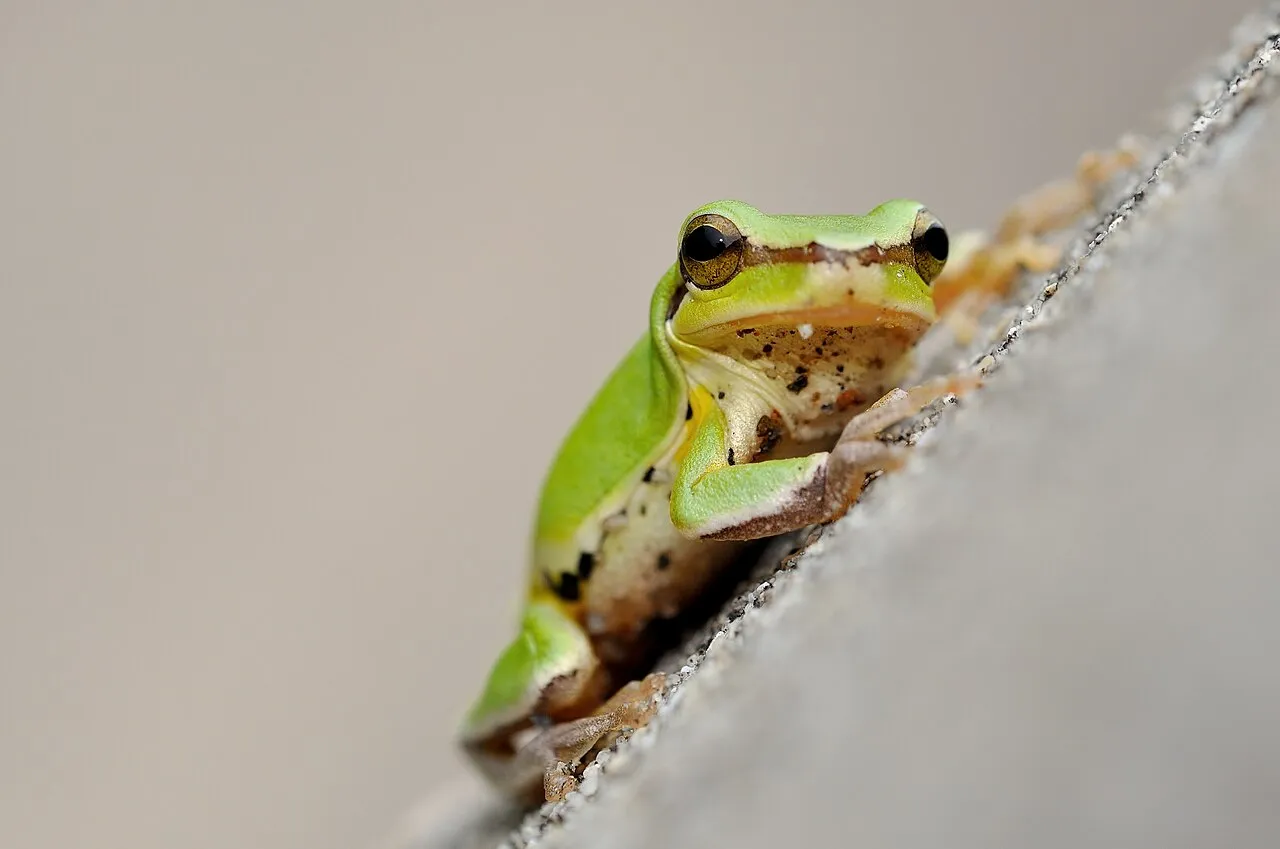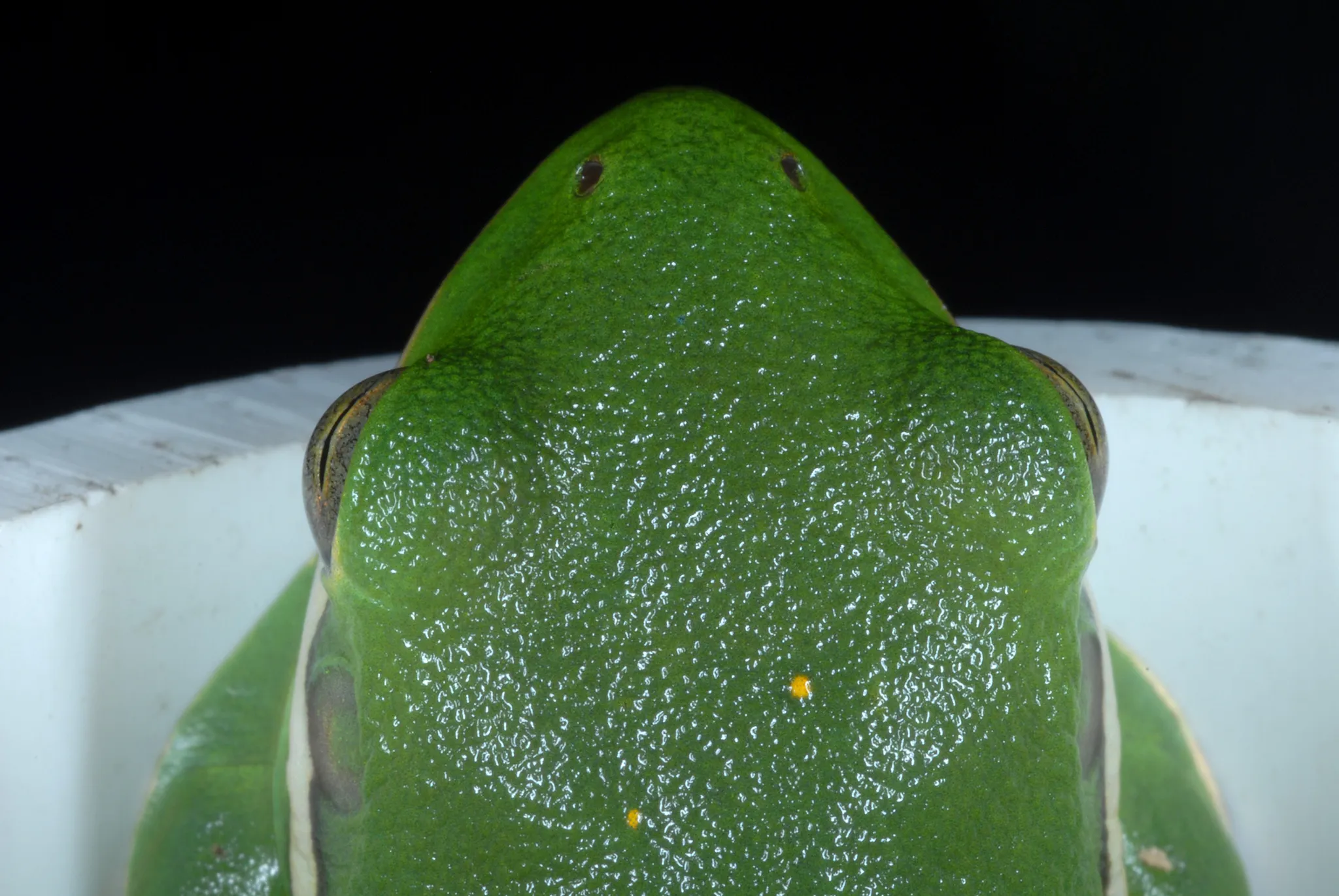
Dryophytes cinereus, the American green tree frog, is a common arboreal tree frog of the family Hylidae. Animal Diversity Web and the Virginia Department of Wildlife Resources3 list it under the name Hyla cinerea. It is commonly found in the central to southeastern United States, from Virginia’s eastern shore to the southeast tip of Florida and as far west as central Texas2. It became the state amphibian of Louisiana in 1997 and of Georgia in 20051.
Identification
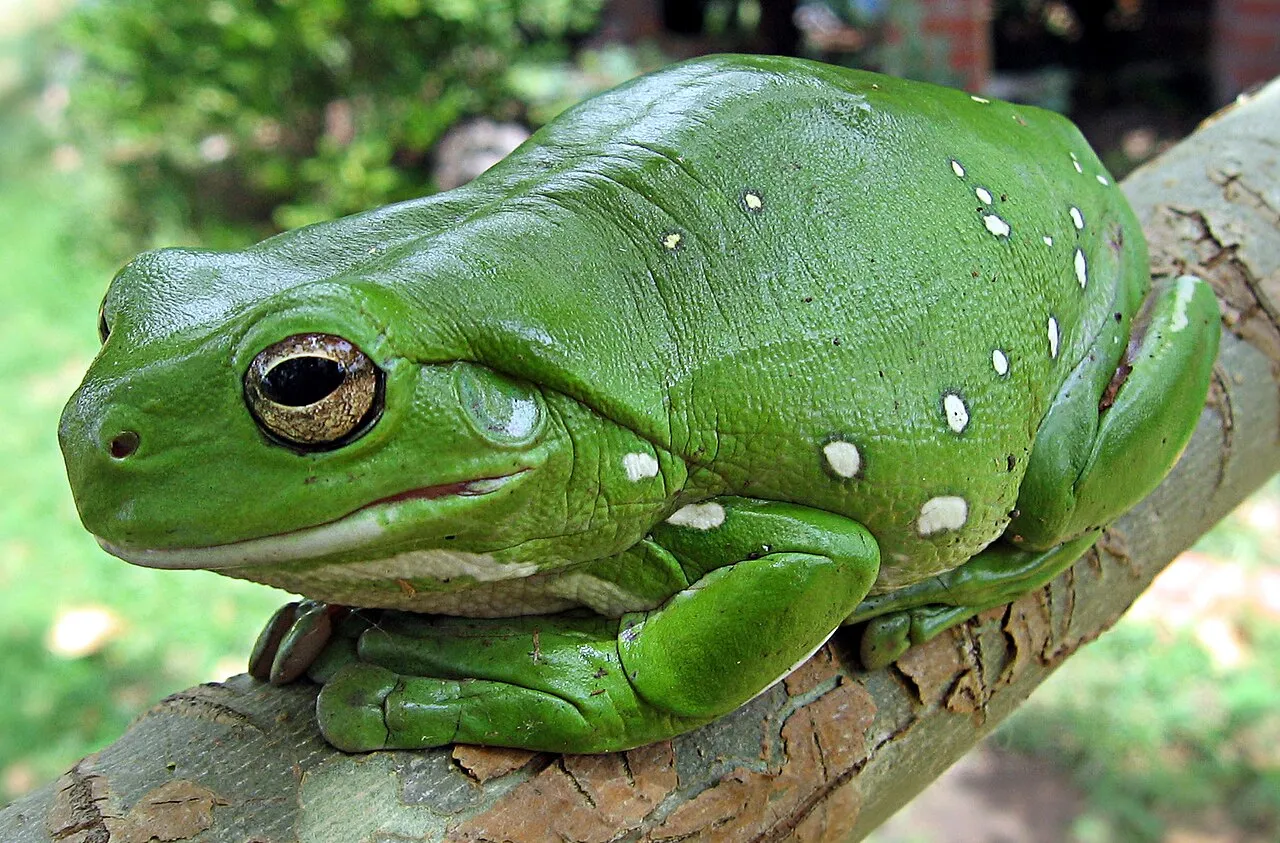
This is a long-legged, smooth-skinned treefrog with a streamlined and slender build and large, protruding eyes with horizontal pupils. Adults measure 32 to 64 mm, and females tend to be larger than males2. The frog weighs 3.76 g on average, within a range of 2.15 to 5.11 g1.
Most individuals have a bright yellow-green back, but reddish-brown to green individuals are also common, and the Virginia DWR notes the frog can be various shades of gray or brown. The back often carries small golden spots over the green. The underside is white to cream2. Usually a white to yellowish stripe runs along each side from beneath the eye back to the groin, though this stripe may be reduced or absent in some populations. The toe pads are prominent3. Some evidence suggests the frog can change colour in response to its background or temperature1.
Recently metamorphosed young were found to measure about 20.6 mm, and individuals reach sexual maturity within a year. Tadpoles are green with a yellow or white stripe1 from each nostril to the eye, and they may have mottled tail fins.
The male’s advertisement call is a repeated nasal quank, quank, quank in quick succession3. Large choruses can be heard up to 1-2 kilometers away1.
Habitat and range
The range reaches as far north as Maryland and Delaware2; populations are also recorded as far north as southern New Jersey, and the distribution may be larger or vary seasonally1. In Virginia the species primarily occurs in the Coastal Plain, with scattered records in the Piedmont and introduced populations in Pulaski and Craig counties in the west of the state. In 2024 the Virginia DWR wrote that green treefrogs appear to be expanding their range in some areas3.
The frog lives in small ponds, large lakes, marshes, and streams, and prefers habitats with plentiful floating vegetation, grasses, and cattails. The Virginia DWR places it in floating and emergent vegetation along the swampy edges of freshwater habitats, and notes it may occasionally occupy sites with brackish water3. In one study in an artificial hardwood forest setting, 88% of 331 individuals2 were found where the forest canopy was open. The species also lives in settled areas and is often sighted in backyards with ponds, in garages or garden structures. It is often found perched on twigs, low branches, and grasses1.
Behaviour and breeding
The American green tree frog is a nocturnal insectivore1. For most of the year it is solitary, and it is most active when the weather is moist. Besides the mating call it uses alarm and rain calls; the rain call is given when frogs sense that there will soon be rain2.
Its prey includes flies, mosquitoes, grasshoppers, cockroaches, spiders, beetles1 and other small insects. In a study by Freed (1980), nearly 90% of the prey were actively pursued. Adults may be eaten by snakes, birds, large fish, and even other frogs. When they tuck in their legs and close their eyes2, the adults blend in with the colour of leaves.
In a Florida population, males were heard calling between March and September, and pairs in amplexus were seen between April and August. The Virginia DWR gives a breeding season of April-August3. The frogs generally breed following rainfall, and there is some evidence that the breeding season decreases as latitude increases. The mating system is polygynous. The species is one of the only species in the genus Hyla2 in the southeastern United States that typically breeds in areas with large predatory fish.
Eggs are attached to substrates such as emergent vegetation, typically in permanent bodies of water rather than vernal pools1. In 2008 Animal Diversity Web reported an average clutch size in one Florida population of approximately 400 eggs, while the Virginia DWR states that a female may lay multiple clutches, each with up to 1,000 eggs3. The eggs hatch in 4 to 14 days, on average about 5 days after fertilization. The front and rear legs begin to develop eight to ten weeks after hatching. Lifespans in the wild are unknown, but captives can live 6 years2 with proper care.
Conservation
The species is listed as Least Concern4, as stated in the IUCN Red List 2022.2. A growing number of green treefrogs have lost habitat primarily due to urbanization and destructive wildfires, and in central Texas scientists have tried artificial shelters using PVC pipes to counter habitat loss after wildfires. Rising salinity and pesticide levels in breeding wetlands have had a negative effect on sperm mobility. Unlike most amphibians, the frog is not easily susceptible to the Bd pathogen1 and the disease chytridiomycosis. In 2024 the Virginia DWR judged the species to appear secure in Virginia3.
Similar species
The squirrel treefrog, Hyla squirella, is smaller, up to 1.6 inches against the green treefrog’s own up to 2 inches3; it often shows a dark spot or bar between the eyes and lacks the gold flecks often seen in Green Treefrogs5.
The barking treefrog, Hyla gratiosa, is the largest of Virginia’s treefrogs at up to 2.75 inches, with granular skin and a back typically evenly covered with dark, elliptical or round spots6 encircled with black.
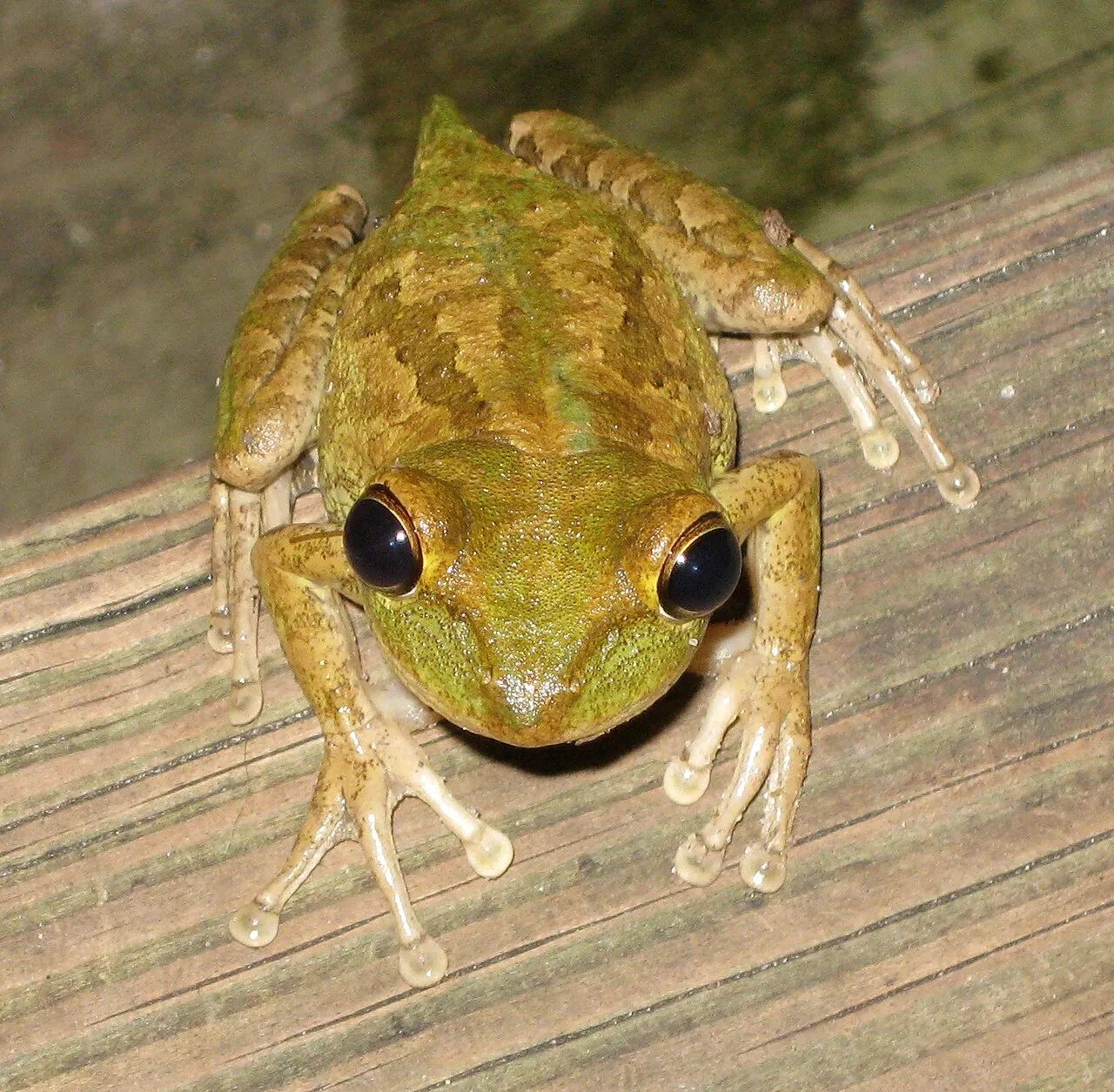
The Cuban tree frog, Osteopilus septentrionalis, reaches 2.5 to 12 cm long, making it one of the largest of the treefrog species found in Florida and a known predator of native treefrogs in Florida7. In southern Florida its call is similar in timing and pitch to the green treefrog’s, and American green tree frogs there made their calls shorter, louder, and more frequent1 to compete.