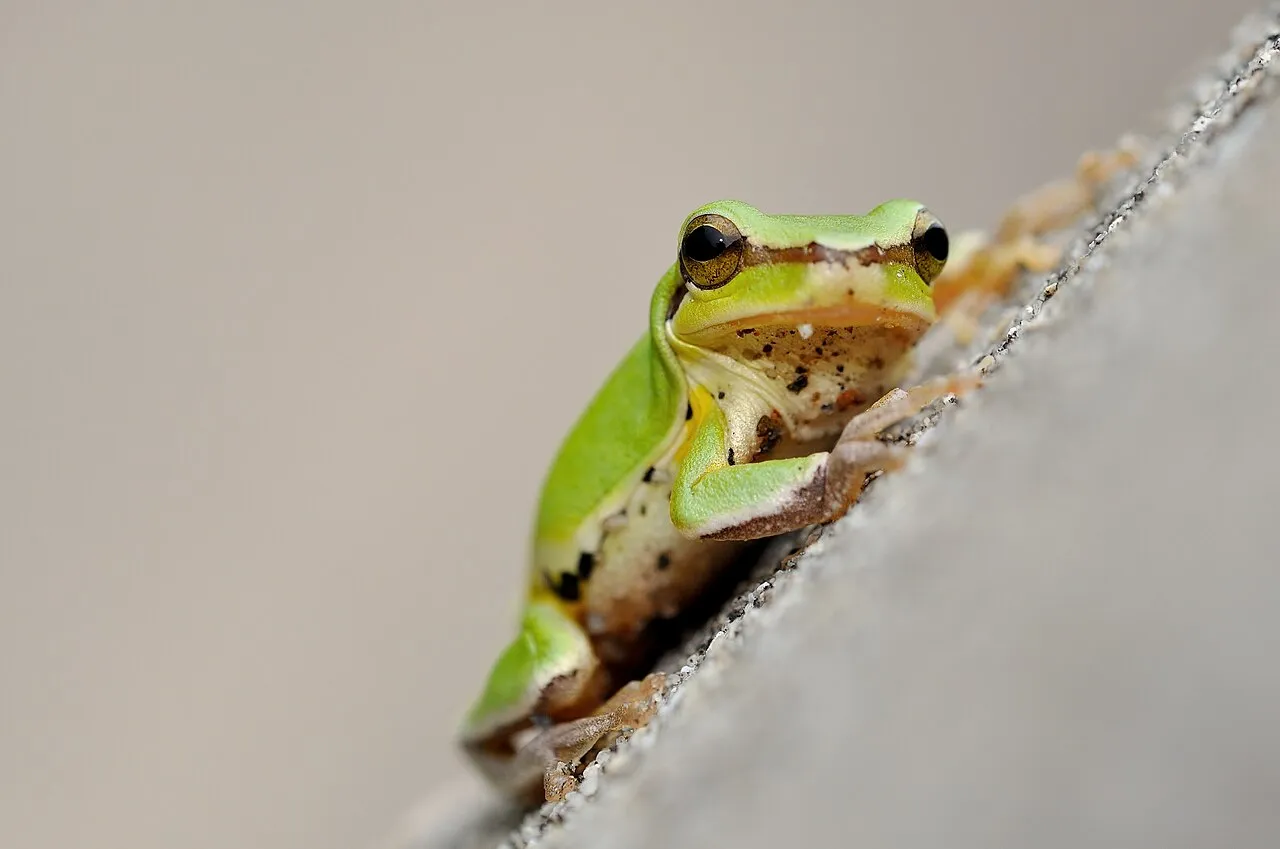
Hyla chinensis, the common Chinese tree frog (also recorded as the common Chinese treetoad or Chinese tree toad), is a small tree frog in the family Hylidae, first described by Albert Günther in 1859. Wikidata’s record for the species gives its type locality simply as “People’s Republic of China”, with no more precise collecting site attached to the original description. More than a century and a half after Günther named it, the species lives in southeastern and eastern China and Taiwan, with one unconfirmed record from Vietnam that may in fact belong to a different, related species. It is a genuinely common frog across that range, reflected in 19 Wikidata sitelinks across Wikipedia and its sister projects, yet, as the sections below show, the species’ biology beyond its size, habitat and conservation status is only thinly documented in the sources open to this profile.
Identification
Adults are small, with a snout–vent length of about 25–33 mm — modest even by the standards of the genus Hyla, whose members are generally compact, long-legged climbing frogs. Beyond that measurement, the species’ colouring, skin texture and markings are not described in the sources open to this profile: the English Wikipedia entry for H. chinensis is itself only a short stub, and no open-access paper, museum page or other allow-listed source covering its appearance in detail turned up in this check. AmphibiaWeb and the IUCN Red List, which would normally be the first places to look for a full diagnosis, both answered with a bot challenge rather than a page this profile could open, so neither could be cited. That leaves H. chinensis one of the less-documented tree frogs in its genus online, despite being a common species across a wide range, and this profile reports only what the open sources actually state rather than filling the gap with a plausible-sounding description.
Habitat and range
Within its China–Taiwan range, H. chinensis is not a forest specialist. It uses trees and shrubs in forests, as well as agricultural landscapes such as cultivated rice fields, ponds and corn bushes, putting it among the tree frogs that have adapted to farmed land rather than retreating from it. Wikidata’s entry for the species records it as nocturnal, active after dark across both wooded and farmed ground rather than confined to deep forest by day. Taken together, the habitat and activity data point to a generalist that tracks moisture and cover — paddies, ponds and field margins as much as woodland — across the lowland and hill country of its two range states, rather than a species tied to a single, narrow habitat type.
Behaviour and breeding
Its nocturnal habit aside, no source available for this profile describes the species’ advertisement call, breeding season, amplexus, egg-laying sites or tadpole development in any detail — a gap left by the stub-length coverage the species has on the English Wikipedia and by the lack of an open-access paper or museum account this profile could open. Many Hyla tree frogs breed explosively around still or slow water after rain, but that pattern is not stated for H. chinensis specifically in any source checked here, so it is left out rather than assumed. Nothing in this section has been invented to fill the gap; it will grow once a fuller, openly accessible source on the species’ reproduction turns up.
Conservation
The facts box above carries the species’ current IUCN category, drawn from its Wikidata record. Even a common, wide-ranging frog like this one can suffer from habitat loss, and the same Wikipedia source that documents its use of rice fields, ponds and corn bushes also flags ongoing conversion of farmland and lower-elevation forest as a threat. Because the species spans two separate range states, China and Taiwan, its conservation outlook also depends on land-use trends in both, rather than on a single national policy — though no source open to this profile breaks the assessment down by range state, so this profile does not speculate about which part of the range is under more pressure.
Similar species
No Hyla species is confirmed to share H. chinensis’s China–Taiwan range outright, but the one unconfirmed Vietnamese record attributed to it may actually represent Hyla annectans, Jerdon’s tree frog, instead. The source behind that note does not give H. annectans’s own range, only that the single Vietnamese specimen is ambiguous between the two species, so this profile does not describe where H. annectans is otherwise found. What the ambiguity does show is that H. chinensis is best identified from confirmed material within its documented China–Taiwan range; a record from well outside that range, such as the Vietnamese one, is exactly the kind of case where a look-alike congener has to be ruled out before the identification can stand.