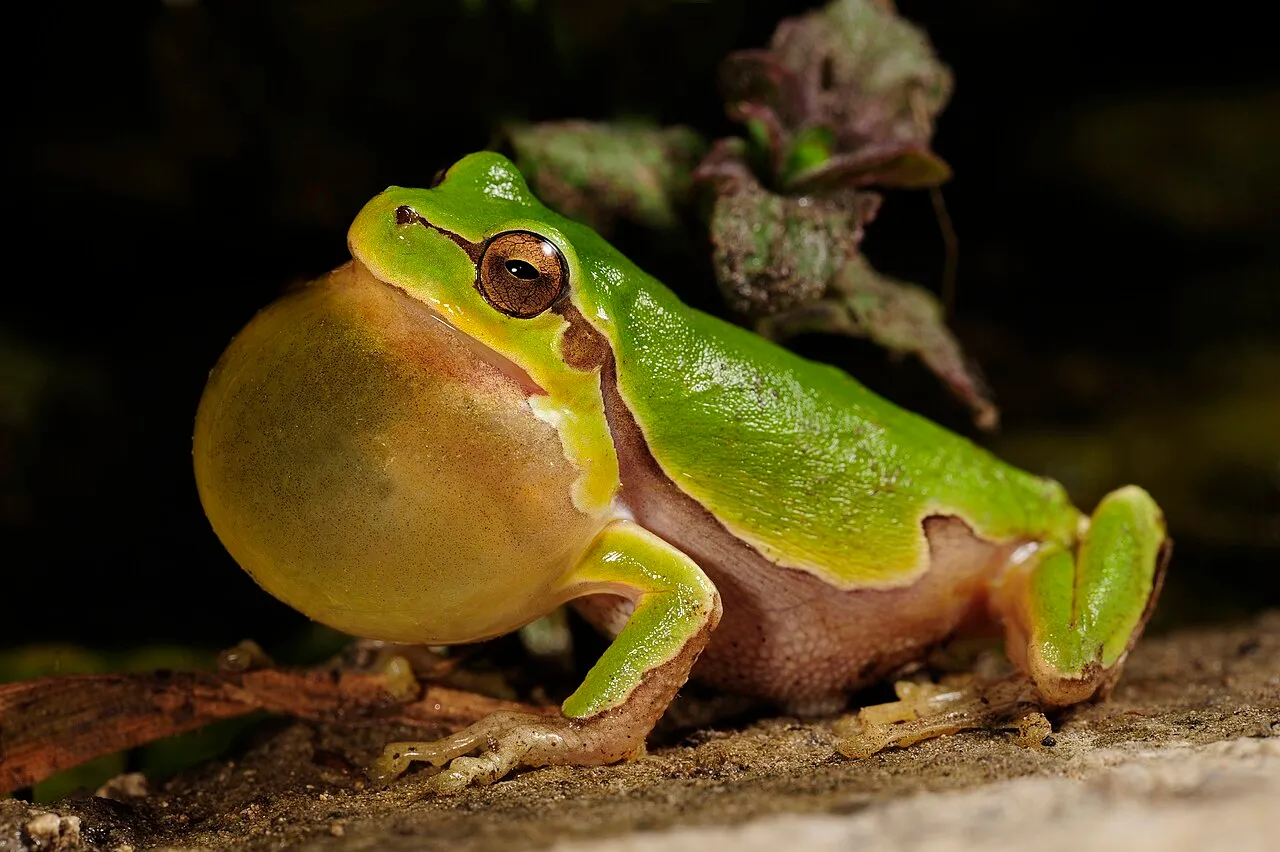
Hyla intermedia, the Italian tree frog, is a small climbing frog native to continental Italy and Sicily, with additional populations in southern Switzerland and western Slovenia near the Italian border, and possibly San Marino. It was long treated as a subspecies of the European tree frog, Hyla arborea, before being recognised as a species in its own right.
Identification
Adults grow to about 40–50 mm, with females typically larger than males. The back is smooth and bright green, and the belly is whitish, the two separated by a pale beige line running along the flank. A black stripe runs from the eye to the armpit — shorter than the flank stripe of its closest relatives, which is the easiest field mark for telling the two apart.
The hind legs are longer than the forelegs, and the digits of both hands and feet end in adhesive discs that let the frog grip smooth leaves and bark. Throat colour marks the sexes: males have golden-brown throats with an inflatable vocal sac, while females have white throats.
Habitat and range
Within its Italian and Sicilian range the species occupies temperate forests, rivers and intermittent rivers, freshwater marshes, arable land and urban areas, from lowland woods and mountain valleys to wet reed beds, reaching elevations of up to 1,855 m. Its climbing ability and adhesive toe discs let it move through the countryside via hedgerows, ditches and canals as well as through bushes and trees, so it turns up as readily in a garden hedge or a canal bank as in a mountain reed bed.
Behaviour and breeding
The Italian tree frog feeds on small invertebrates such as flies, mosquitoes and midges. At breeding time, dominant males establish territories near a pond, paddy field or other body of water and call to attract females; each call is a repeated series of six to ten pulses that start quietly and increase in intensity, and both frequency and pulse rate vary between individual males, giving females something to judge. Smaller “satellite” males use an alternative tactic, lurking near a calling male and trying to intercept females drawn in by his call rather than holding a territory themselves. Females are not passive about the choice: they appear to take notice of various attributes of the calls when choosing a male, which is why the pulse rate and frequency of an individual male’s call can matter as much as simply calling loudly or often.
Conservation
The facts box gives the species’ IUCN category. It remains common in Italy, with a stable population and no severe pressures identified so far, though it is likely threatened by habitat loss and possibly by water pollution where wetlands and streams are drained or fouled.
Similar species
The Italian tree frog was long classified as a subspecies of the European tree frog, Hyla arborea, and the two remain very similar in colouring and size. The clearest distinction is the dark flank stripe: in H. arborea it runs from the eye all the way to the groin, while in H. intermedia it stops at the armpit. The two also occupy different ground: H. arborea is absent from Italy south of the Alps, while H. intermedia is confined to peninsular Italy, Sicily and a narrow band of neighbouring Switzerland and Slovenia, so range alone settles most identifications in the field.