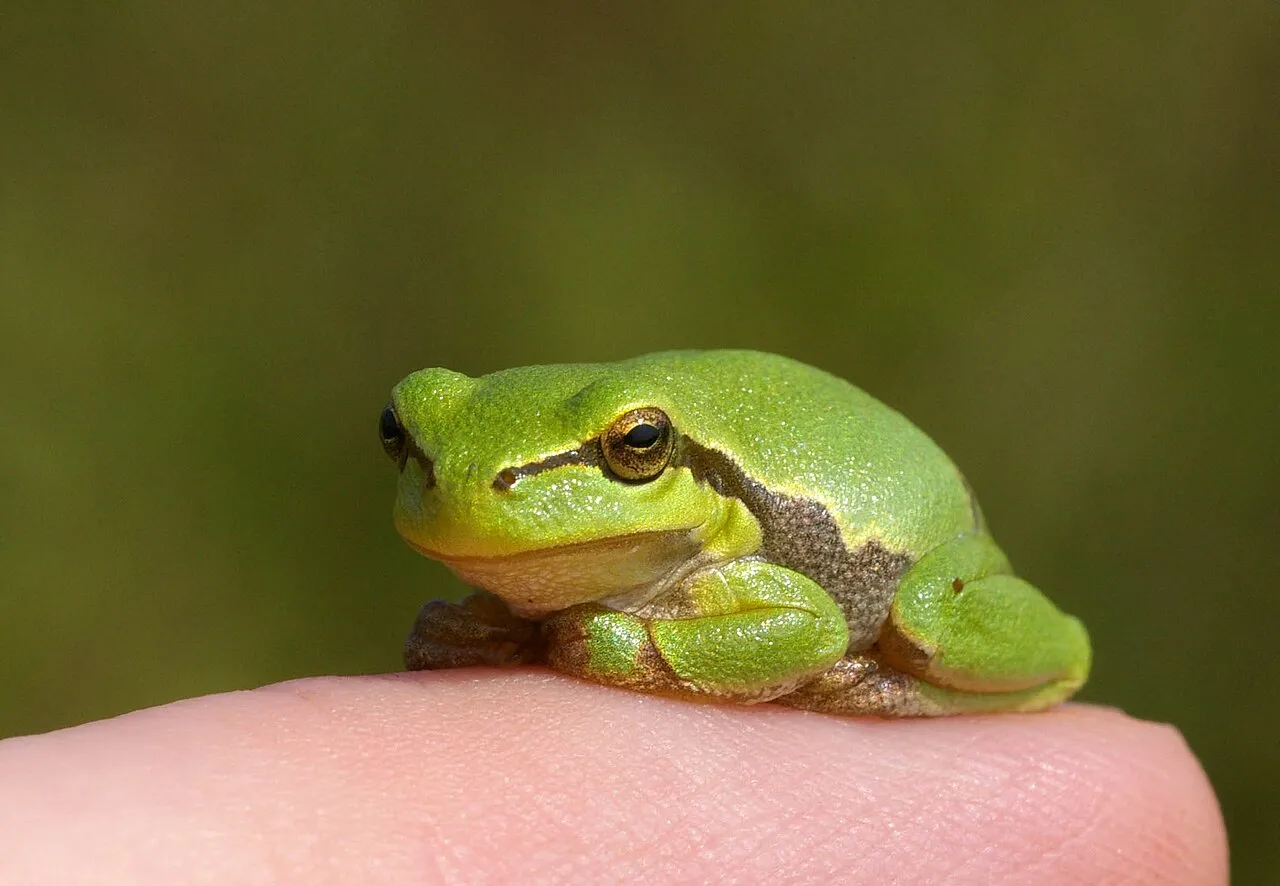
Hyla arborea, the European tree frog, is a small, slender climbing frog of continental Europe. Members of its species complex are the only tree frogs (family Hylidae) native to mainland Europe, and in its narrow modern sense the species itself lives from France east to Poland and south to Greece. It is absent from the British Isles and the Iberian Peninsula.
Identification
Adults are small: males measure 32–43 mm and females 40–50 mm, so females run larger, and both have a slim body on long legs. The back is smooth and green, grey or tan, shifting with temperature, humidity and the frog’s mood; the belly is whitish and granular, and a dark brown stripe runs along each flank from the eye to the groin, dividing the two.
The throat separates the sexes: females have white throats, males golden-brown ones with a large folded vocal sac. Other marks are a rounded head, a horizontally oval pupil and a clearly visible eardrum, and the adhesive discs on the toes that it uses to climb trees and hedges, a characteristic feature of the species.
Habitat and range
Within that France–Poland–Greece range it uses a wide spread of damp and semi-open places: marshlands, damp meadows, reed beds, parks, gardens, vineyards, orchards, stream banks and lake shores, and humid or dry forest. It tends to avoid dark or dense forest and can cope with some dry spells, so it sometimes turns up in dry habitats too. Winter is spent in hibernation in walls, cellars, under rocks or clumps of vegetation, or buried in leaf or manure piles.
Behaviour and breeding
Tree frogs call in response to approaching rain, and for that reason they were historically used as barometers. They eat small arthropods such as spiders, flies, beetles, butterflies and smooth caterpillars; long leaps let them catch fast-flying insects, which make up most of the diet.
Breeding runs from late March to June in still water: lakes, ponds, swamps, reservoirs and sometimes puddles. Males keep calling through the season, even while migrating to the pond, and after spring rain call to females from low vegetation or shallow water; they may also switch breeding ponds within a single season. A female lays about 800 to 1,000 eggs in walnut-sized clumps, each egg about 1.5 mm across. The eggs hatch after 10 to 14 days, and the tadpoles metamorphose about three months later, with a peak from late July to early August. Adults can live up to 15 years.
Conservation
The facts box gives the species’ IUCN category; the IUCN also records its population trend as decreasing. Introduced fish are one documented pressure: trout put into a pond lead to a significant decline of the tree frogs there. The species is sensitive to habitat fragmentation, but habitat restoration since the 1980s, new breeding ponds, corridors linking breeding sites and reintroductions have increased populations in Sweden, Latvia and Denmark, and protecting habitat has proved the most important measure.
Similar species
Several frogs once included in H. arborea are now recognised as separate species on molecular genetic and other evidence. The dark flank stripe, which in H. arborea runs from the eye to the groin, is the first thing to compare.
The Mediterranean tree frog, H. meridionalis, lives in central and southern Portugal, Spain, southern France, Liguria in Italy and north-west Africa. It is the bigger frog, with some females up to 65 mm, longer hind legs and a flank stripe that reaches only the front legs, and its call is deeper and slower. The Italian tree frog, H. intermedia, is very similar in colouring, but its black stripe runs from the eye only to the armpit; it is native to mainland Italy and Sicily and very rare in southern Switzerland and western Slovenia.
The Iberian tree frog, H. molleri, is endemic to the Iberian Peninsula and the far south-west of France and was split from H. arborea on genetic differences. The eastern tree frog, H. orientalis, lives in eastern and south-eastern Europe, Asia Minor and parts of western Asia. The British Isles are a different case: no Hyla species is native there at all, and the tree frogs once reported in Britain were an introduced population of H. arborea itself, legally non-native and now thought to be extinct.