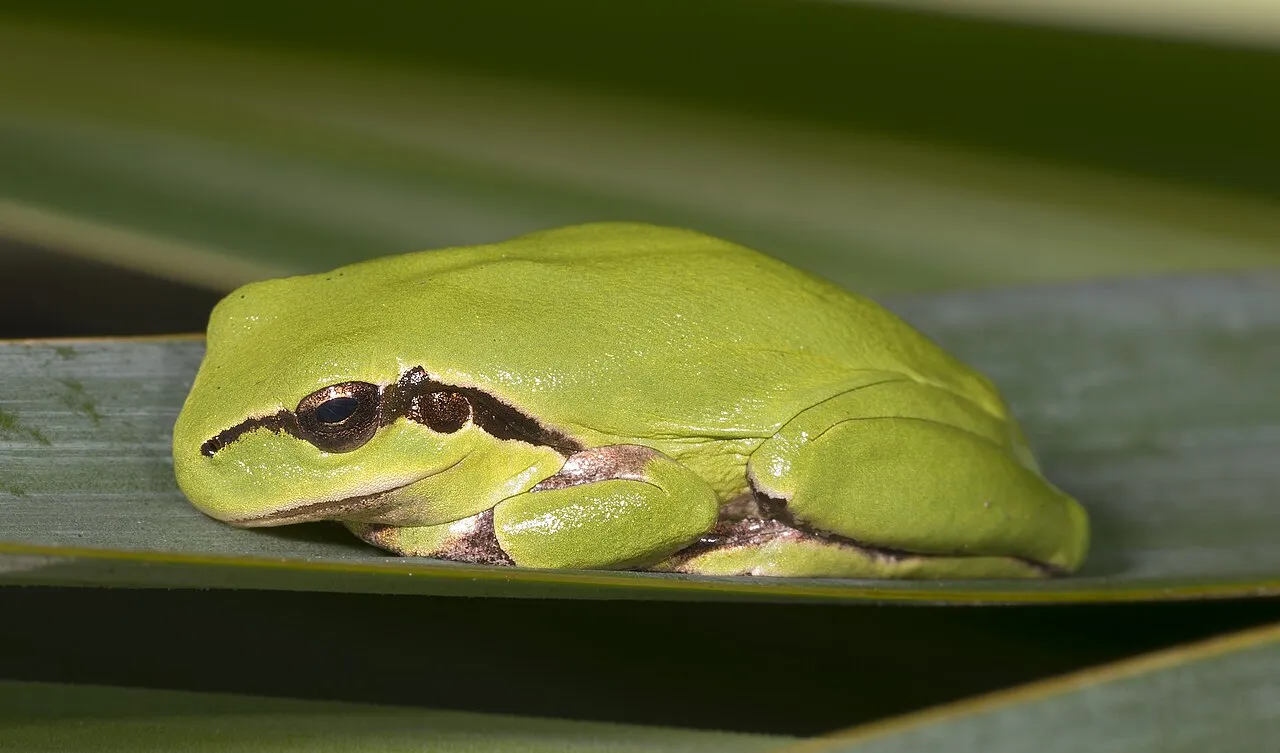
Hyla meridionalis, the Mediterranean tree frog, also called the stripeless tree frog, is a hylid of south-west Europe and north-west Africa. Its range runs across central and southern Portugal, Spain from Catalonia to Andalusia and Extremadura, southern France, Liguria in northern Italy, Morocco, northern Algeria and northern Tunisia, with long-established introduced populations on Madeira and the Canary Islands and a recent introduction on Menorca.
Identification
The species is named for its close relative, the European tree frog H. arborea, which it closely resembles but exceeds in size: some females reach about 65 mm, against roughly 40–50 mm in female H. arborea. It also has longer hind legs than H. arborea. The common name “stripeless” refers to its dark flank stripe, which reaches only as far as the front legs, often starting at the eyes rather than the nostrils, unlike the longer stripe that runs the full flank in H. arborea. Its call also resembles that of H. arborea but is deeper and slower. A further sourced description of its colouring beyond the flank stripe has not turned up in a source this guide could open this run; AmphibiaWeb, which would normally carry that detail, answered with a bot challenge rather than a page, so nothing from it is repeated here.
Habitat and range
The species breeds in and around standing water, with the breeding season running from the end of March through the beginning of July; its exact timing each year depends on water availability rather than falling on fixed dates. A more detailed account of the terrestrial habitats it uses outside the breeding season has not turned up in a source this guide could open this run.
Behaviour and breeding
Once eggs are laid, the larval period lasts about 15 days before tadpoles complete their development. A sourced account of clutch size, egg counts or adult lifespan has not turned up in a source this guide could open this run; the paper most likely to hold that detail sits behind a publisher paywall rather than in an open-access journal, so it is not cited here.
Conservation
The facts box gives the species’ IUCN category, taken from its Wikidata item. No further sourced detail on population trend or specific threats has turned up in a source this guide could open this run.
Similar species
The European tree frog, H. arborea, is the species most often confused with H. meridionalis and the two were once treated as a single species. H. arborea is smaller, with females reaching only about 40–50 mm, has shorter hind legs, and carries a dark flank stripe that runs the full length from eye to groin, rather than stopping at the front legs. H. arborea also occupies a different range, from France east to Poland and south to Greece, overlapping with H. meridionalis only in southern France. Wherever the two ranges meet, the longer hind legs, the larger size and the shorter flank stripe separate H. meridionalis from its northern relative.