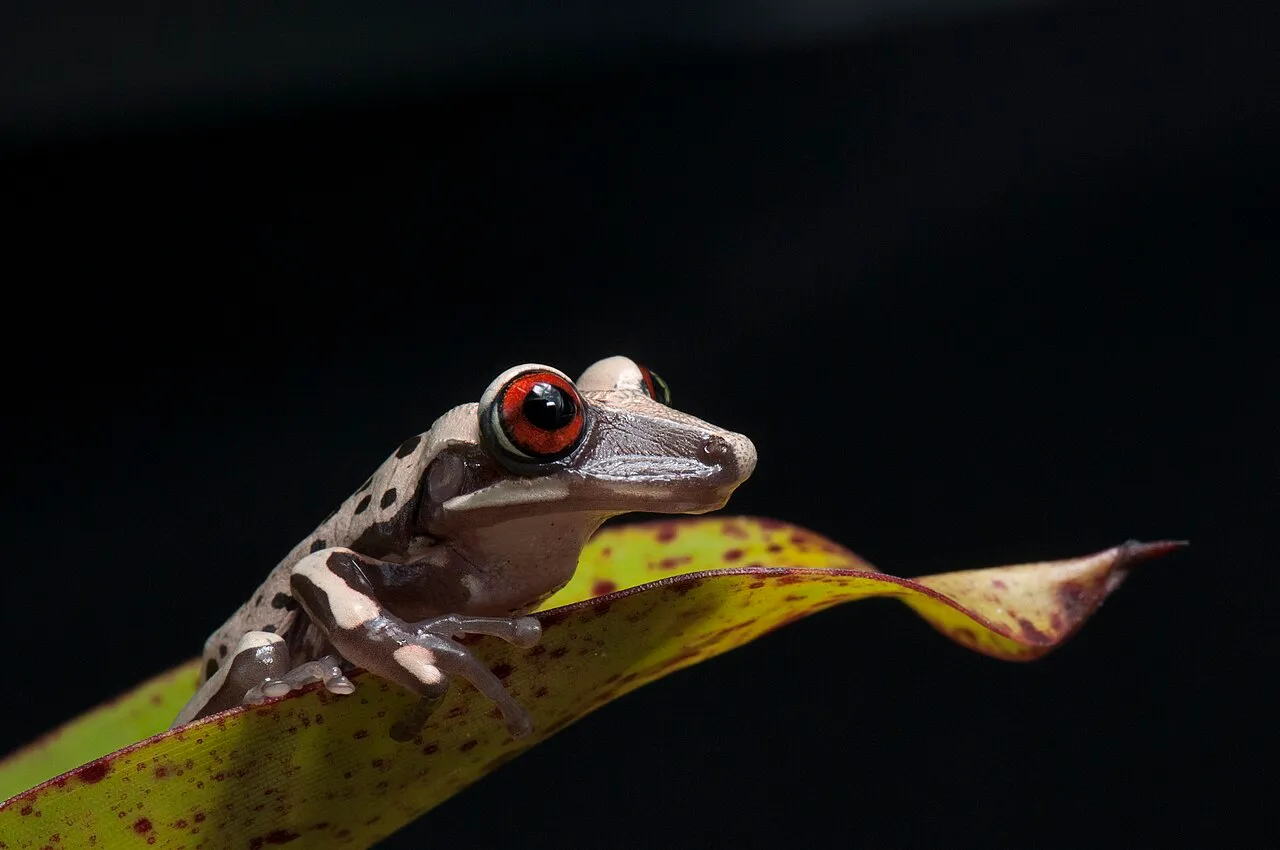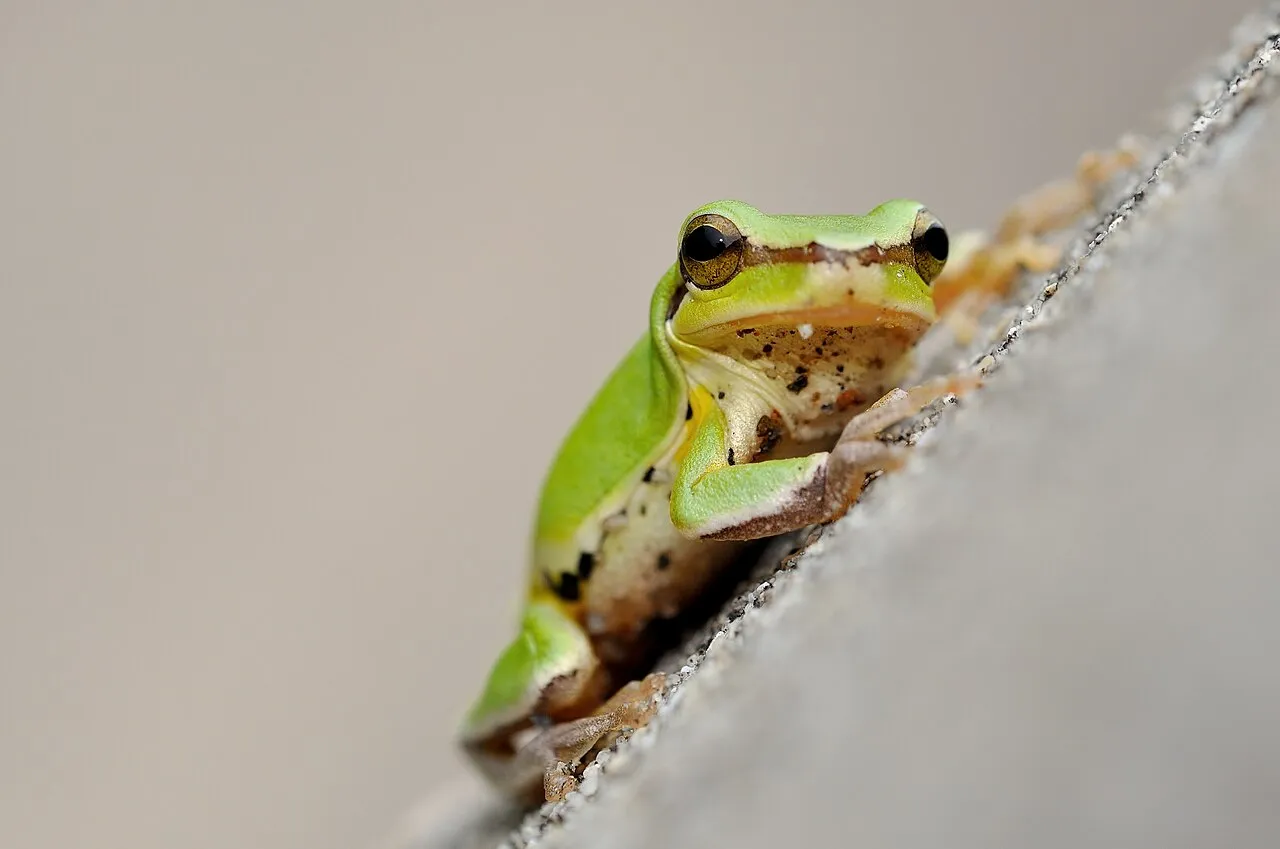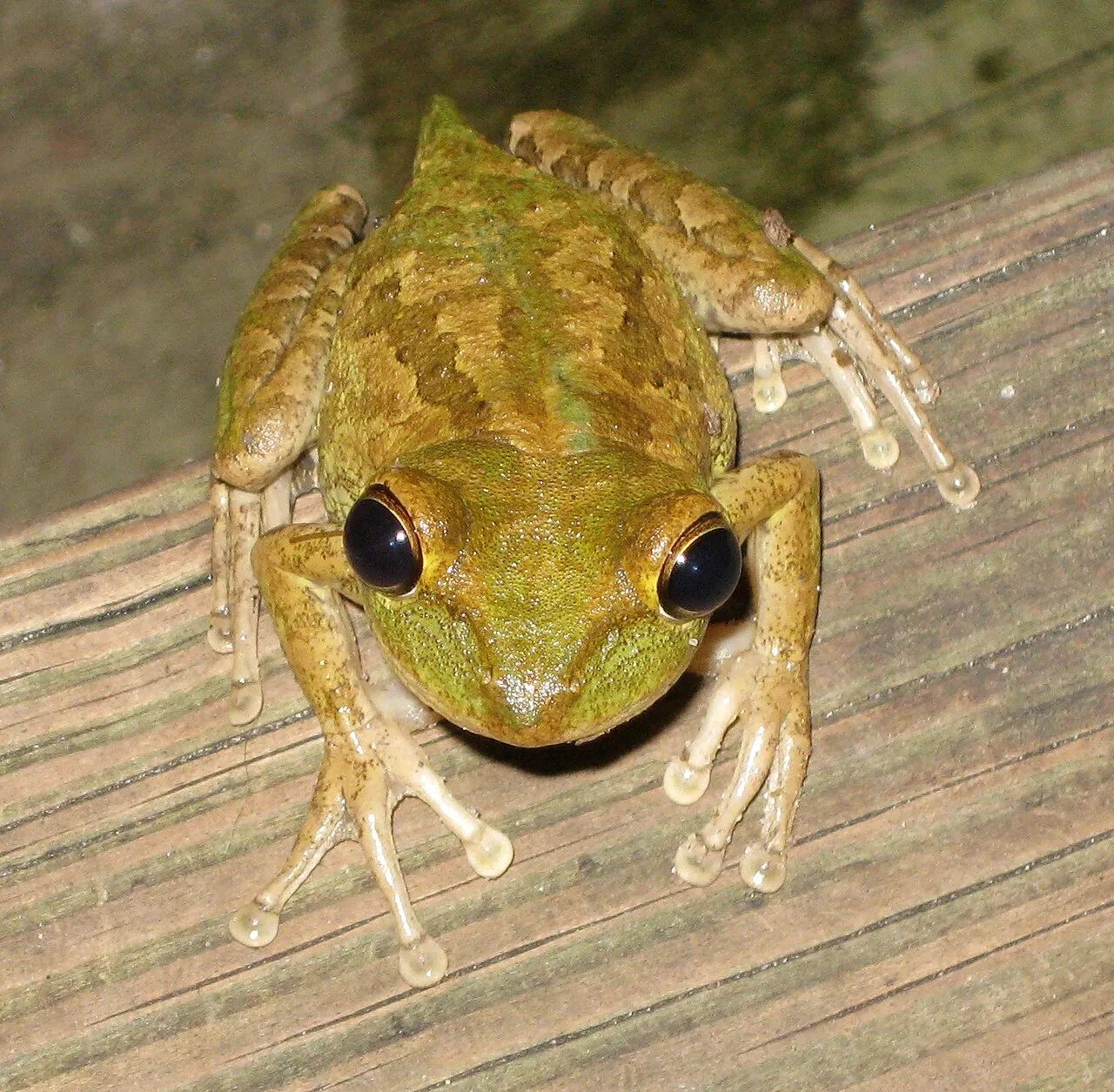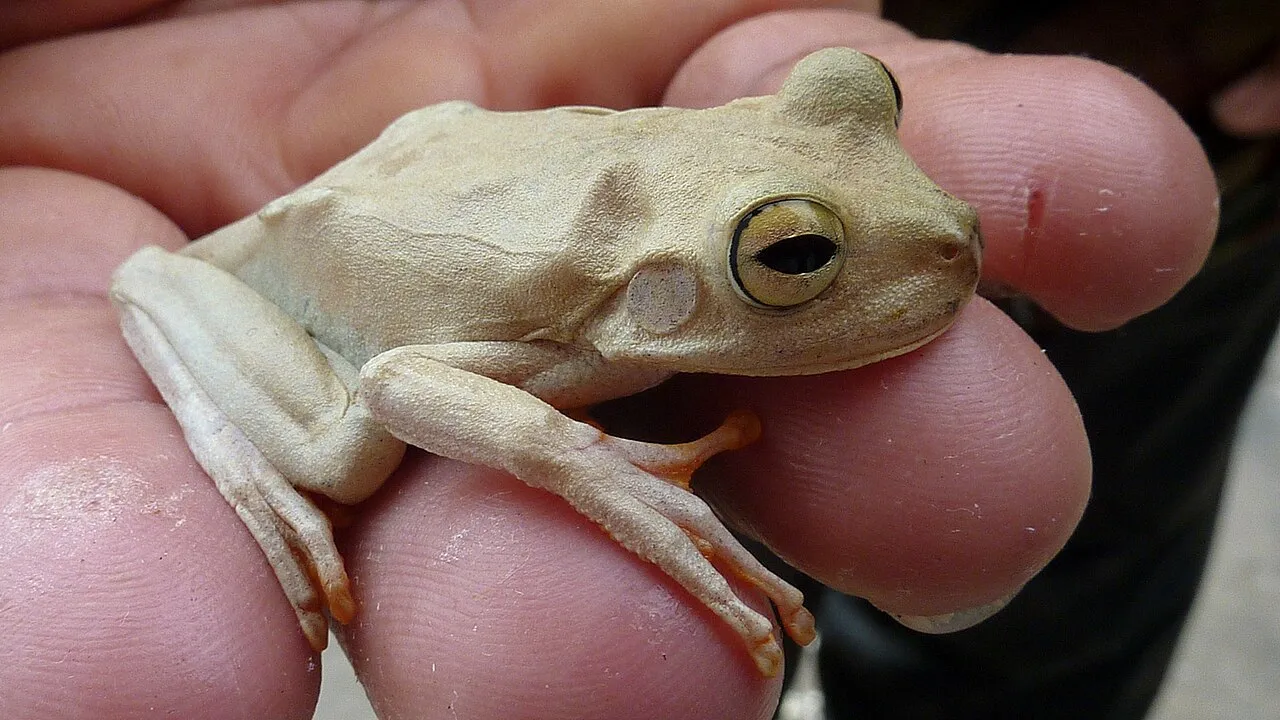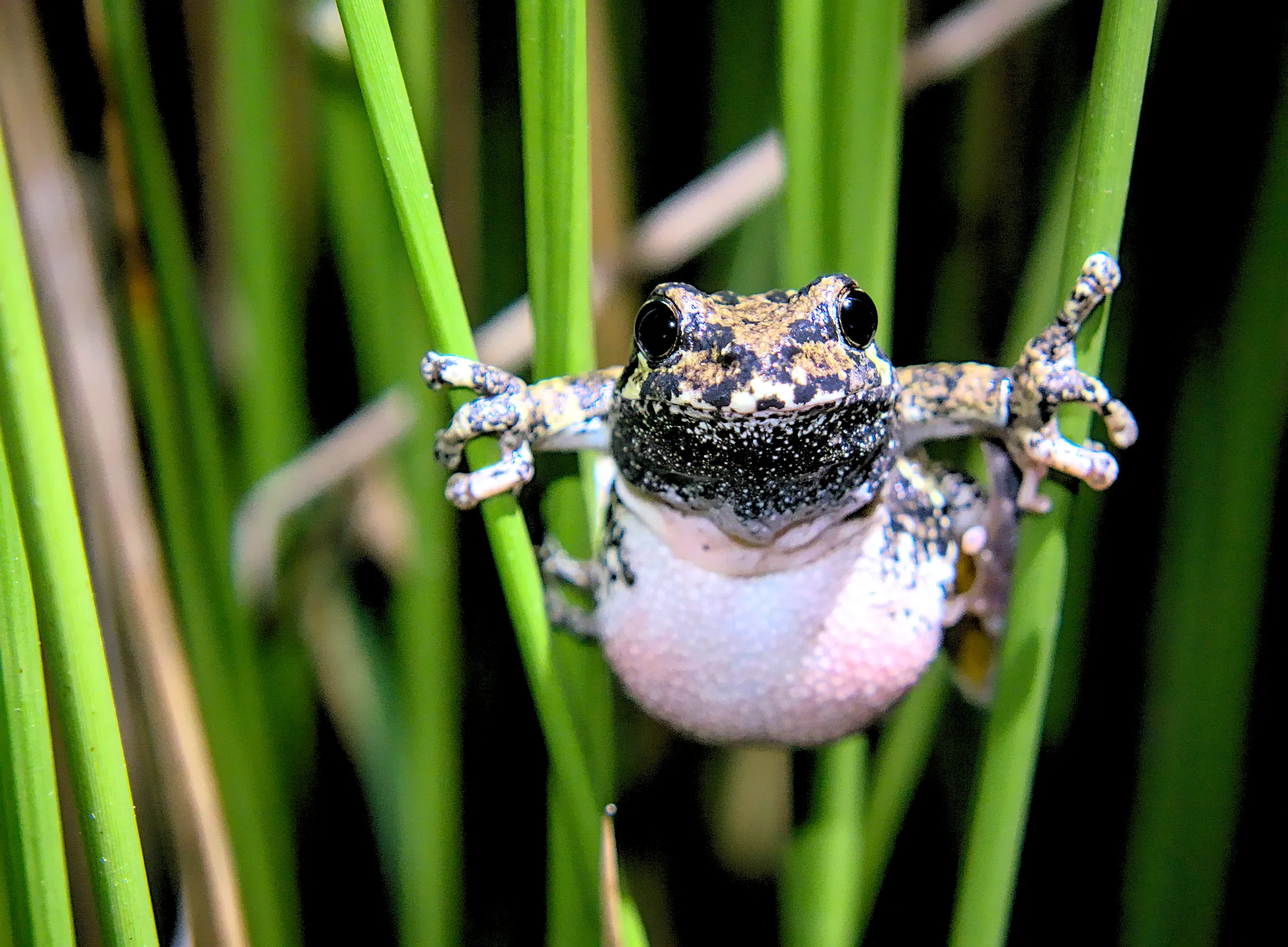
Dryophytes versicolor, the gray treefrog, is a small arboreal frog in the family Hylidae, native to much of the eastern United States and southeastern Canada1. It was first described as Hyla versicolor2, the name under which Animal Diversity Web3 (2006) and the Virginia Department of Wildlife Resources4 (2024) list it. As its Latin name suggests, the frog has a chameleon-like ability to change its colour5.
Identification
Adults measure 1.25 to 2 inches (3-5 cm), with a record of 2.25 inches (6 cm); the Virginia DWR gives a size of up to 2.4 inches4. The average mass is 7.175 g3.
Rough and lightly sprinkled with warts, the back carries more texture than most frogs but less than the average toad. According to the Virginia DWR it typically has a dark star-shaped pattern4 and many minute warts on a gray to light green background. Shades of gray with black blotches on the back are the most common colouring, but brown, green and pearl-gray frogs have been noted, and green colors are more prominent3 during the breeding season and in yearling frogs.
A light squarish spot beneath the eye4 marks the face, and the concealed surfaces of the thighs are orange or yellowish. The frog has large suction-cup-like toe pads5, like many treefrogs. Males have black or gray throats1, while the throats of the females are lighter.
The tadpoles are 3.2 to 3.8 cm long, light green to yellow, with heavy black dots along the tail margin3 on a red or orange background.
Habitat and range
The range reaches as far west as central Texas and Oklahoma1 and north into the provinces of Quebec, Ontario and Manitoba, with an isolated population in New Brunswick. Within the range it shares with Cope’s gray treefrog, D. versicolor is mostly found to the north and northeast, although both species share the same breeding ponds in Wisconsin and northern Michigan3. In Virginia it occurs in the mountains north and east of the New River watershed4, through the Blue Ridge and the Piedmont.
It lives in wooded areas near temporary and permanent waters, from swamps and old fields to wooded suburban neighbourhoods, farm woodlots and mixed or deciduous forests. Ontario Nature describes it as a true tree frog that can be found at the top of even the tallest trees5. In summer it is most often found in damp rotten logs or hollow trees3.
Winter is spent on land under woody debris such as logs, roots and leaf litter. The frog has a high freezing tolerance due to glycerol in its blood: during hibernation 80% of the body freezes3 and breathing and heartbeat are temporarily suspended.
Behaviour and breeding
Gray treefrogs are most active in the evening and night and rarely leave the trees until the breeding season. Adults eat most types of insects and their larvae, along with mites, spiders, plant lice, harvestmen and snails, and may also eat smaller frogs, other treefrogs included. They have been seen around windows and porch lights1 eating insects drawn to the light. Tadpoles graze on algae and detritus3.
Breeding choruses begin in late April to early May after the evening air temperature rises above 15°C, and calls sometimes continue into late June or early July. In Virginia the species breeds from April-August in shallow, ephemeral wetlands. Males call from vegetation beside the water, preferably in tree branches that overhang the water. The call is a lower frequency, musical trill, lasting 1-3 seconds4 that ends abruptly. Females choose ponds relatively free of predators3 and especially try to avoid fish.
They breed once yearly, with a range of 1,000 to 2,000 offspring. The egg mass breaks up almost at once into loose clusters of 10 to 40 eggs attached to plants. The tadpoles hatch in three to seven days and turn into froglets in six to eight weeks, at approximately 1.5 cm snout to vent. Females mature at 2 years, males at 1 to 2 years. One captive gray treefrog lived for over seven years3, but it was not identified as either this species or Cope’s gray treefrog.
Conservation
The species is listed as Least Concern2, as stated in the IUCN Red List 2022.2. Ontario Nature gives habitat loss and degradation from clearcutting, roads, agriculture and urbanization as the main threats, while noting that the frog is probably present in fairly large numbers. In Ontario it is a Specially Protected Amphibian5 under the Ontario Fish and Wildlife Conservation Act. In 2024 the Virginia DWR wrote that the species appears to be secure in Virginia4.
Similar species
- Cope’s gray treefrog (Dryophytes chrysoscelis): the two appear identical, and the only reliable ways to tell them apart are the calls of the males or a look at their chromosomes under a microscope. The gray treefrog has a slower trill than Cope’s3, and at a given temperature its pulse rate is approximately one-half that of Cope’s1. Cope’s has 24 chromosomes4, and the gray treefrog twice as many.
- Bird-voiced treefrog: both gray treefrogs have bright-yellow patches on their hind legs1, a mark that distinguishes them from other treefrogs such as the bird-voiced treefrog.
- Toads: they are similarly warty but almost always various shades of brown5, lack the gray treefrog’s toe pads and have large parotoid glands behind the eyes. The gray treefrog’s call is shorter than those of other frogs3 in its range but similar to the call of the American toad, listed there as Bufo americanus.