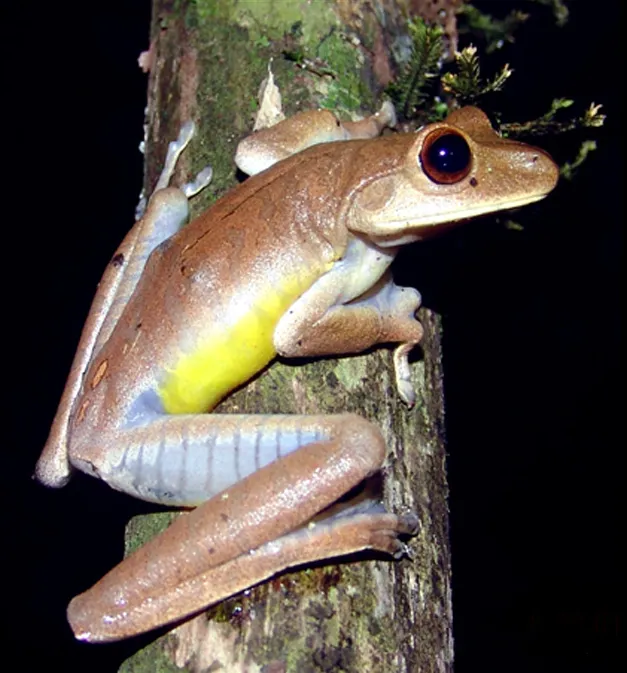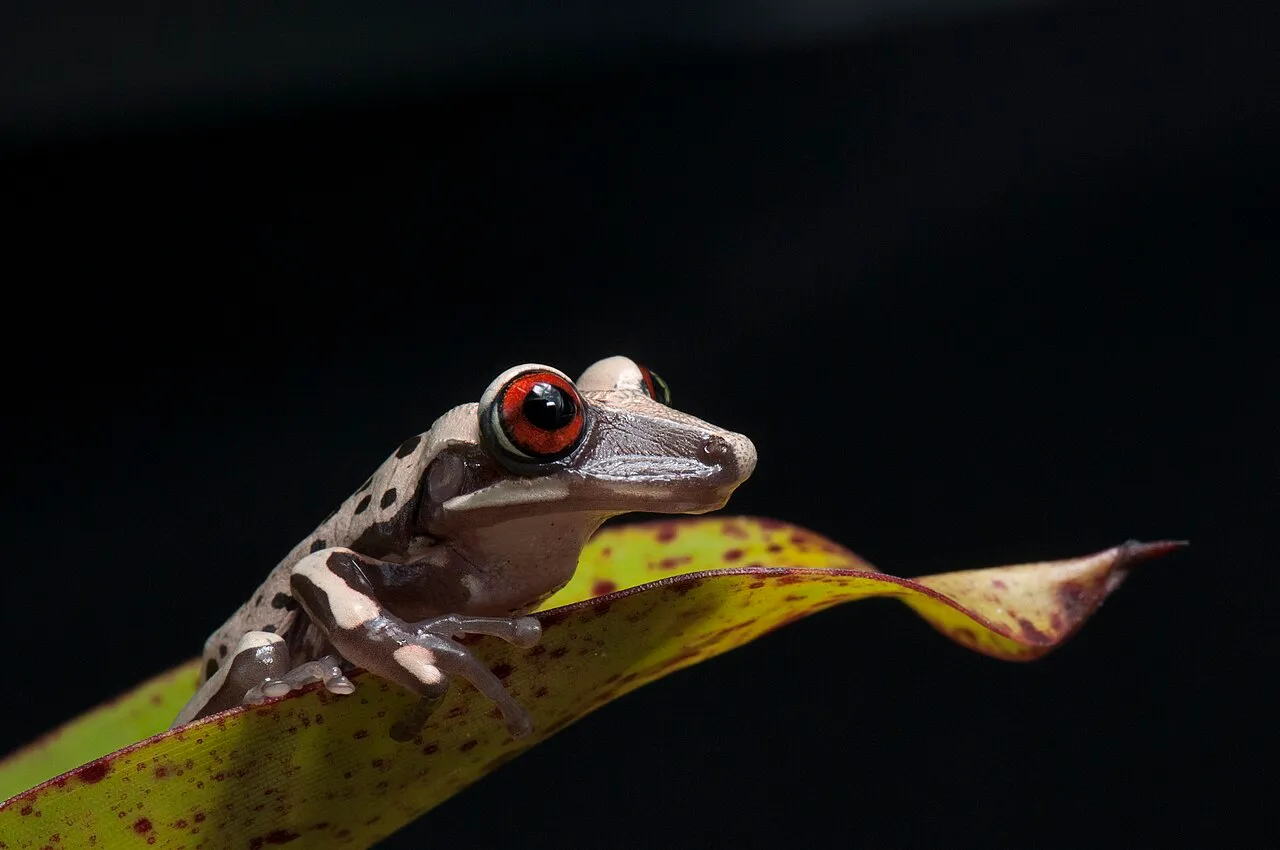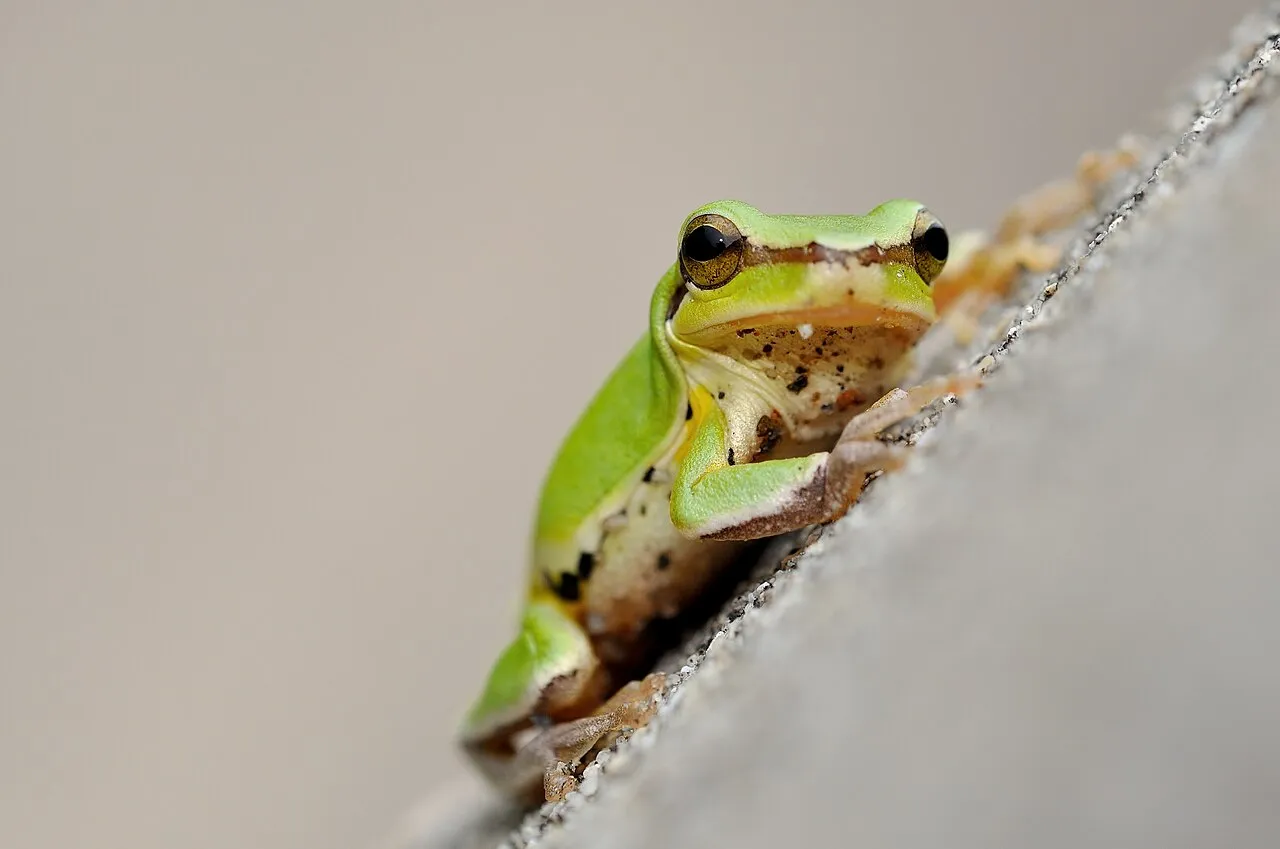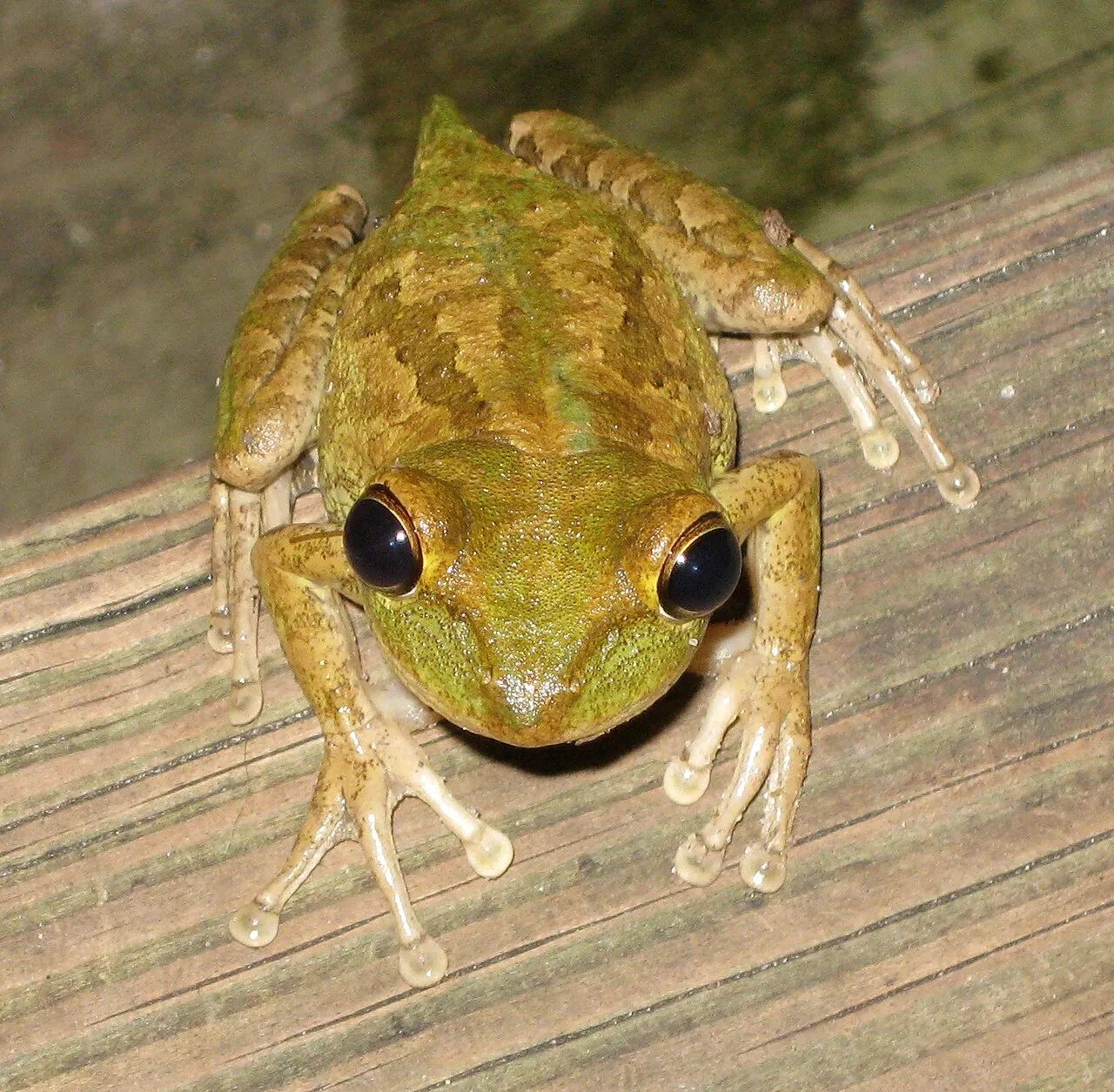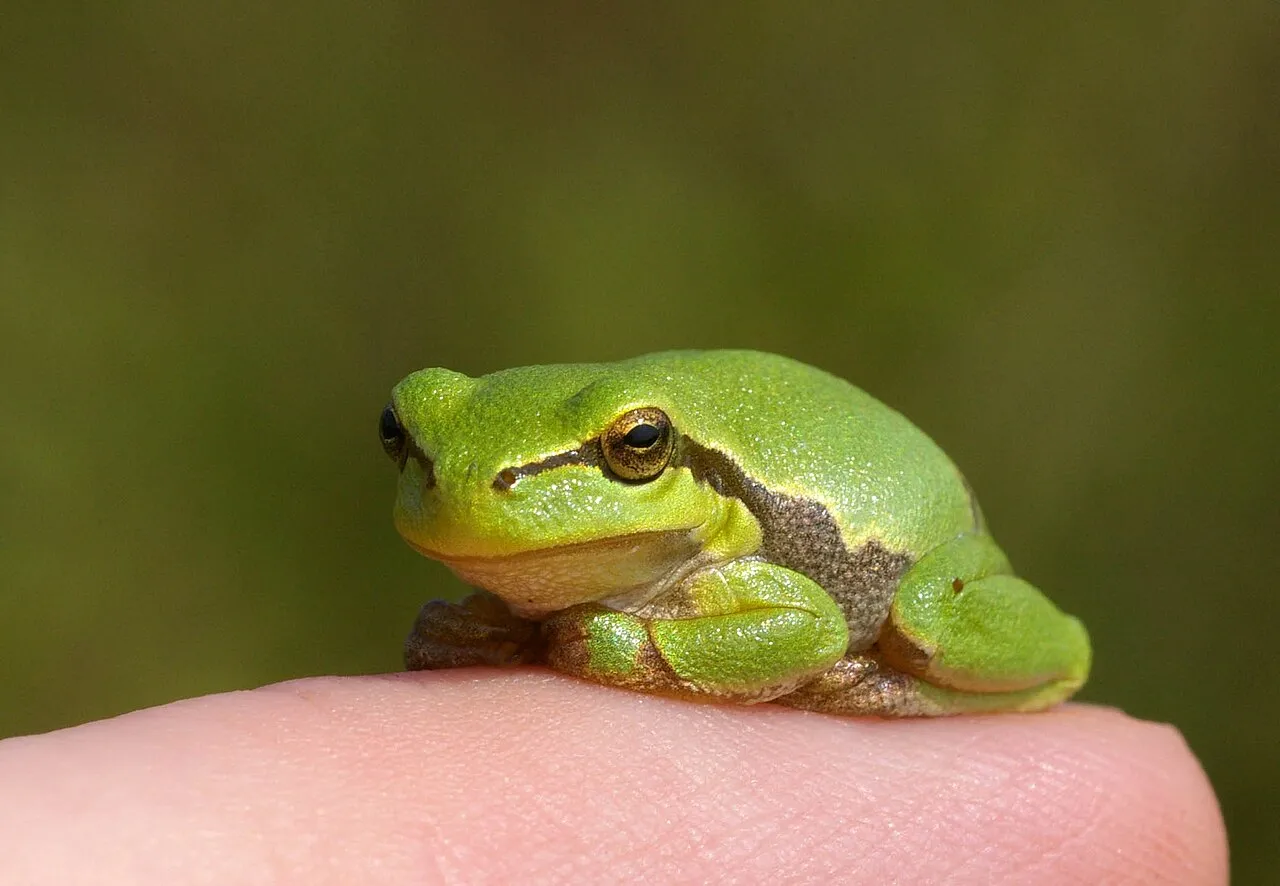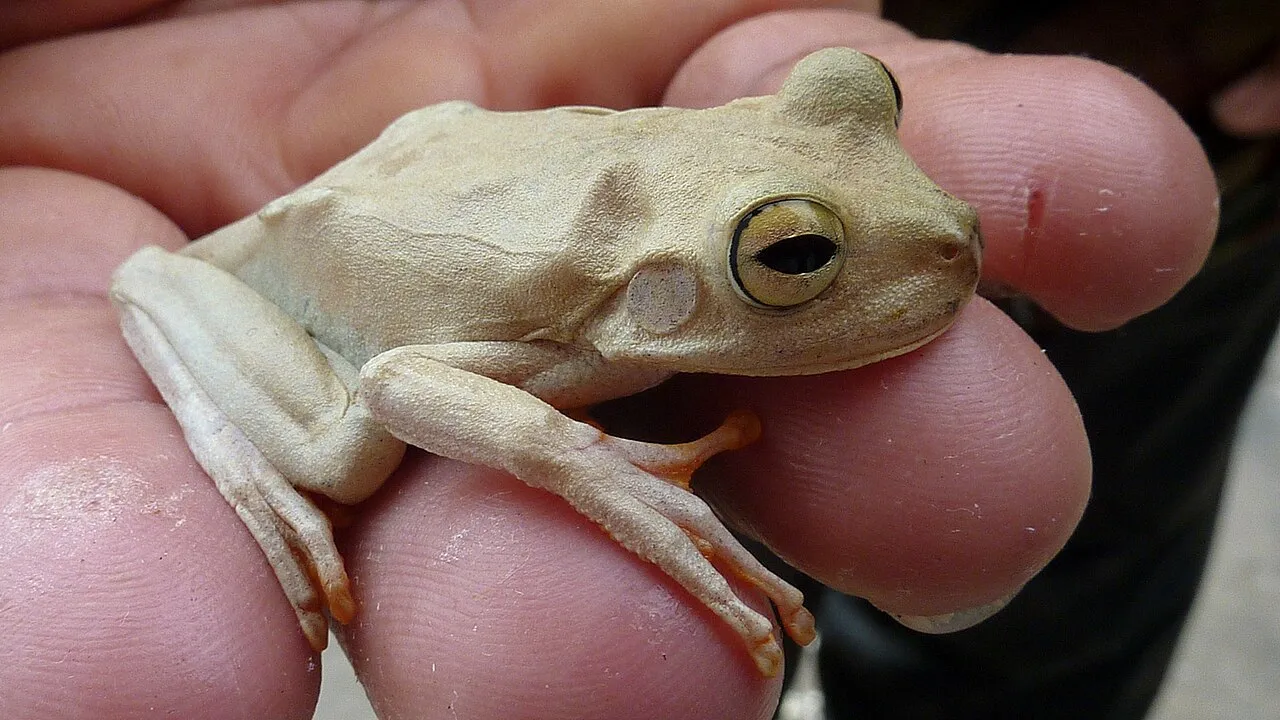
The emerald-eyed treefrog, Hypsiboas crepitans, is a species of frog in the family Hylidae, now named Boana crepitans, and Hypsiboas crepitans is one of its synonyms. As of 2025 it is described as largely restricted to the Atlantic Forest region of Brazil, although it is also recorded from the Aquicuana Reserve in Bolivia. Its type locality is Tamburil, Jiboya, Arrayal da Conquista (Brazil). The species was once drawn much more widely: some populations previously regarded as Boana crepitans1 have been separated into Boana xerophylla and Boana platanera. The Smithsonian portal also lists it as the Rattle-voiced Treefrog and Flying Frog2.
Identification
The common name stems from the frog’s metallic green iris, and its colour varies between green, tan and reddish-brown. Males are smaller than females1.
The Smithsonian Tropical Research Institute’s Panama portal, describing frogs under the old name, calls it a large treefrog with long, slender arms and legs, with males to 59 mm and females to 68 mm. In that account males have a dagger-like spine at the base of the thumb. The back is pinkish tan with some darker brown spots, blotches or other markings, and a thin, dark middorsal stripe is usually present. Dark bars are present on the upper surfaces of the thighs and extend onto their rear surfaces. The concealed surfaces are colored similarly to the dorsum2, apart from that dark barring on the rear of the thighs.
Below, the ventral surface has an orangish tint, except for the throat and chest, which are white with some brown flecking. The same portal gives the eye as grey, with a bronzy or yellowish cast, and notes that the webbing between the hands and feet is not particularly extensive2 and is pale in colour.
Tadpoles are grey or light brown, and their tail has more yellow undertones. The tadpole body is ovoid, with a rather long tail that ends in a distinct point, and the upper caudal fin is much deeper than the lower2.
Habitat and range
Northern populations once filed under this name were moved to other species, one of them described in 2021. Boana platanera is distributed within Venezuela, Colombia, Panama, and Trinidad and Tobago3, and its individuals were previously classified as Boana crepitans or Boana xerophylla. Boana xerophylla is found in northern Brazil, the Guianas and Venezuela south of the Orinoco4. For the Panama frogs, the Smithsonian portal gives a habitat of lowland and premontane forest to 2300 m2.
These frogs are arboreal1, and they use the shade from leaves during the day to protect themselves from the sun, as well as using leaves as camouflage against predators.
Behaviour and breeding
The frogs are nocturnal and feed during the night, mostly at the edges of ponds and rivers and in shrubs and trees, on small insects such as crickets and flies. Like all frogs, it has a distinctive call1 that it uses to communicate with other frogs and to find mates. The call is rattle-like2, a series of short notes of low or medium pitch.
In the Panama account, breeding occurs throughout much of the rainy season. There, males call from the edges of temporary ponds or flooded grassy areas, and males do not construct nests2, as do other species in this group. The Trinidad and Tobago guide adds that reproduction occurs year round where water is available5, with savanna populations breeding in the rainy season.
Females may lay over 1,000 eggs in a single oviposition event2. The eggs float at the top of the water for 24 hours1 before sinking, and the tadpoles take 3 months to metamorphose, with no parental care given to them.
Conservation
The species is listed as Least Concern6 on the IUCN Red List, in an assessment published in 20231 by the IUCN SSC Amphibian Specialist Group.
Similar species
- Boana platanera: the sister species of Boana xerophylla, formerly classified as Boana crepitans; in Venezuela it lives only north of the Orinoco river, and it also occurs in Colombia, Panama, and Trinidad and Tobago. By day it has a pale cream coloration, and its females average a snout–vent length of 63.1 mm3.
- Boana xerophylla: regarded as a synonym of Boana crepitans for decades until it was resurrected in 2017; it lives in northern Brazil, the Guianas and Venezuela south of the Orinoco, with an average snout–vent length of 49.69 mm4.
- Blacksmith tree frog (Boana faber): breeds in pools and slow-moving streams where the frogs make nests7, while in the Panama account emerald-eyed treefrog males do not construct nests2.