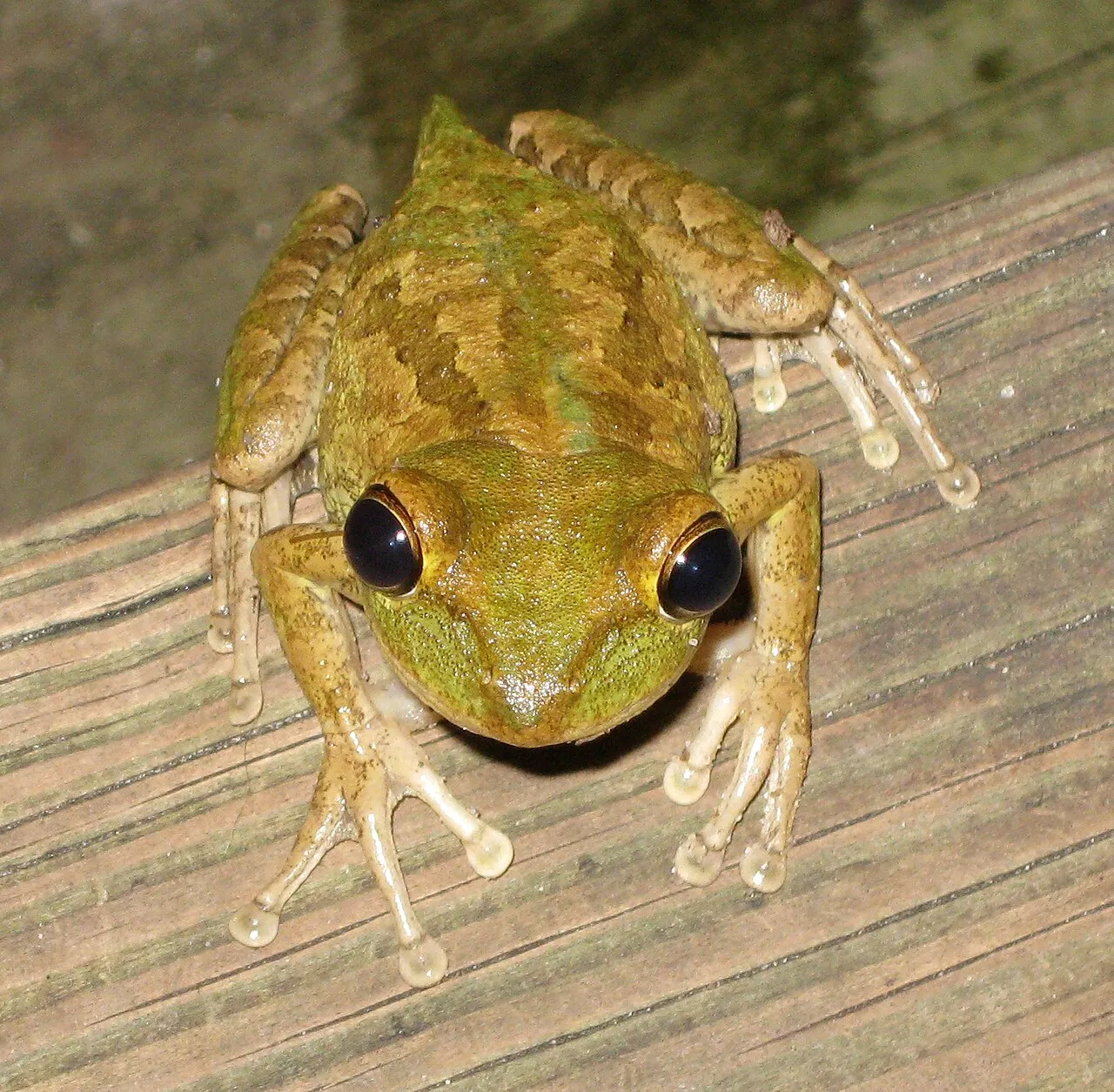
The Cuban tree frog, Osteopilus septentrionalis, is native to Cuba, the Cayman Islands and the Bahamas, but it is better known today as a stowaway. It has become established as an invasive species in coastal Florida, from south of Tampa and Orlando down to Miami, as well as in Puerto Rico, Anguilla, Costa Rica, Guadeloupe, the Turks and Caicos Islands, and the British and U.S. Virgin Islands, riding plant shipments and cargo far beyond its original range.
Identification
Size in this species varies widely: adults range from about 25 to 120 mm in length, with an average mass of around 57 g, and the facts box carries the full span. Females can grow to nearly twice the size of males, and the largest individuals make this the biggest tree frog species found anywhere in the United States. Bulging eyes and the expanded pads on the tips of its toes give it away, and the same toe pads give it its climbing ability. Colour varies between individuals, running from white to light brown or from green to dark brown, usually paired with a white, coarse-skinned belly.
Habitat and range
The species tolerates a broad spread of conditions, occupying freshwater, tropical and terrestrial habitats, including mountain, forest and coastal biomes as well as urban and suburban areas. It leans toward xeric, or dry, environments and shows up around buildings and disturbed ground, including inside houses in suburban southern Florida, drawn in by human activity and the food availability that comes with it. It has been recorded up to 1,110 m in elevation, though climate is the main factor limiting how far it has spread in the southeastern United States.
Behaviour and breeding
The Cuban tree frog is generally nocturnal, most active from dusk to dawn, hunting as an ambush predator that waits and jumps rather than chasing prey. When temperatures drop below 9.5°C it enters a state of torpor rather than staying active. After heavy rainstorms, frogs move en masse to breeding sites, with breeding running from May to October and some activity possible year-round in warm years. Mating is polygynandrous, with both males and females taking multiple mates; males reach sexual maturity at around 120 days and females at around 255 days. A female can lay more than 3,000 eggs in a season, released in batches of 75 to 1,000 at a time, and the eggs hatch quickly, within 24 to 32 hours.
Conservation
The species’ facts box carries its current IUCN Red List category, Least Concern, reflecting a wide native and introduced range and a large overall population. That listing says nothing about its effect where it has become invasive: it is a known predator of native tree frogs and negatively affects ecosystems in Florida by displacing them, and it releases a toxic skin mucous that can irritate humans and other mammals handling it. It also causes direct nuisance to people by entering homes through plumbing and clogging toilets and sink drains.
Similar species
Size sets it apart from most tree frogs sharing its invasive range in the southeastern United States. Females reaching nearly twice the size of males and a maximum length that makes this the largest tree frog species found in the United States mean it outgrows the smaller native frogs it preys on. The oversized toe pads that let it climb walls and window glass are the other field mark separating it from similar frogs at the same ponds and porches.