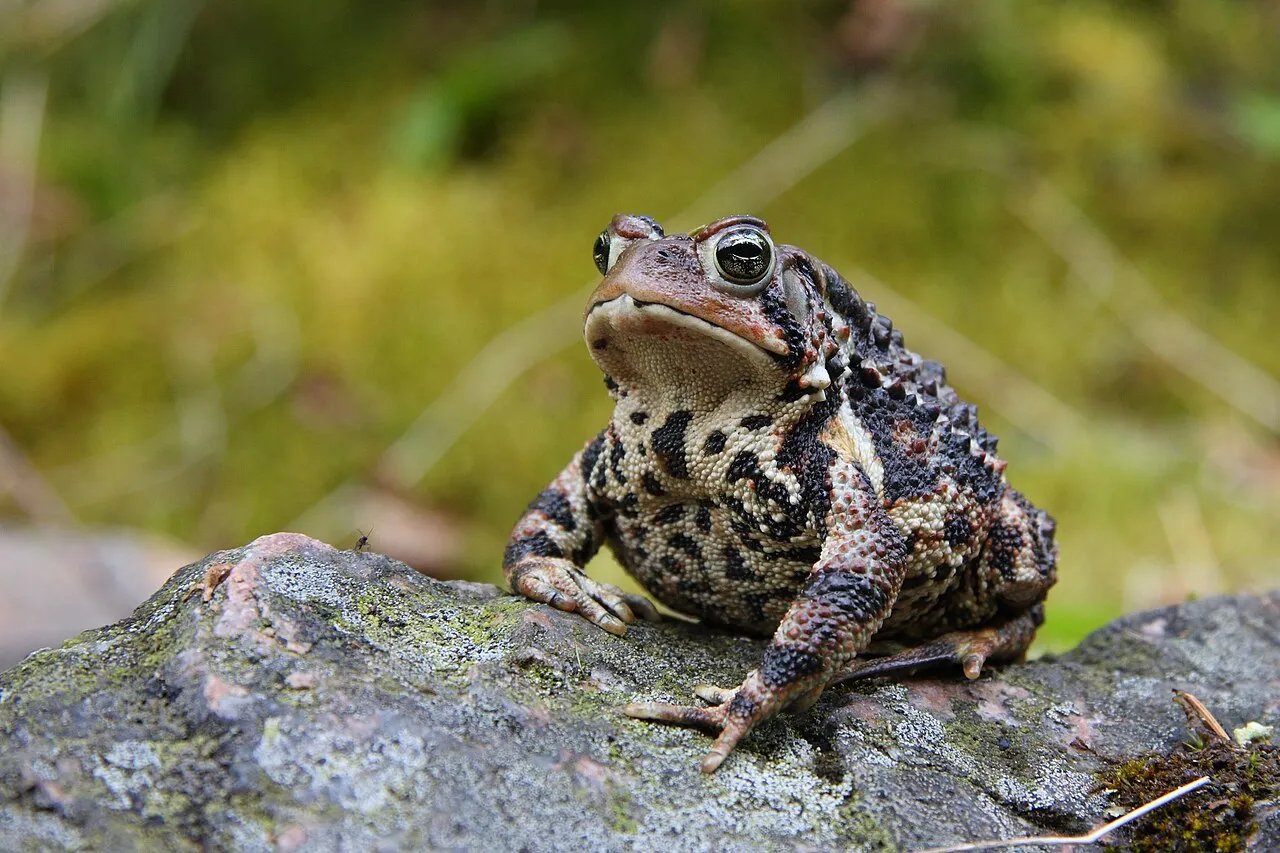
Anaxyrus americanus, the American toad, is found throughout the eastern half of Canada and the United States. It is a mid-sized, warty toad: the widespread eastern subspecies typically measures 5–9 cm (2.0–3.5 in), with a record length of 11.1 cm (4.4 in), while the more range-restricted dwarf subspecies reaches only about 6 cm (2¼ in).
Identification
Colour and pattern vary considerably, especially in females, running from yellow to brown to black, either solid or speckled, and shifting with habitat, humidity, stress and temperature. The clearest field marks sit in the warts: eastern American toads carry only one to two warts in each dark spot on the back, plus enlarged warts on the tibia, below the knee. The belly is usually spotted, more heavily so toward the front, and the parotoid glands behind the eyes are the same colour as the surrounding skin rather than standing out; the raised cranial crests on the head almost never touch the parotoid glands, another useful check in the hand.
Habitat and range
Across its range the species occupies forests, grasslands and gardens, tolerating everything from deep woodland to suburban yards. Breeding, though, depends on one specific kind of water: a semi-permanent freshwater pond or pool with shallow water, sited near dense patches of vegetation that give cover and hunting ground once the toads move back onto land. This mix of tolerant terrestrial habits and a narrower breeding requirement explains why the toad turns up in so many disturbed and semi-natural landscapes as long as the right pool is nearby.
Behaviour and breeding
Males call to attract mates with a high trill lasting 6–30 seconds, often likened to a ringing telephone, and keep at it for an average of 6–7 nights across the breeding period. A female lays two long ropes holding 2,000–20,000 small black eggs, each 1–2 mm across and wrapped in jelly. The eggs hatch quickly, within 3–12 days, and the resulting tadpoles complete metamorphosis into toadlets in 50–65 days. Outside the breeding season, adults hunt after dark, taking crickets, mealworms, earthworms, ants, spiders, slugs, centipedes, moths and other small invertebrates.
Conservation
The IUCN category for the American toad is given in the facts box above. The species’ broad range and tolerance of altered landscapes — from forest to garden — underpin that secure status; its dependence on a narrower set of breeding pools, noted above, is the main point where local populations could come under pressure if suitable water disappears.
Similar species
The closest look-alike is Fowler’s toad, which shares much of the American toad’s eastern range but differs in its warts and belly pattern: Fowler’s toad has three or more warts in its largest dark spots rather than one or two, and it never shows a spotted belly. The two species also part company at the head, since Fowler’s toad’s cranial crests touch its parotoid glands, where the American toad’s almost never do. Farther west, the similarly built Woodhouse’s toad replaces the American toad at the edge of its range, and is best told apart by locality rather than by eye.