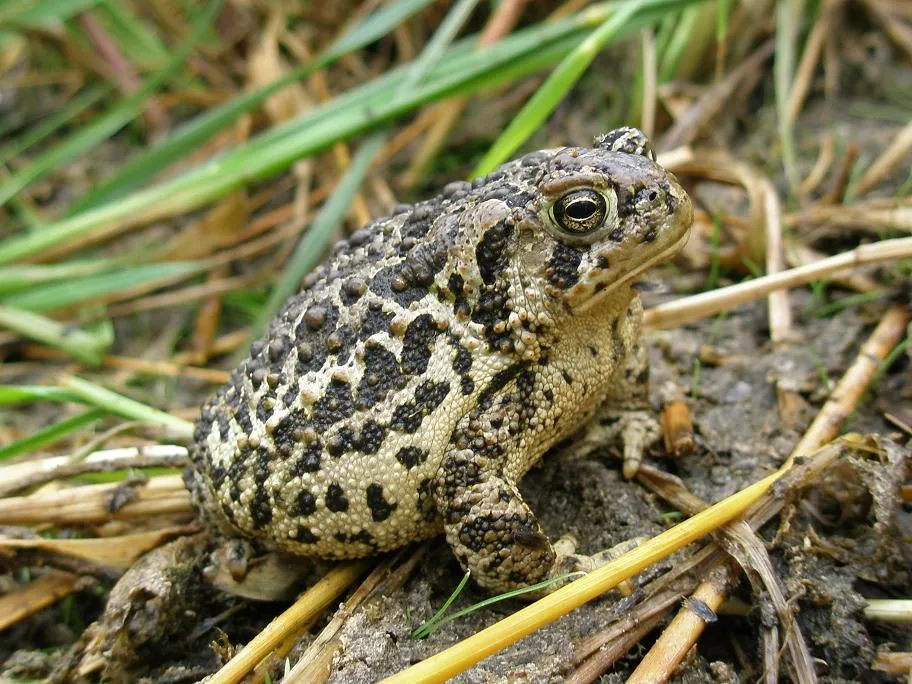
Anaxyrus baxteri, the Wyoming toad, is endemic to the Laramie Basin in Albany County, Wyoming, where it now survives only at Mortenson Lake National Wildlife Refuge, in captive-breeding facilities, and at a handful of reintroduction sites elsewhere in the basin. It is a small toad, reaching up to 5.6 cm (56 mm) snout-to-vent, with females growing slightly larger than males, and it is one of the rarest amphibians in North America.
Identification
The Wyoming toad’s back ranges from dark brown to gray or green, marked with small, rounded, blotchy warts and blurry light lines running along the body; the underside carries small dark markings. Males show a dark throat, a useful field mark for telling the sexes apart at a breeding pool. Individual toads vary enough in colour and wart pattern that researchers can identify single animals by these markings alone. Its skin is unusually sensitive and poorly adapted to withstand pathogens, a trait that made the species especially vulnerable once chytrid fungus reached the basin.
Habitat and range
The species occupies floodplains and the shallow edges of ponds, creeks and lakes, sheltering through hibernation in abandoned pocket-gopher and ground-squirrel burrows. Adults tend to favour denser vegetation and cooler ground, around 20°C, set back further from the shoreline than the juveniles, which stay closer to open water. Outside of Mortenson Lake, the wild range has contracted to a few sites in the Laramie Basin stocked through reintroduction; the species has not re-established itself anywhere beyond this one small corner of southeastern Wyoming.
Behaviour and breeding
Nocturnal, the Wyoming toad hunts mainly by detecting the movement of prey, since its eyesight is poor; toads held at breeding facilities are fed mealworms, waxworms and crickets. Males reach sexual maturity at two years old and females at three, both earlier than the closely related Canadian toad, to which the Wyoming toad was originally assigned as a subspecies, Bufo hemiophrys baxteri, before being recognised as its own species. The male’s mating call is pitched at a lower frequency and slower pulse rate than other toads, but lasts longer, carrying across the shallow pools where breeding takes place in late spring and early summer. Wild egg-laying remains rare enough to be tracked mass by mass: four egg masses turned up at the Mortenson Lake release site in 1998, with two more found in 1999.
Conservation
The IUCN category for the Wyoming toad is given in the facts box above. The decline began with its listing as endangered in 1984, and the species was declared extinct in the wild in 1991 after chytrid fungus, to which its sensitive skin offers little resistance, swept through the remaining wild populations alongside habitat loss and pesticide use. Captive breeding began in 1989 at the Thorne Williams Unit, which alone produced nearly 46,000 offspring between 1995 and 2006 before stock moved to the Red Buttes Environmental Biology Laboratory; the Saratoga National Fish Hatchery joined the effort in 1998, and offspring have since gone out to seven zoos as well as to release sites at Mortenson Lake and Lake George. Every Wyoming toad alive today descends from this captive-breeding stock; around 1,500 individuals existed as of 2017.
Similar species
Confusion is most likely with its nearest relative, the Canadian toad (Anaxyrus hemiophrys), of which it was once classified as a subspecies before its range, call and maturation schedule were judged distinct enough to warrant full species status. Within the same genus, the American toad (Anaxyrus americanus) overlaps in general build but occupies a far larger range across eastern North America and lacks the Wyoming toad’s restriction to a single basin. In practice, locality is the surest guide: any Anaxyrus toad found in the Laramie Basin’s wetlands today is almost certainly this species or an animal released there as part of its recovery programme.