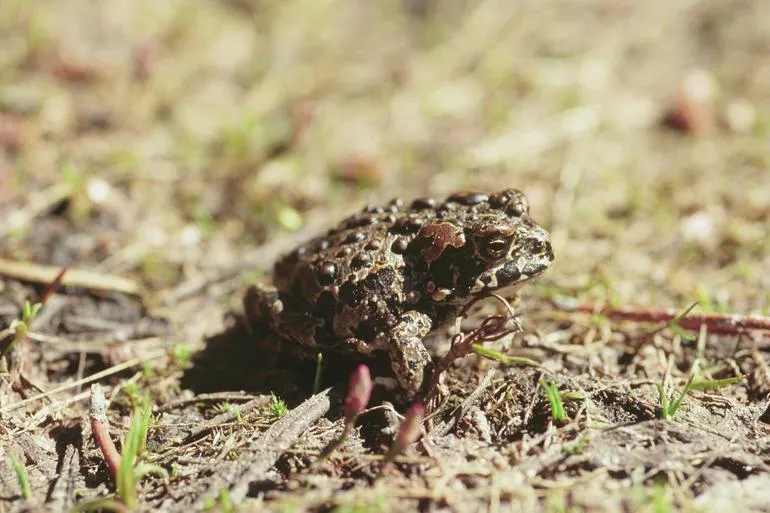
Anaxyrus canorus, the Yosemite toad, is endemic to the Sierra Nevada of California, from Alpine County south to Fresno County. It is a stocky, medium-sized toad, 48–84 mm snout-vent length, with females averaging larger than males, and its species name, canorus, means “tuneful” — a nod to the male’s distinctive call.
Identification
The Yosemite toad is considered the most sexually dichromatic frog species in North America: males are plain yellow-green to olive-drab, sometimes flecked with black, while females carry black blotches edged in white or cream on a tan, copper or ruddy background. Both sexes show large, irregularly shaped parotoid glands set less than one gland-width apart, narrowly spaced eyes, and large, smooth warts separated by smooth skin, with no prominent mid-dorsal stripe. The iris is dark brown with gold flecks. Tadpoles are jet black throughout, 10–37 mm long, with a short blunt snout and a rounded tail tip.
Habitat and range
The species lives in a montane to subalpine zone between 1,950 and 3,445 m elevation, well above the lowland range of most other North American toads. It breeds in wet meadows and shallow snowmelt ponds, favouring flatter, southwest-facing meadows that collect more precipitation and warm faster, with breeding water usually less than 5 cm deep. Outside the breeding season, adults move to upland ground with seeps, springs, willow thickets, tall forbs, granite boulders and rodent burrows, and the species shows high fidelity to the same breeding pools and upland refuges year after year. Living this high up means crossing late-season snow is routine, and the toad does it without sinking in: it has been nicknamed “the toad that stays on its toes” for crossing snowdrifts without its belly touching the surface.
Behaviour and breeding
Males are explosive breeders that arrive at meadow pools while snowbanks still cover roughly half the ground, with the timing shifting from April to July depending on snowmelt. A calling male produces a high, flute-like trill of 26–51 evenly spaced notes lasting about 2.6 seconds. A female lays one clutch of 1,000–2,000 eggs in one or two strands tangled in vegetation, each egg about 2.1 mm across, swelling to 4.1 mm with its jelly envelope. Eggs hatch within one to two weeks, and tadpoles — which graze on algae and detritus and will scavenge other tadpoles — complete metamorphosis in four to six weeks depending on conditions. Toads reach sexual maturity slowly, males at 3–5 years and females at 4–6 years, and can live a long time once mature: at least 12 years for males and 15 for females. Largely diurnal thanks to the cold mountain air, adults hunt mainly hymenopterans such as bees and wasps, along with beetles, craneflies, mosquitoes, caterpillars, ants, dragonfly naiads, centipedes, millipedes and spiders; hymenopterans alone make up roughly 80% of the adult diet, while recently metamorphosed juveniles feed mostly on owl flies, flies, springtails, spider mites and spiders. Adults retreat to rodent burrows or willow thickets to hibernate once the first freezing nights arrive, typically in September or October.
Conservation
The IUCN category for the Yosemite toad is given in the facts box above. The species is also listed as Threatened under the U.S. Endangered Species Act. Its narrow elevational band and dependence on specific snowmelt meadows leave it exposed to drought, worsened by climate change, and to chytridiomycosis disease, both identified as the main pressures on remaining populations.
Similar species
The closest look-alike across its Sierra Nevada range is the western toad (Anaxyrus boreas). The Yosemite toad is distinguished by its larger, more narrowly spaced parotoid glands, narrower eye spacing, smoother warts, and the absence of a prominent mid-dorsal stripe that western toads typically show; calling males also carry vocal sacs, which western toad males lack. Farther from its range, other members of the former Bufo group in the western United States, such as the black toad and the Amargosa toad, lack the vocal sac needed to produce the Yosemite toad’s musical trill at all. Elevation is the quickest field check: few other North American toads breed as high as the Yosemite toad’s 1,950–3,445 m meadows; narrowly set parotoid glands and no back stripe confirm the identification.