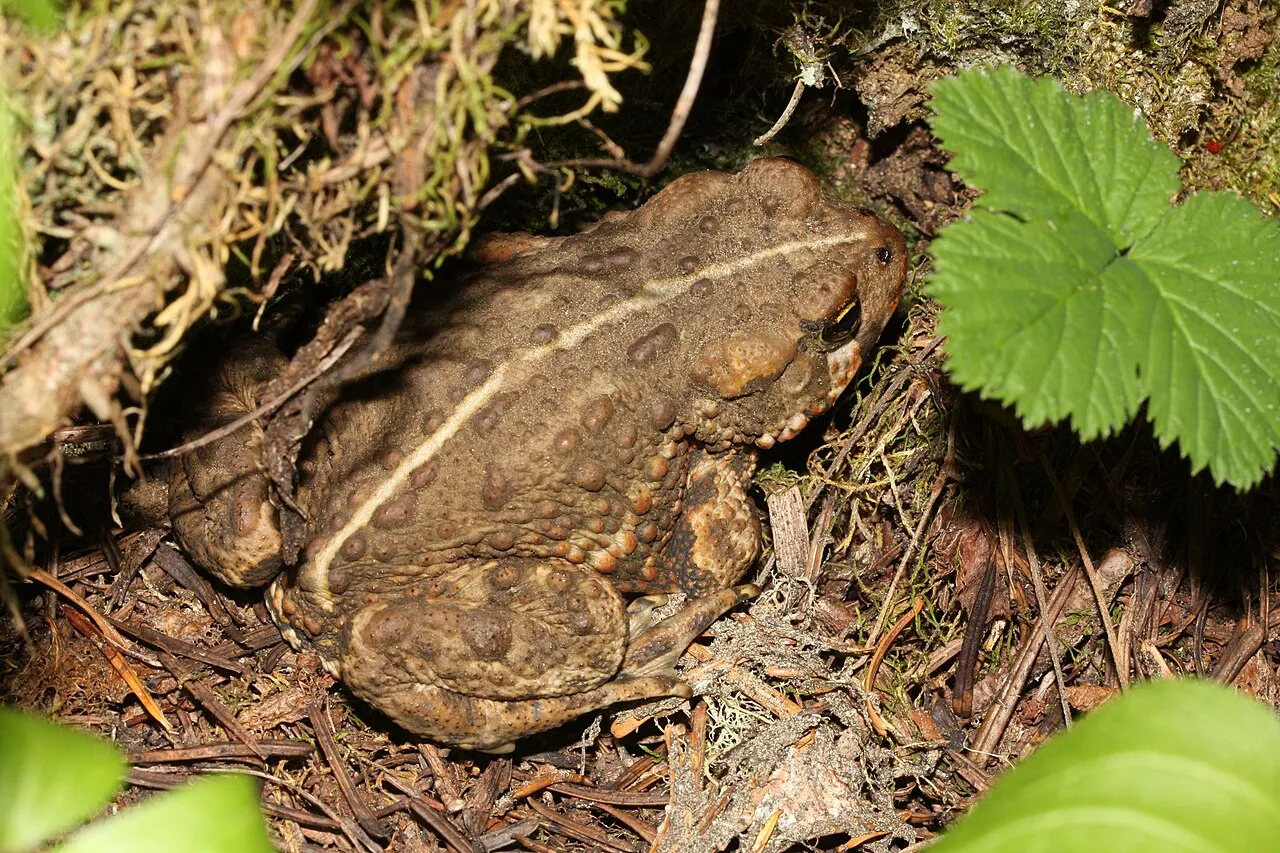
Anaxyrus boreas, the western toad, ranges across western British Columbia and southern Alaska south through Washington, Oregon and Idaho to northern Baja California, Mexico, and east to Montana, western and central Wyoming, Nevada, the mountains and higher plateaus of Utah, and western Colorado. It is a mid-to-large toad, measuring 56–130 mm (2.2–5.1 in) snout to vent.
Identification
The western toad shows a white or cream stripe down the middle of the back, set against dusky gray or greenish skin, with a mottled underside. Its parotoid glands, behind the eyes, are oval, widely separated, and larger than the upper eyelids, and unlike many other toads this species lacks cranial crests on top of the head. During the breeding season, males develop smoother skin, reduced blotching, and thickened skin pads on the forefeet used to grip females. Juveniles carry a weak or absent dorsal stripe but prominent dorsal and ventral spotting and yellow feet, so young toads can look markedly different from adults.
Two subspecies are recognised: the boreal toad (A. b. boreas), which lacks a cranial crest and carries a considerable number of dark blotches on the underbelly, and the California toad (A. b. halophilus), with a wider head, larger eyes, smaller feet and weaker dorsal-stripe margins. The species was described in the now-obsolete genus Bufo before being placed in Anaxyrus.
Habitat and range
Within its broad range, the western toad occupies desert streams and springs, grasslands and mountain meadows; it is less common in heavily wooded country, though it also turns up in aspen groves and riparian forest in the Rocky Mountains and, less often, Douglas fir forest in the Pacific Northwest. Elevation is no barrier: the species occurs from sea level to elevations near or above regional treeline, although it grows scarcer the higher it goes. It also tolerates brackish water, surviving 40% seawater concentration, though it dies within a week at 50%.
Behaviour and breeding
Activity runs from January to October depending on latitude and elevation, with the toad hibernating over winter. At low elevations it is nocturnal, while at high elevations and in the northern part of its range it becomes diurnal; in dry country it shelters by day under rocks, logs, stumps or in rodent burrows, often returning to the same retreat repeatedly. Its diet is mostly bees, beetles, ants and arachnids, supplemented with crayfish, woodlice, grasshoppers, caddisflies, moths and flies.
Breeding runs from February to July, peaking in April (as early as January at lower elevations). Males reach sexual maturity at 3 years, females at 4–5 years in Oregon and around 2 years in California. A female lays her eggs in gelatinous strings, up to 17,000 eggs per female, at 13 to 52 eggs per inch of string. Tadpoles complete metamorphosis in 28 to 45 days. Tadpoles fall prey to fish, reptiles, other amphibians, birds and mammals, while adults are taken by ravens (Corvus corax) and badgers among other predators, their skin toxins deterring many would-be attackers. Females can live 10 years or more, though a Colorado population topped out at around 9 years.
Conservation
The IUCN category for the western toad is given in the facts box above. Threats include chytridiomycosis, the fungal disease implicated in amphibian declines worldwide, and fertiliser contamination: urea absorbed through the skin has been linked to increased mortality in the species.
Similar species
Within its own species, the boreal and California subspecies are told apart mainly by head and foot shape and by the pattern on the underbelly, noted above. Farther east, the American toad (Anaxyrus americanus) overlaps only at the margins of the western toad’s range, and is easy to separate at the head: American toads carry cranial crests, which almost never touch the parotoid glands, a structure the western toad lacks entirely.