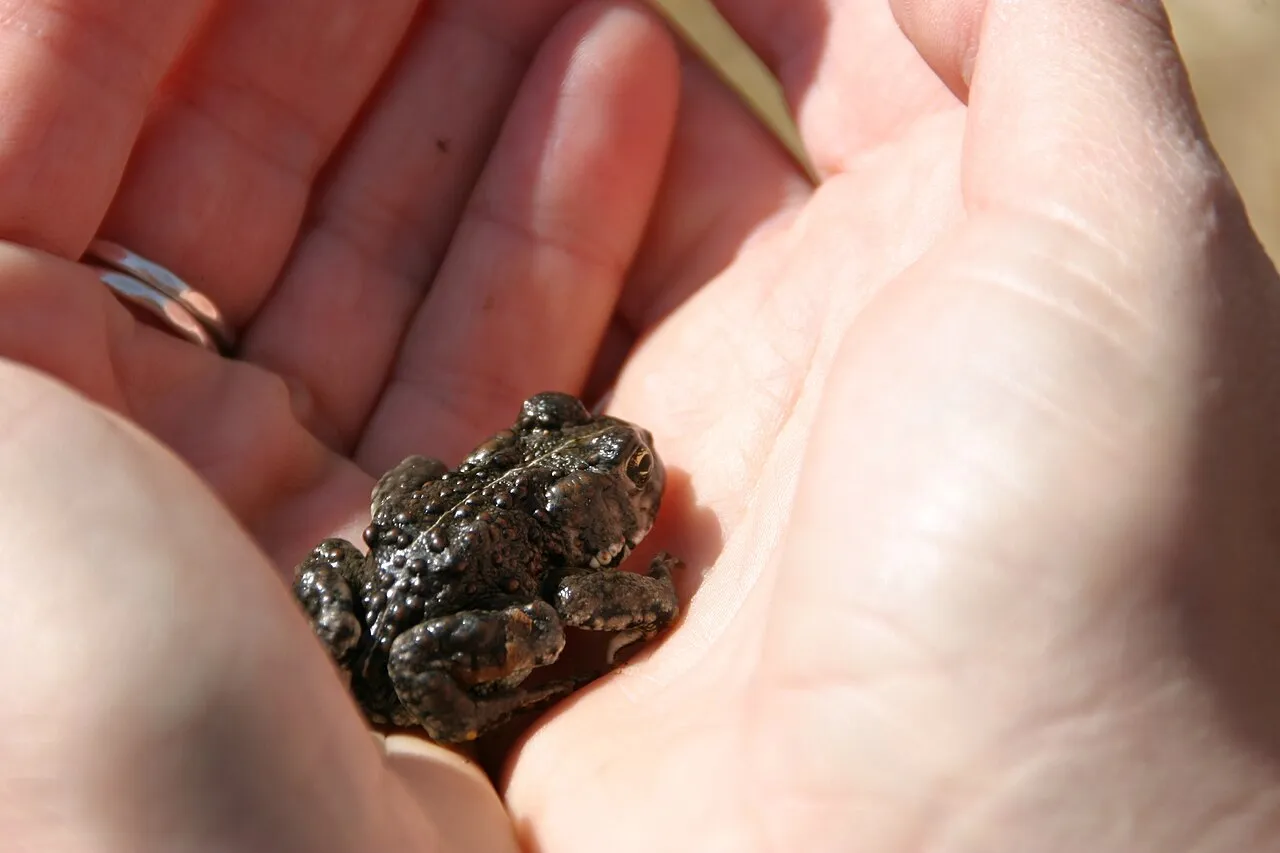
The Amargosa toad, Anaxyrus nelsoni, is one of North America’s most narrowly distributed toads, endemic to a roughly 10-mile (16 km) stretch of the Amargosa River and its tributary springs in the Oasis Valley, between Springdale and Beatty in Nye County, Nevada, with part of its range extending into neighboring Esmeralda County. The species name honours the American naturalist and ethnologist Edward William Nelson; it was formerly treated as a subspecies of the western toad, Anaxyrus boreas, before being recognised as a distinct species.
Identification
The Amargosa toad is a medium-sized, short-limbed toad with a buff to olive coloured body. Its smooth skin carries many spots flecked with lighter-coloured warts, and a lighter stripe runs down the middle of the back, flanked by darker stripes. The species shows sexual dimorphism: males tend to be smaller than females. Vocally the toad is quiet, limited mostly to small chirps, or “release calls” given when handled, rather than an advertisement call carrying far across open water.
Habitat and range
The Amargosa toad’s entire known range sits where the Great Basin meets the Mojave Desert, confined to riparian desert habitat along the Amargosa River and its springs, where riverside growth of cottonwoods, sedges and cattails lines the water. It breeds in tributary and isolated springs, ponds and artificial impoundments that carry little aquatic vegetation. Away from the water’s edge, toads shelter by day in burrows, under dense vegetation, and in piles of debris.
Behaviour and breeding
Foraging happens almost entirely after dark: adult Amargosa toads do the majority of their foraging at night, catching prey with a sticky tongue and taking spiders, snails, insects, and even scorpions among other invertebrates.
Breeding takes place in the springs themselves, and females lay up to 6,000 eggs in long strands, placed along the edges of slow streams, among vegetation, and in shallow water. Development speed tracks water temperature, since eggs develop and hatch into tadpoles faster in warmer water, and the tadpoles need open water to complete their growth.
Conservation
The IUCN category for the Amargosa toad is given in the facts box above. Wikipedia reports the population as declining, under pressure from variable rainfall, off-road vehicle use, livestock trampling, dredging operations and commercial development, compounded by non-native predators: catfish, crayfish and bullfrogs all prey on the toad or its tadpoles. In Nevada the species carries state-level protection, listed as a “Priority Species” and “State Protected” amphibian, and local conservation work draws on local citizens, ranchers, and farmers working alongside wildlife agencies, in part to keep the species off a federal Endangered Species Act listing. NDOW names water diversion and the degradation of wetland habitat as a core ongoing threat.
Similar species
The Amargosa toad’s closest relative is the western toad, Anaxyrus boreas, of which it was once considered a subspecies before taxonomists split it out as distinct; the western toad ranges far more broadly across the western United States and Canada and overlaps only at the margins of the Amargosa toad’s tiny Oasis Valley range. Within Nevada, range alone is usually the simplest check: no other toad occupies the short stretch of the Amargosa River and its springs that this species calls home.