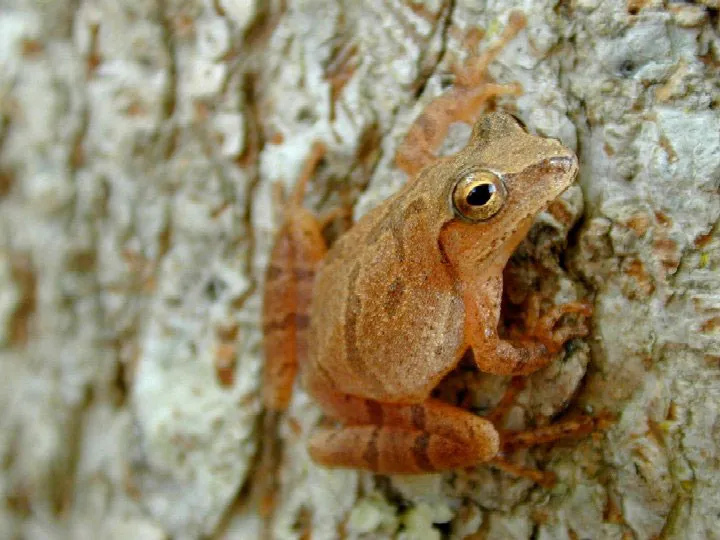
Pseudacris crucifer, the spring peeper, is a small chorus frog found across eastern North America, from southeastern Manitoba east to the Atlantic coast and south to eastern Texas and mainland Florida, with an introduced population in Cuba. It is best known for the piercing, high-pitched call of its spring choruses, produced by a frog that measures only about 20-25 mm in body length and weighs 3-5 g.
Identification
The spring peeper is a tan, grey or brown frog marked with a dark, X-shaped cross on its back, the feature that gives the species its scientific name; the marking is sometimes indistinct. Dark lines also run between the eyes and across the hind limbs as a crossband. Like other treefrogs it carries large, sticky toe pads for climbing, and shows a pale yellow wash on the inside of the thighs. Males and females can be told apart: females are lighter-coloured and bulkier in the abdomen, while males are slightly smaller, with dark throats marking the vocal sac. Adult body length ranges from under 25 mm up to about 38 mm, with males between 18 and 30 mm and females between 20 and 35 mm.
Habitat and range
The species favours marshy woods and non-wooded lowlands near ponds and swamps, living mainly in forests and regenerating woodland near ephemeral or semi-permanent wetlands outside the breeding season. It breeds in freshwater ponds or pools, especially fishless and temporary ones that dry up after the tadpoles complete metamorphosis, but also uses intermediate ponds, ponds that hold water year-round, swamps and disturbed habitats; in more permanent ponds it holds its own against competitors thanks to greater resistance to predation. Breeding aggregations can be large, frequently numbering several hundred individuals.
Behaviour and breeding
Males call from the edges of the water bodies where they breed, hidden near the bases of shrubs or grasses, producing a high, piping note likened to a young chicken, only much louder; a single male may repeat the call up to 13,500 times in one night, typically 15 to 25 times a minute, and a chorus of many males can sound like sleigh bells. Calling activity tracks temperature closely: about 63% of the variance in calling is explained by temperature, and peepers are among the first frogs heard each year, calling soon after the ice melts off the wetlands. Females choose mates by the speed and volume of their calls, and tend to prefer older, larger males with faster, louder calls; some smaller males instead behave as satellites, staying silent near a loud caller and attempting to intercept arriving females. Breeding timing varies with latitude, running from October to March in the south and from March to June further north, once warm rains begin. A female lays her eggs singly or in small groups of two or three, hidden under vegetation or debris at the base of the water, with a typical clutch of around 900 eggs and as many as 1,000 in some cases. The tadpoles remain in the water for two to three months before transforming into frogs, grazing as suspension feeders on algae and other organic and inorganic matter; adults are nocturnal insectivores, hunting beetles, ants, flies and spiders in low vegetation rather than climbing high into trees. In the north, overwintering frogs shelter under logs or behind loose bark and tolerate freezing: the liver floods the bloodstream with a glucose cryoprotectant, raising tissue glucose by as much as 10 to 100 times normal levels and letting the frog survive its body fluids freezing to as low as -8°C. A spring peeper typically lives about three years in the wild and reaches sexual maturity around its third spring, at roughly two years old.
Conservation
The IUCN category for the spring peeper is given in the facts box above. The species is described as common and widespread across the eastern regions of its range, and NatureServe rates it secure, though it is listed as locally threatened in both Iowa and Kansas. The main pressures on populations are loss of wetlands, climate change, herbicide exposure, chytrid fungus and road salt contamination of breeding ponds.
Similar species
Two forms have traditionally been recognised: a northern subspecies, Pseudacris crucifer crucifer, found across the eastern United States and eastern Canada, and a southern subspecies, Pseudacris crucifer bartramiana, marked by a strong dark patch on the belly; however, genetic and behavioural analysis suggests this split does not reflect true taxonomic divisions. Within its range, the spring peeper’s small size, toe pads and dorsal cross mark, combined with its distinctive high piping call, make it hard to confuse with other chorus frogs once heard.