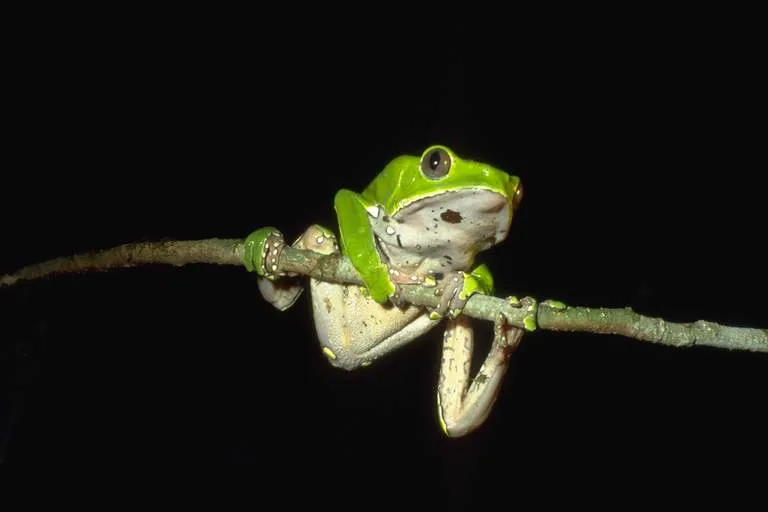
The giant leaf frog, Phyllomedusa bicolor, is a large tree frog of the Amazon basin, first described by Pieter Boddaert in 1772 and also known as the bicolor tree-frog or giant monkey frog. It is found across the Amazon basin of Brazil, Colombia (Amazonas), Bolivia and Peru, extending into the Guianan region of Venezuela and the Guianas, and into the Cerrado of Maranhão, Brazil. The species is best known outside herpetology for a skin secretion that Indigenous Amazonian peoples have long used in a purging ritual now called kambo.
Identification
The frog is large for the genus: males measure 91–103 mm and females 111–119 mm in snout-vent length, with females noticeably the bigger sex. The back is lime green while the underside ranges from white to cream, giving the species both its bicolor name and its common name. Sparse white spots edged in dark borders mark the lower lips, chest and front legs, and are denser across the flanks and hind legs. The fingers are transparent brown and carry large green adhesive discs suited to gripping smooth leaves and branches, and a prominent gland runs behind each eye over the tympanum, with a dark grey iris.
Habitat and range
Like other leaf frogs, P. bicolor is nocturnal and arboreal, living in the trees of tropical humid Amazon rainforest and gallery forest, calling from the canopy rather than from the ground. Its range, spanning some of the largest intact forest in the Amazon basin, runs from lowland Brazil, Peru, Bolivia and Colombian Amazonas into the Guianas and Venezuela’s Guianan region, with an outlying population in the drier Cerrado of Maranhão — a spread that underlies the favourable conservation status below.
Behaviour and breeding
Breeding activity peaks in the rainy season, when males call from trees to attract mates and compete aggressively for access to females, using their heads to dislodge rival males and combining vocal displays with hind-leg pushing to defend a mating position. The extra calling that breeding season brings has a cost: it also draws in predators, against which the frog’s skin peptides serve as a chemical defence. Mating itself follows the amplexus pattern typical of frogs, with the male mounting the female to fertilise the eggs as she lays them. Pairs build a nest by folding a leaf roughly 70 cm above a forest pool and depositing their eggs inside it in a gelatinous mass. The eggs hatch within about 14 days, after which the tadpoles drop into the water below to continue developing. The exposed leaf nests are heavily preyed upon: up to 61% of egg clutches are lost to predators including rove beetles, phorid flies, possibly tufted capuchin monkeys, and banded cat-eyed snakes.
The species’ skin secretion, traditionally called “vacina do sapo” (frog vaccine) and known today as kambo or sapo, contains a mix of opioid peptides including deltorphin, deltorphin I, deltorphin II and dermorphin. Indigenous Amazonian groups have long applied it in a cleansing ritual that induces intense vomiting, a practice that has since spread well beyond its original context.
Conservation
The facts box carries the species’ current IUCN Red List category, Least Concern, reflecting the wide range it holds across the Amazon basin and its large overall population.
Similar species
The related Phyllomedusa sauvagii, the waxy monkey leaf frog, shares the same genus, the same waterproofing skin secretions and a broadly similar leaf-nesting breeding strategy, but occupies the drier Gran Chaco rather than the humid Amazon basin, and is smaller and paler than the giant leaf frog. Within P. bicolor’s own Amazonian range, the size difference between the sexes and the combination of lime-green back, white-spotted flanks and large adhesive finger discs distinguish it from other leaf frogs that share its forests.