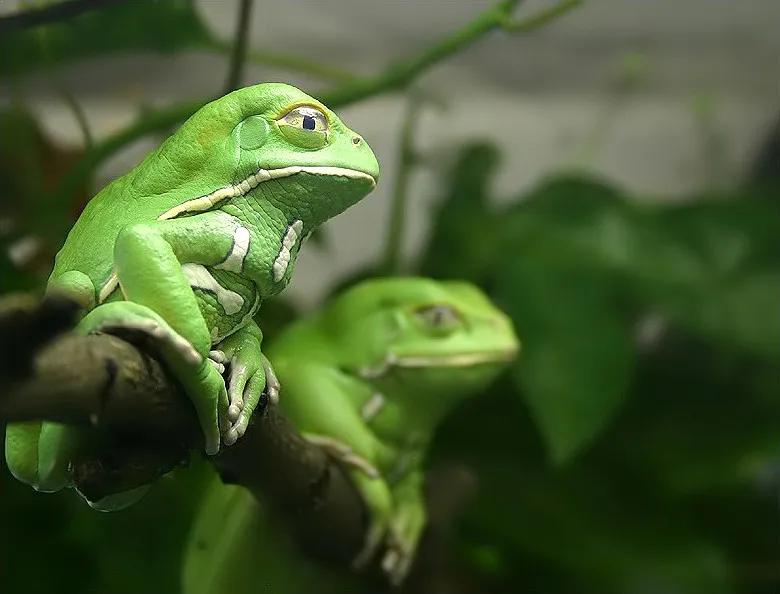
The waxy monkey leaf frog, Phyllomedusa sauvagii, is a South American tree frog best known for a trick most amphibians cannot pull off: it keeps its skin dry. It is native to South America, occurring in the Gran Chaco region across Paraguay, Argentina, Bolivia and Brazil, a hot, seasonally dry lowland forest and scrub biome where staying hydrated is a constant challenge for an amphibian. The species was formally described by the Belgian-British zoologist George Albert Boulenger in 1882.
Identification
Adults are green above with brown patterning, and the facts box carries the species’ current family and genus placement. The frog’s most distinctive feature is not colour but chemistry: cutaneous glands densely packed across the entire body surface secrete a waxy lipid coating that seals moisture in. That coating is so effective that evaporative water loss is only 5–10% of that of other frogs, a rate comparable to a lizard’s. Handled frogs can be seen wiping their legs over their body, spreading the secretion evenly, in what is thought to be a grooming behaviour that maintains the seal. Newly hatched young are already sizeable for embryos, exceeding 20 mm in length at hatching.
Habitat and range
The species is arboreal, living in the vegetation of the Gran Chaco, spending daylight hours resting on a perch, nocturnal and inactive by day. Its waterproof skin is what makes this exposed, sun-baked habitat survivable: rather than sheltering in damp leaf litter like most frogs, it can perch in the open canopy without drying out, and it can tolerate body temperatures ranging from about 20 to 40 °C, an upper limit higher than most frogs can withstand. That wide tolerance reduces how much water the frog would otherwise need to spend on temperature regulation. In prolonged dry conditions it may enter a state of torpor that further reduces water loss through breathing.
Behaviour and breeding
Breeding is tied to rainfall: the species breeds during the rainy season, which typically runs from October to March, mating only during or shortly after heavy rain rather than continuously through the season. Males call from shrubs or trees near water to attract females, and pairs lay their eggs together on a leaf overhanging standing water, cooperatively wrapping the leaf around the clutch, with the male fertilising the eggs as the female lays them. Because the eggs are highly permeable to water and would otherwise dry out on an exposed leaf, the female surrounds them with empty gelatinous capsules that supply extra fluid to the developing embryos and help prevent desiccation. Development inside the leaf-bound clutch is quick: embryos hatch spontaneously after six to nine days and drop directly into the water below, emerging as tadpoles already equipped with large external gills, a keratinised oral disc and a tail making up about two-thirds of their body length. Its skin secretions do double duty as chemical defence, containing a range of pharmacologically active peptides, including the opioid peptide dermorphin, a compound that has itself become a subject of pharmacological research.
Conservation
The facts box carries the species’ current IUCN Red List category, Least Concern, reflecting its wide distribution across the Gran Chaco region it shares with Paraguay, Argentina, Bolivia and Brazil.
Similar species
Several other tree frogs in the genus Phyllomedusa share the same green-and-brown colouring and perching habit, and many produce similar waxy skin secretions as an adaptation to dry, open habitats. One close congener, Phyllomedusa azurea, occurs alongside it and has been studied for comparable breeding biology. Within the Gran Chaco, P. sauvagii’s combination of a strongly waterproofed skin, leaf-laid clutch wrapped in protective empty capsules, and tolerance of a wide temperature range distinguishes it from frogs that rely on damp shelter instead of a sealed skin to survive the dry season.