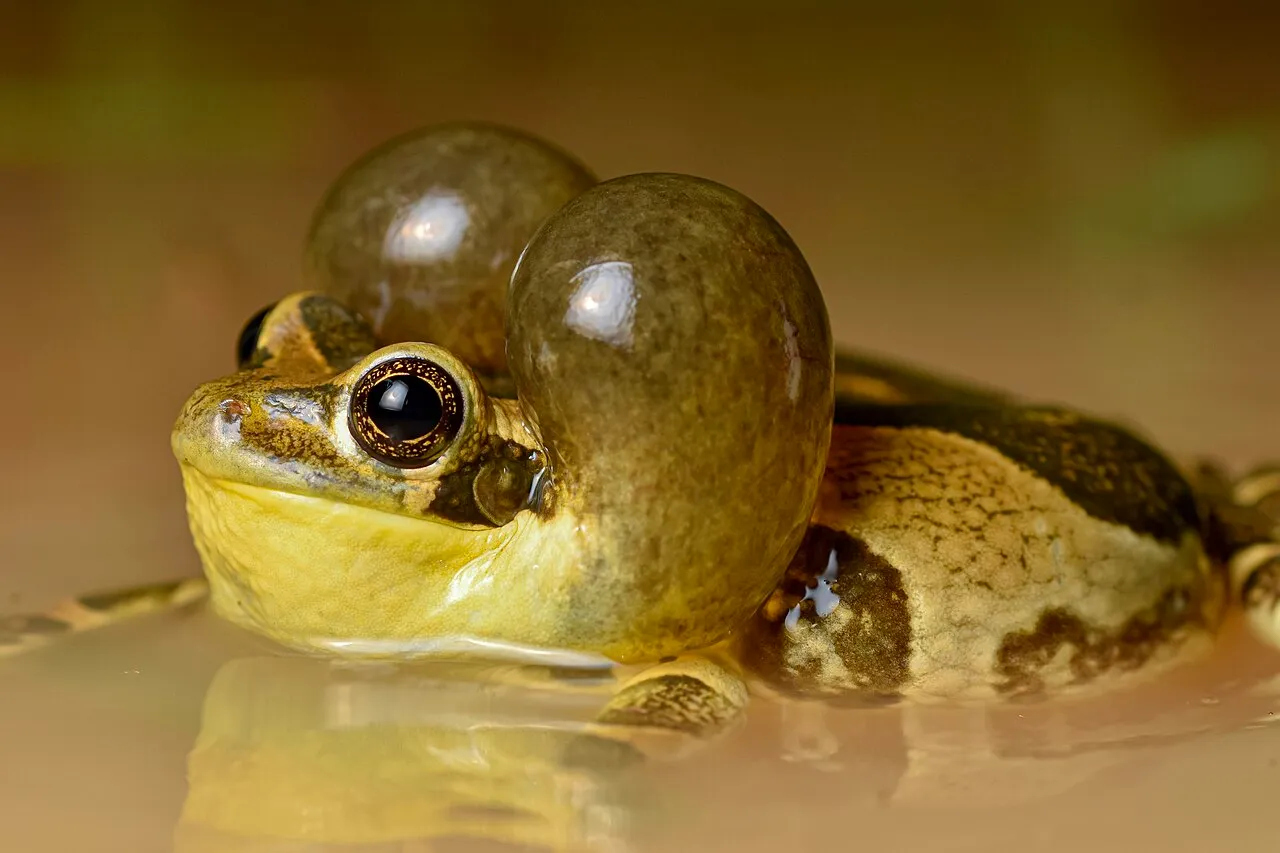
The veined tree frog, Trachycephalus typhonius, is a hylid frog found across Central and South America, with a range spanning the genus Trachycephalus — formerly placed in Phrynohyas — from Mexico through Central America into South America, including Brazil and Venezuela. It is one of the more adaptable members of its family, turning up in habitats from untouched forest to city gardens.
Identification
Trachycephalus typhonius belongs to the family Hylidae and the genus Trachycephalus, a group of tree frogs known for pale, often marbled skin and toxic defensive secretions. Its common name, veined tree frog, refers to the vein-like pattern often visible across its skin. Like its relatives, it secretes a substance from its skin that causes extreme irritation and pain on contact with mucous membranes, a defence that deters many potential predators.
Habitat and range
Few hylids match its tolerance for different environments: the species occupies subtropical and tropical dry and moist lowland forest, moist shrubland and dry lowland grassland, rivers, intermittent rivers, freshwater lakes and marshes, arable land, pastureland, plantations, rural gardens, urban areas, degraded former forest, water storage areas and ponds. That range of habitats, combined with a distribution running from Mexico to Brazil and Venezuela, explains why the species is recorded across so much of Central and South America rather than being confined to a single forest type.
Behaviour and breeding
The veined tree frog is nocturnal and arboreal, typically found on tree branches and in dense vegetation, resting by day and becoming active after dark. Its skin toxin is strong enough to cause real discomfort to anything that mouths or handles it, yet the species is still recorded as prey for mantises, a reminder that even well-defended frogs have predators willing to take the risk. Beyond these points, open-access sources document little further detail on its breeding biology, and no unsourced detail fills that gap here.
Conservation
The facts box carries the species’ current IUCN Red List category, Least Concern, consistent with its broad range and tolerance for both natural and human-altered habitats.
Similar species
Trachycephalus typhonius shares its genus with Trachycephalus resinifictrix, the Amazon milk frog, which overlaps with it across parts of the Amazon basin but is distinguished by its larger size, grey-and-brown banded pattern and blue-tinted blood visible at the mouth and toe pads. Its own vein-like skin pattern, nocturnal arboreal habits and wide habitat tolerance together help separate T. typhonius from other tree frogs across its very broad range.