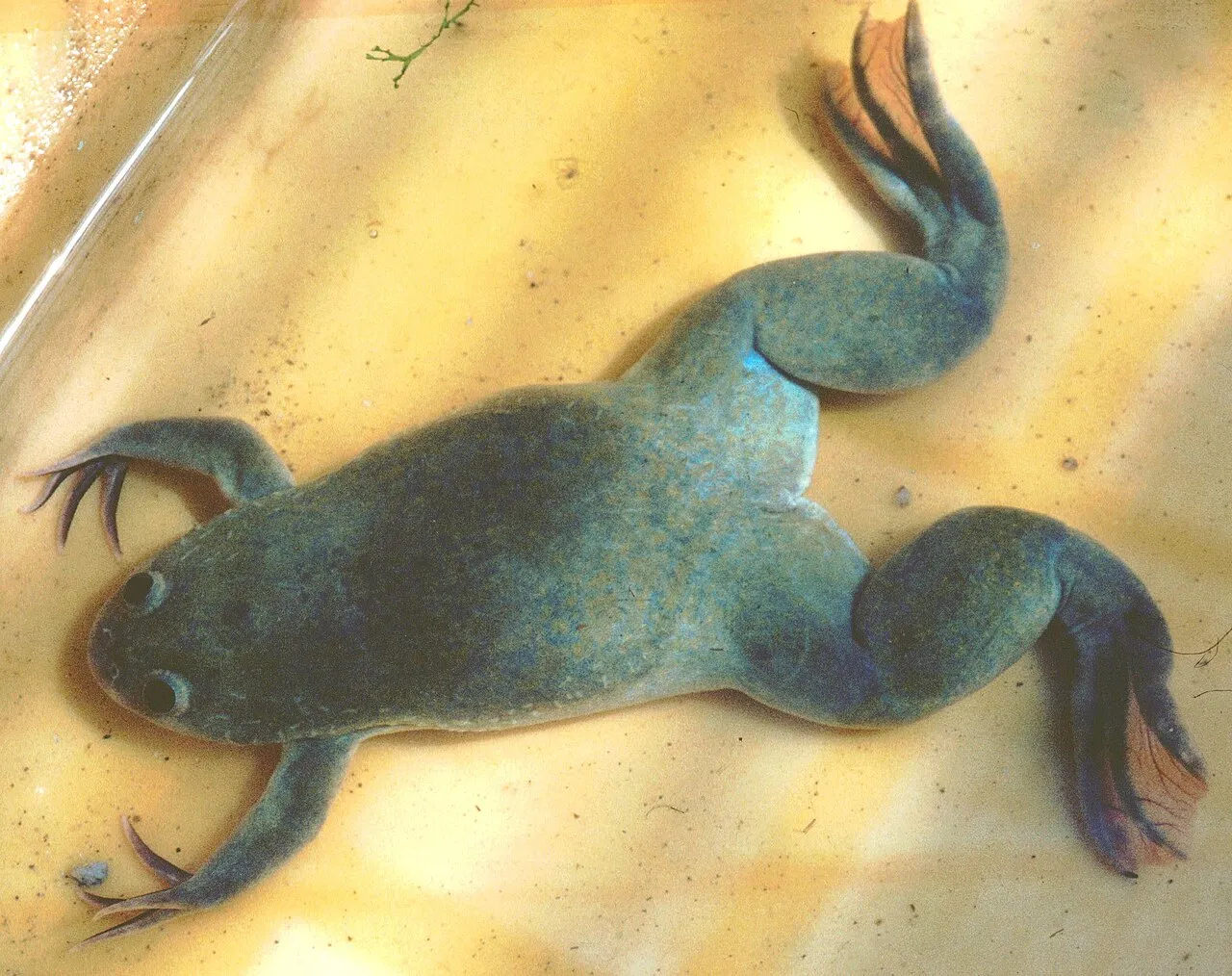
Xenopus laevis, the African clawed frog, is a fully aquatic member of the family Pipidae, built for a life almost entirely spent underwater. It is native to sub-Saharan Africa but has been carried around the world by the aquarium and laboratory trade, and now holds wild footholds on four continents.
Identification
The species has a distinctive flattened body and a wedge-shaped head smaller than its torso, with small eyes set on top of the head and no visible eardrum or eyelids. Unlike most frogs it lacks a tongue, and it detects prey and vibrations partly through lateral lines running along its back, a sensory system otherwise typical of fish. The back is multicoloured, mottled olive-grey or brown, while the underside is creamy white with a yellow tinge. The species gets its common name from the three black claws on the innermost toes of each webbed hind foot, used to tear food apart and to scratch at predators; the front feet, by contrast, are small and unwebbed. The species is strongly sexually dimorphic: males are about 50-60 mm in body length and weigh around 60 g, while females are larger, about 100-120 mm and around 200 g. Males also lack the vocal sac most frogs use to call.
Habitat and range
The African clawed frog is native to sub-Saharan Africa, from Nigeria and Sudan south to South Africa. Decades of export for the aquarium trade and, in the mid-20th century, for pregnancy testing in laboratories have given it established feral populations well outside that native range, including in the United States (California among them), Chile, the United Kingdom’s South Wales, continental Europe and China. It is almost entirely aquatic, living in warm, stagnant or slow-moving water such as grassland ponds, lakes and streams in arid and semi-arid regions, often where the water carries little vegetation but heavy algae cover. It tolerates a wide range of water temperatures, roughly 15-27 degrees C, and a wide range of pH, and it rarely leaves the water except to migrate overland to a new pond, typically during rain, drought or overcrowding; feral frogs tracked in Wales have been recorded moving up to 2 km between sites during such overland journeys. When its pond dries up entirely, the frog can burrow into the mud and lie dormant for up to a year until water returns.
Behaviour and breeding
Powerful hind legs make the African clawed frog an adept swimmer capable of moving quickly in any direction underwater, even though it is barely able to hop on land. It hunts mainly at night, relying on its sense of smell and lateral-line detection of water movement rather than eyesight to find food, then using its front feet to grab prey and shovel it into its mouth. It is an opportunistic carnivore and scavenger, taking living and dead prey including fish, tadpoles, crustaceans and other invertebrates, and it is markedly cannibalistic: stomach contents from feral populations regularly turn up large numbers of its own species’ larvae. The species sheds its skin every season and eats the shed skin afterwards. Reported lifespans vary by source but agree the species is long-lived for a frog, with wild individuals surviving roughly 15 years or more and captive frogs reported living 20 years and, by some accounts, as long as 25-30 years.
Breeding is opportunistic rather than tied to a single season: the species reaches sexual maturity at 10 to 12 months and can breed up to four times a year, with a peak in spring, and adults migrate toward new ponds during wet periods when conditions allow. Since males have no vocal sac, they call by rapidly contracting their internal laryngeal muscles to produce alternating long and short trills underwater; unusually, females answer with their own sounds, a fast rapping to signal acceptance of a mate or a slow ticking to signal rejection. Rather than the front-limb clasp typical of most frogs, mating pairs use pelvic (inguinal) amplexus, with the male gripping the female just in front of her hind legs. A female releases hundreds of sticky eggs over a span of three to four hours, attaching them to underwater plants as the male fertilises the egg mass. Tadpoles develop into froglets over roughly six to eight weeks, with the final loss of the tail during metamorphosis taking only four to five days.
Conservation
The IUCN category is shown in the facts box above. Within its native sub-Saharan African range the species remains common and adaptable, tolerant of a wide range of pond conditions. Outside that range it is a different story: the same hardiness that lets it survive drought and poor water quality has helped its introduced populations persist and spread in California, Chile, the United Kingdom, continental Europe and China, where it is generally treated as an invasive species that competes with and preys on native amphibians rather than one in need of protection.
Similar species
Within its native and introduced range, the African clawed frog is told apart from most other frogs by its flattened body, eyes set on top of the head, and the small black claws on its hind feet, none of which are typical of the true frogs and toads it shares ponds with. It is easily confused with other members of its own genus, such as the smaller, more slender African dwarf frog (Hymenochirus species) sometimes sold alongside it in the aquarium trade; the clawed hind feet and the larger, more robust body of Xenopus laevis are the clearest field marks separating the two. Because it almost never leaves the water and rarely calls above the surface, a fully aquatic frog seen swimming rather than sitting at a pond’s edge is far more likely to be this species than a typical native frog.