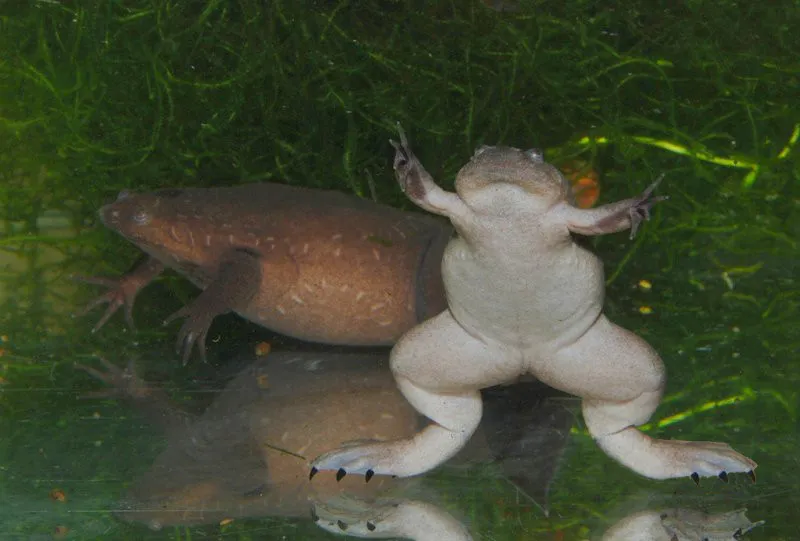
Xenopus tropicalis, the Western clawed frog, is a small, fully aquatic member of the family Pipidae found only in the West African rainforest belt. It shares its flattened body and clawed hind feet with its better-known relative Xenopus laevis, but it is considerably smaller and has become a favourite laboratory animal in its own right because of its simpler genetics.
Identification
The species has a somewhat flattened, medium-sized body with bulging eyes set high on the head, a short tentacle beneath each eye, and a row of unpigmented tubercles along its flanks that mark the position of its lateral line organ, the same fish-like sensory system found in other Xenopus species. Its limbs are short and plump, ending in fully webbed feet armed with horny claws, and its skin is finely granular rather than smooth. The back is pale to dark brown with small grey and black spots, while the underside is dull white or yellowish with dark mottling. Snout-vent length runs from 28 to 55 mm, with females larger than males, making it noticeably smaller than the African clawed frog. Unusually for the genus, it is the only diploid species of Xenopus, the rest being polyploid, which has made it a preferred subject for genome research.
Habitat and range
The Western clawed frog is native to the West African rainforest belt, from Senegal east to Cameroon and eastern Zaire, with confirmed populations in Benin, Burkina Faso, Cameroon, Ivory Coast, Equatorial Guinea, Gambia, Ghana, Guinea, Guinea-Bissau, Liberia, Nigeria, Senegal, Sierra Leone and Togo, and possibly Mali. It occupies subtropical and tropical moist lowland forest, moist savanna, slow-moving forest streams, rivers, swamps, freshwater lakes and marshes, and temporary rainy-season pools, and it tolerates man-made water bodies such as ponds, aquaculture ponds, canals and ditches, as well as rural gardens and degraded former forest.
Behaviour and breeding
Like other clawed frogs, this species migrates across the forest floor at night during the rainy season to reach new pools, but retreats to shallow streams in the dry season, sheltering under tree roots, flat stones or in holes in the riverbank when surface water elsewhere disappears. It feeds mainly on earthworms, insect larvae and tadpoles, hunting underwater in the same opportunistic manner as its relatives.
Breeding takes place in large pools with abundant vegetation, where females lay single eggs that either attach to plants or float free, rather than the egg masses typical of many frogs. Compared with the African clawed frog, this species has a generation time of under five months and produces a larger number of eggs per spawn, traits that have made it attractive for laboratory breeding. The tadpoles are distinctive: they have broad, jawless mouths with long tentacles on the upper lip, ventral tail fins broader than the dorsal fin, and an orange body with a transparent tail that can turn blackish in darker habitats, and they filter-feed on zooplankton rather than grazing or scavenging. Metamorphosis into a froglet occurs at around 5 cm in length. The species also has an unusual triple sex-chromosome system involving Y, W and Z chromosomes, which produces variable sex ratios between populations.
Conservation
The IUCN category is shown in the facts box above. The species’ wide distribution across the West African rainforest belt and its adaptability to a broad range of habitats, including heavily modified ones such as aquaculture ponds and ditches, support a stable population trend and a listing that reflects relatively low current risk rather than active recovery from decline.
Similar species
Xenopus tropicalis is most easily confused with Xenopus laevis, the African clawed frog, which shares the same flattened body, eyes set high on the head and clawed hind feet. The two are best told apart by size and range: this species rarely exceeds 55 mm in snout-vent length and is confined to the West African rainforest belt, while the African clawed frog is larger, more robust and native much further east and south across sub-Saharan Africa, with introduced populations on several continents. Within its own genus, this species is also the only diploid member, which is why it, not its larger relative, is the standard Xenopus species for genetic research.