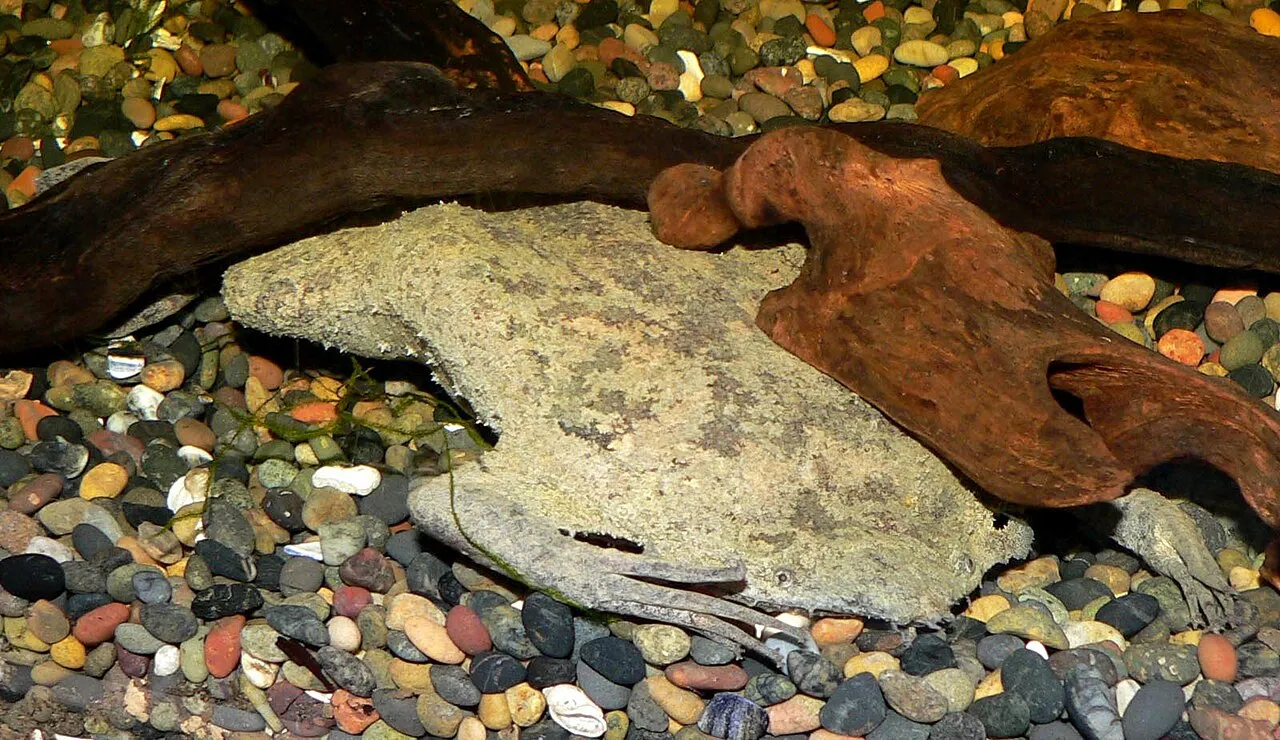
Pipa pipa, the Surinam toad, is a fully aquatic member of the family Pipidae, built for a life spent entirely underwater. It is native to the eastern region of tropical South America and Trinidad, where it hides in plain sight, resembling nothing so much as a dead leaf drifting along the riverbed.
Identification
The body is wide and greatly flattened, with a triangular-shaped head, an outline that reads as a mottled brown leaf rather than an animal. Adults reach a body length of about 105-171 mm in females and 106-154 mm in males, making them among the larger members of the family. The skin is generally light brown, with darker brown spots on the back, and the eyes are very small, black, lidless and beadlike, set into a head that also lacks a visible eardrum. The toad has no tongue at all; instead its forelimbs carry short, webless digits that each end in a star-shaped organ, a feature distinctive enough to give the species its other common name, the star-fingered toad, while large, flipper-like hind feet drive it through the water. A breeding female can be told apart by a ring-shaped swelling around the cloaca, visible only when she is ready to mate.
Habitat and range
The species lives in the eastern region of tropical South America and Trinidad, a range that, per a more detailed account, spans Brazil, Suriname, Bolivia, Colombia, Ecuador, French Guiana, Guyana and Venezuela east of the Andes, plus a small population on Trinidad. It is highly aquatic and does not voluntarily leave the water, occupying murky ponds and swamps as well as slow rivers and streams; a fuller description narrows that further to warm, acidic, murky and slow-moving to still waterways, including streams, backwaters, ponds and seasonal pools. The toad’s body is so specialised for water that on land it is helpless and can scarcely move.
Behaviour and breeding
Surinam toads are usually quiet and still, resting on each other without disturbance, surfacing to breathe only about every half hour. Lacking a tongue, they hunt by using the long, sensitive fingers of their forelimbs to search the pond bottom for food, feeding on worms, insects, crustaceans and small fish; a detailed diet study found the toads take mostly small invertebrates, with Cyclopoida copepods making up 67% of prey items, fly larvae 7.3% and true bugs 6.3%. Rather than snapping at food, they suck it in by rapidly expanding an enlarged throat cavity, creating a burst of negative pressure that draws prey into the mouth. Space in the water seems to be settled by sound rather than fighting: fighting probably occurs rarely in the wild, where the animals space themselves out peaceably using calls, and males advertise with a series of rapid clicking sounds made by snapping the hyoid bone in the throat, delivered at about four clicks per second in bursts of 10 to 20 seconds.
Breeding produces one of the more unusual reproductive strategies among frogs. A pair rises together from the pond floor in a looping swim: they arc up toward the surface, flip onto their backs at the top of the arc, and the female releases 3-10 eggs which the male fertilises and presses onto her back during amplexus, a grip that causes the cloaca and the skin of the female’s back to swell. The pair repeats this arc until around 100 eggs, each about 6.5 mm across, are laid and fertilised. Over the following day, the eggs sink into the skin of her back and are fully set into it by evening, where skin grows around each one, enclosing it in its own honeycomb-like pocket with a horny lid. The young then develop entirely inside these skin pockets, with no free-swimming tadpole stage: after 12-20 weeks, or by some accounts 4-5 months, they emerge as tailless, fully formed toadlets that already look like miniature adults, about 2-2.5 cm long. They typically leave at the time their mother next sheds her skin, after which she sheds the thin layer of skin used for the brood and can begin the cycle again. In captivity, individuals have been recorded living an average of 6.8 years.
Conservation
The IUCN category is shown in the facts box above. The main pressure on the species is indirect: habitat loss and fragmentation from agricultural expansion and deforestation across Amazonian river systems chip away at the murky, slow-moving waters the toad depends on, even though no population-specific threat has pushed it out of Least Concern.
Similar species
Within the same family, Xenopus laevis, the African clawed frog, shares the Surinam toad’s fully aquatic lifestyle, flattened body, tongueless mouth and lidless eyes, but the two are easy to separate: Xenopus laevis is native to Africa rather than South America, keeps webbed hind feet with claws instead of Pipa pipa’s star-shaped, unwebbed front fingers, and lays free eggs on underwater plants rather than brooding them under the skin of the female’s back. No other frog reproduces quite like Pipa pipa; the honeycomb of skin pockets across a gravid female’s back is, on its own, enough to identify the species on sight.