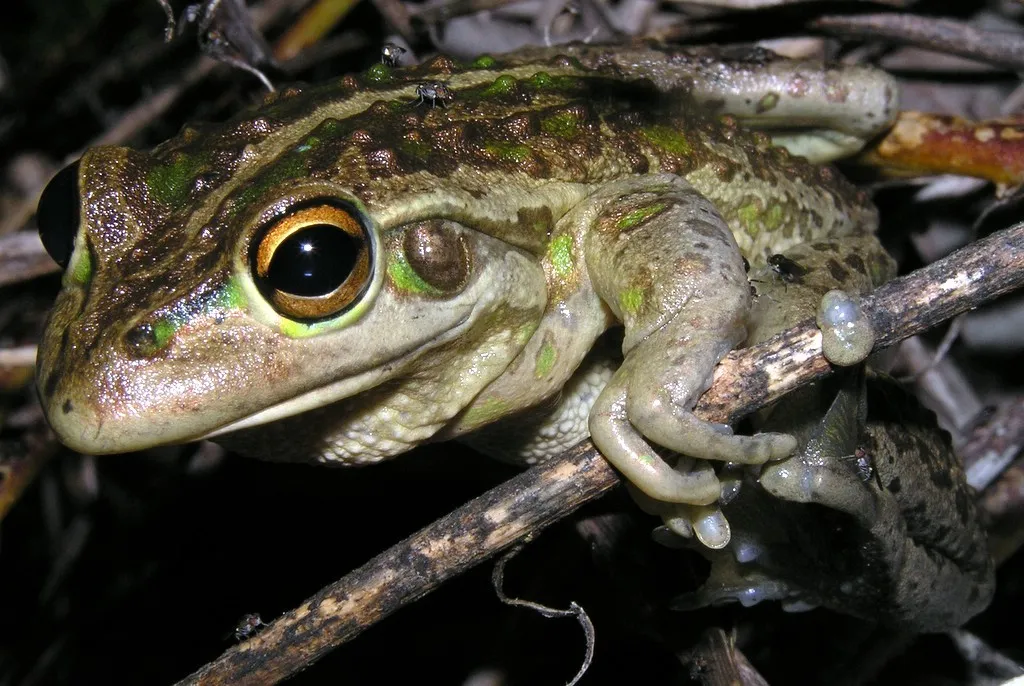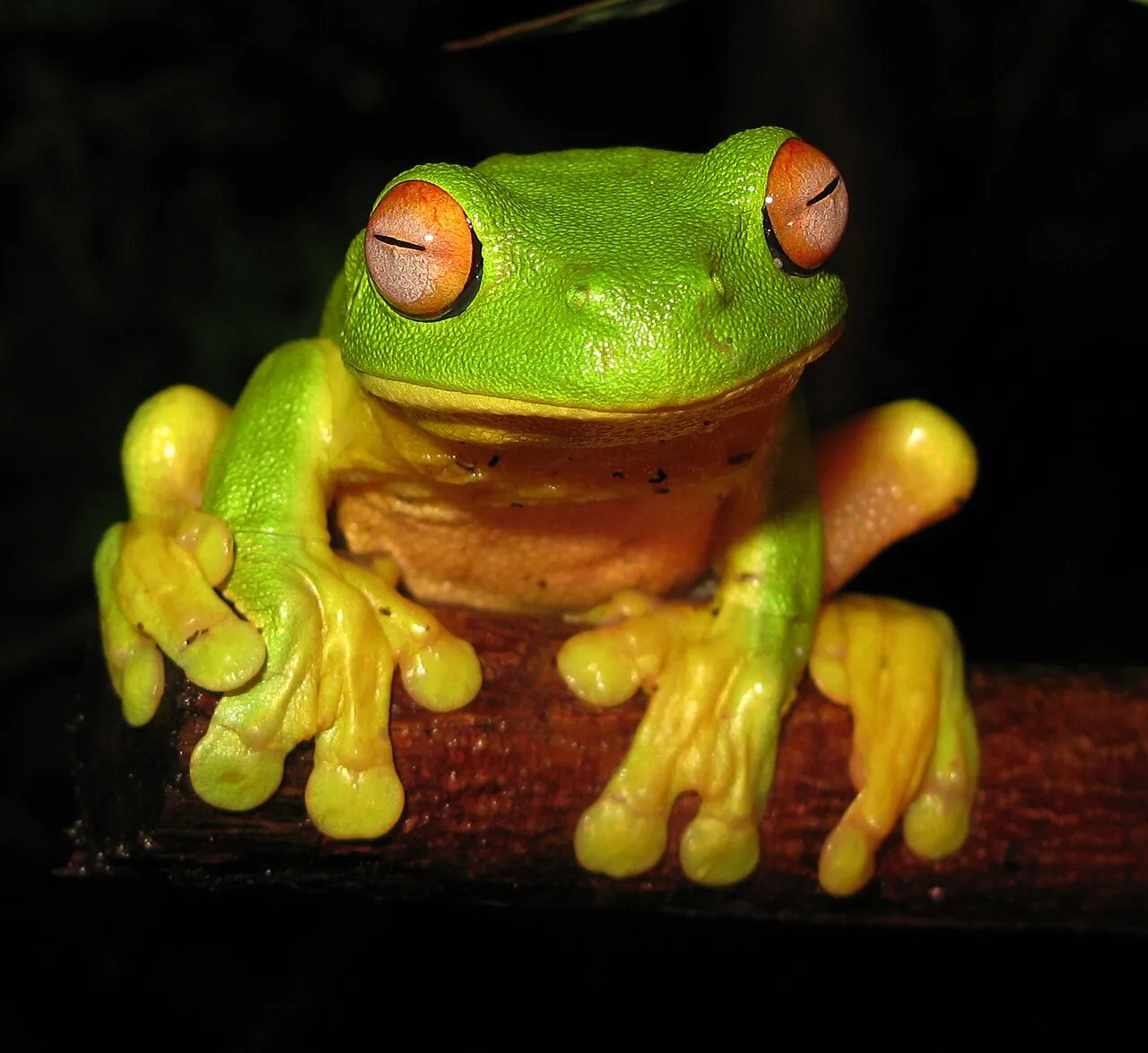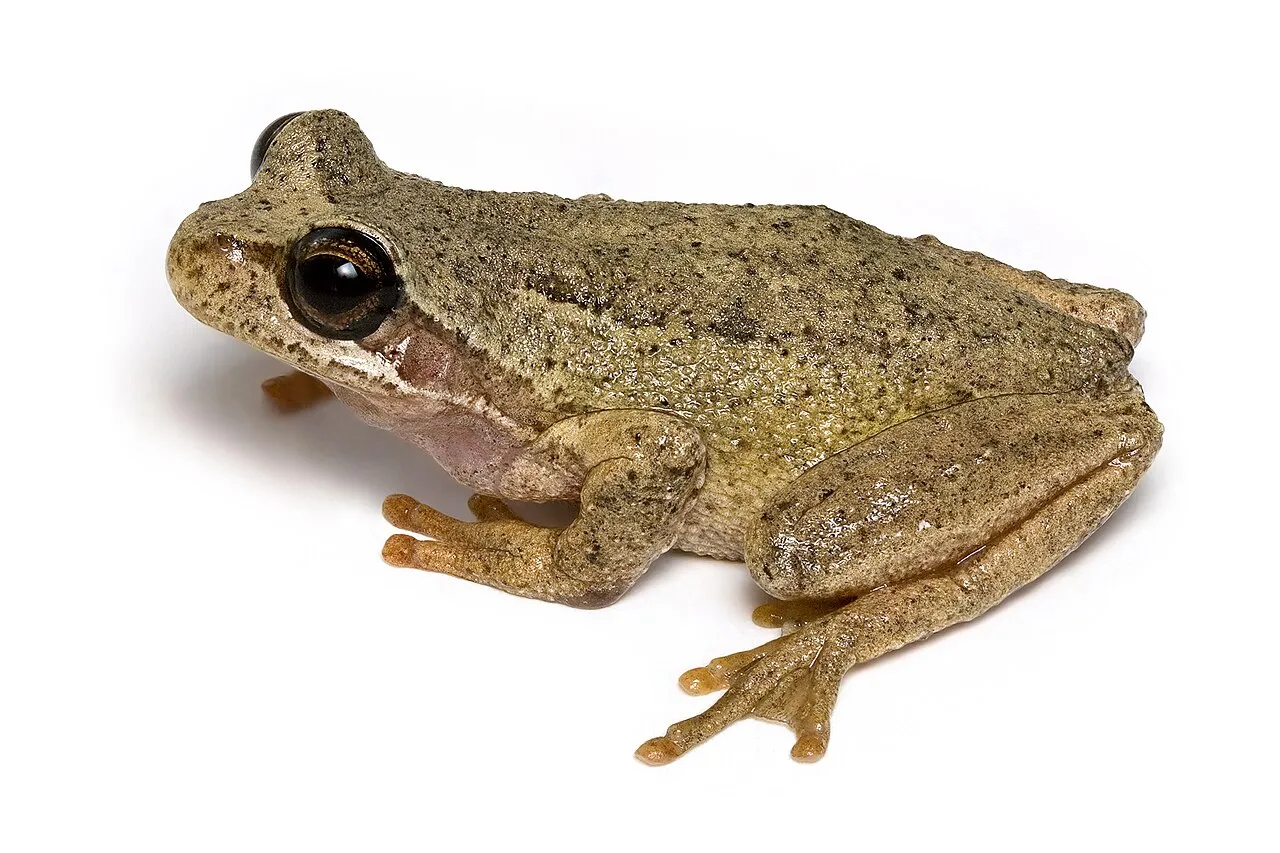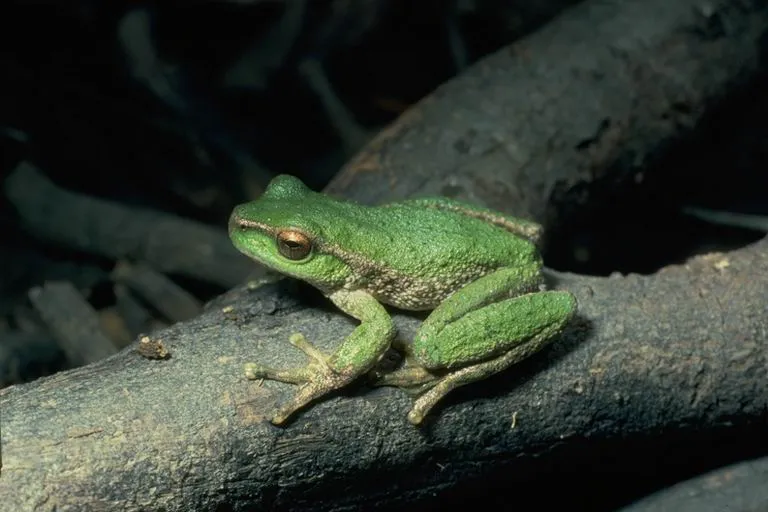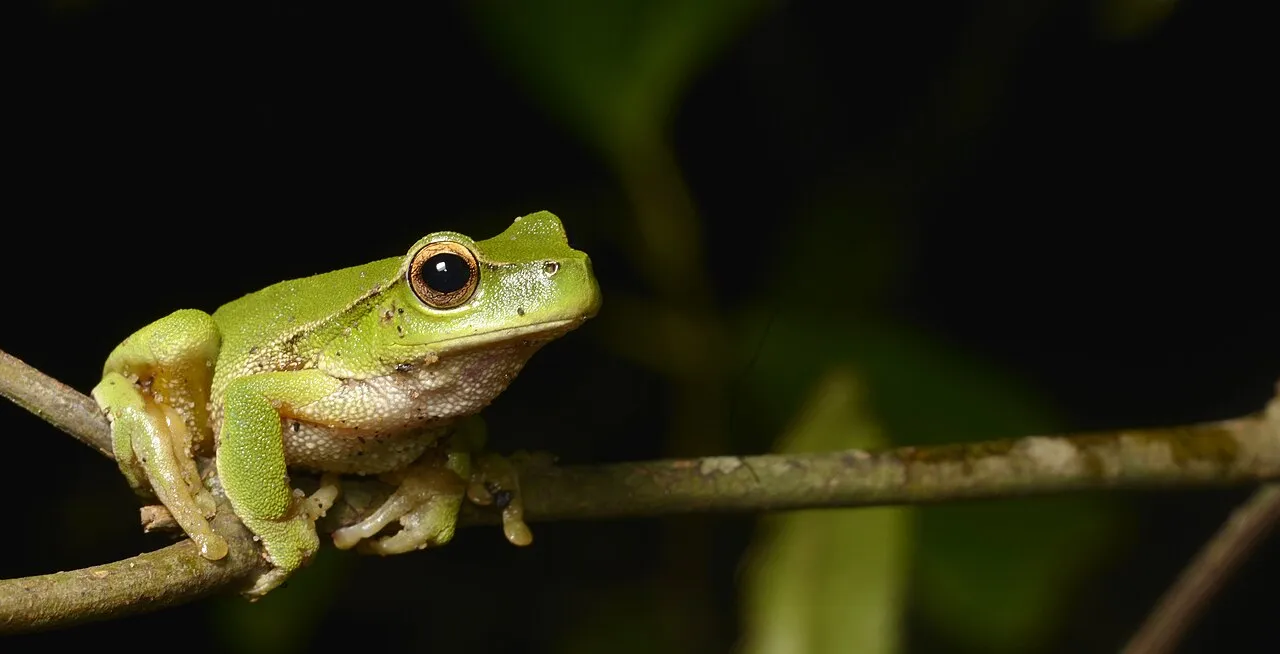
Litoria phyllochroa, the leaf green tree frog1, is called the Green Stream Frog by the Australian Museum, which places it along the coast and ranges between Bellingen and Sydney2 in New South Wales. The museum’s FrogID project lists it under the newer name Dryopsophus phyllochrous and notes that it was previously known as Litoria phyllochroa3.
It belongs to a species group called the Green Stream Frogs, whose members can be virtually indistinguishable in appearance4.
Identification
Adults reach up to 4 cm in body length. The back is bright green or olive-green2 and can turn very dark when the frog is inactive.
A thin gold or silver stripe runs from the tip of the snout to the eye, then behind the eye to just past the arm. A black stripe2 follows underneath it, beginning from the eye.
The belly is white, sometimes with small black flecks. The pupil is horizontal, and the iris is gold. The fingers are only slightly webbed2 and the toes nearly fully webbed, both with large discs.
The forelimbs, groin and thighs are dark red, while the toes are three-quarters webbed1 by that account.
Habitat and range
FrogID records the species near streams and creeks in heathland and sclerophyll forest3. Its breeding sites are creek and stream pools, and still ponds2.
FrogID gives the same range, the coast and ranges between Bellingen and Sydney Region3 in New South Wales. Mapping this group has been hard: past misidentifications left the Green Stream Frogs quite poorly known, and in a 2022 study the museum’s researchers judged almost a third of the non-FrogID records4 likely misidentifications.
The same 2022 study, built on call recordings sent in by the public, found that this species and the Southern Green Stream Frog, Litoria nudidigitus, share a large area just south of Sydney, from Stanwell Tops to Budderoo. The two had been thought geographically separated. In roughly its first three years, FrogID gathered 2,919 records of Green Stream Frogs, a rate of record accumulation 18 times faster4 than all other records of these frogs.
The northern limit is given differently elsewhere: one account runs the range from the Queensland/New South Wales border south to Sydney1.
Behaviour and breeding
Males give an “Erk..Ek..Ek..Derk” call1 from stream-side vegetation in spring, summer and autumn, especially on warm nights. FrogID marks September, October and November3 as the peak calling months.
Calls matter for this group. Males call to attract females and have evolved distinct calls that attract only their own species, so in 2022 the museum’s researchers wrote that they had started to use their ears, rather than eyes4 to identify the Green Stream Frogs.
The species breeds during spring to summer. Eggs are laid loosely in small groups2 and attached to vegetation on, or just below, the surface of the water.
Tadpoles can reach nearly 3.5 cm in total length and are dark or light gold-brown with gold specks. They often stay at the bottom of the water, avoid fast-flowing stream sections and take at least two months2 to develop into frogs.
The species is kept as a pet; in Australia it may be kept in captivity with the appropriate permit1.
Conservation
The IUCN rates the species least concern5 in its Red List version 2022.2. FrogID lists it as Unlisted under the federal EPBC Act3.
Its relatives are a mixed picture: within the Green Stream Frogs, some are doing OK while others have declined in number4, and the Peppered Tree Frog, Litoria piperata, is feared extinct.
Similar species
The Australian Museum names five look-alikes and says they are distinguished most easily by their different calls and distributions2.
The Southern Green Stream Frog, Litoria nudidigitus, has a tympanum that is indistinct, where the leaf green tree frog’s is distinct; it is the southernmost member of the group. The Barrington Tops Tree Frog, Litoria barringtonensis, carries black dots on its back, usually very distinct and many; where the two live together they can be identified by their distinct calls. Pearson’s Stream Frog, Litoria pearsoniana, has a head stripe that passes through the tympanum, not over it, and no shoulder or groin colouration1 where the leaf green tree frog shows red-brown on the shoulder and red in the groin; it is a northern member4 of the group. The Kroombit Tree Frog, Litoria kroombitensis, and the Peppered Tree Frog, Litoria piperata, are told apart by their different calls and distributions3.