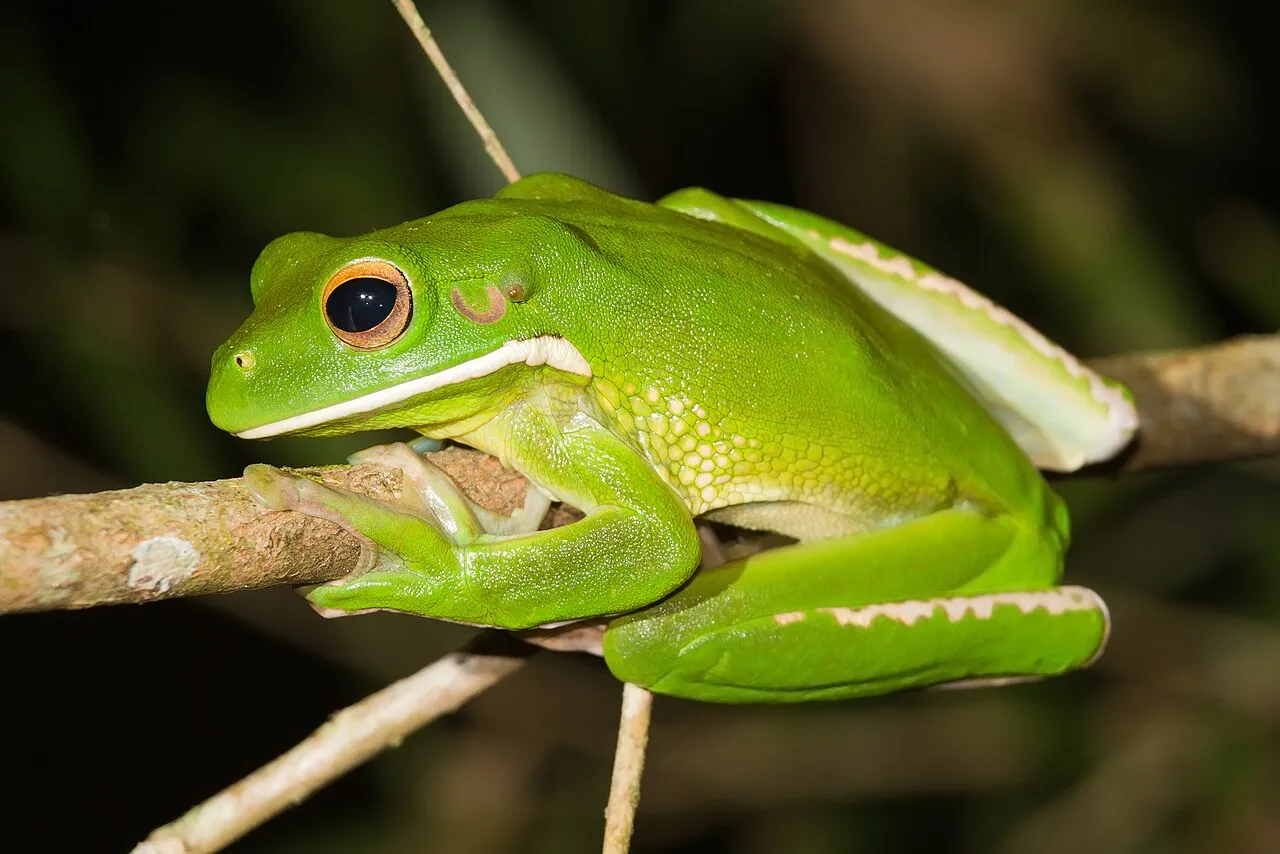
Litoria infrafrenata, the giant treefrog, is the world’s largest treefrog species, a pale-green climber that ranges from northeastern Australia across New Guinea and the western Pacific. Its common name understates the point: this is a frog built at a different scale from almost every other tree-dwelling species it shares its range with.
Identification
Adults reach 110-140 mm in length and weigh 30-60 g, with females growing notably larger than males and carrying correspondingly thicker skin. The back is usually bright green but shifts toward brown depending on temperature and background, while the underside is off-white. The frog’s name comes from a white stripe that runs along the lower lip and continues onto the shoulder; matching white stripes can appear along the trailing edges of the legs, sometimes turning pink on calling males in the breeding season. Large toe pads help it climb, and the toes are fully webbed while the hands are only partly webbed.
Habitat and range
The species occurs in Australia (coastal Cape York Peninsula and the wet tropics of northeastern Queensland), Indonesia, Papua New Guinea, the Bismarck and Admiralty Islands, the Solomon Islands and Timor-Leste, at altitudes below about 1,200 m. That is one of the broadest ranges of any treefrog in the region, stretching from the Australian mainland across the length of New Guinea and out into the western Pacific archipelagos. Within that range it lives in rainforests, cultivated land and vegetation around houses in coastal regions, a tolerance for gardens and plantations that has made it a familiar frog around human dwellings as well as a forest species.
Behaviour and breeding
The giant treefrog is mainly nocturnal and feeds on insects and other arthropods; it is large enough that at least one unusual case of it preying on a small bird, an olive-backed sunbird, has been recorded. Males call with a loud, barking call from vegetation near still water, and breeding follows rainfall in spring and summer, matching the habitat’s preference for sites near still water bodies. A distressed frog may respond with a cat-like “mew” or by discharging urine rather than fighting. In the wild individuals can live for more than ten years, a long lifespan for a frog of any size.
Conservation
The facts box gives the species’ IUCN category. A wide range spanning Australia, New Guinea and much of the western Pacific, together with tolerance for cultivated and residential habitat, works in the giant treefrog’s favour: it is not confined to intact rainforest and persists around gardens, plantations and houses as well as in forest interior. In Australia, keeping one in captivity requires an appropriate wildlife permit, which limits uncontrolled collection from the wild even where the species is common.
Similar species
The Australian green tree frog, Ranoidea caerulea, is the species most often confused with it, growing to about 11.5 cm and sharing the same pale to bright green colouring. That species’ own account distinguishes it from the giant treefrog by the giant treefrog’s white stripe along the lower jaw and shoulder, which the green tree frog lacks. Ranoidea caerulea’s toes are only about three-quarters webbed against L. infrafrenata’s fully webbed toes, and it rarely approaches the giant treefrog’s maximum size or weight.
Litoria chloris, the red-eyed green treefrog, is another similarly coloured species found further south along the Australian east coast, from around Sydney to Proserpine in mid-northern Queensland, a range that does not reach the giant treefrog’s Cape York and Wet Tropics distribution. It is much smaller, reaching about 65 mm, with an iris that runs gold at the centre to red at the edge, unlike the giant treefrog’s larger size and plain dark eye with white lip stripe.