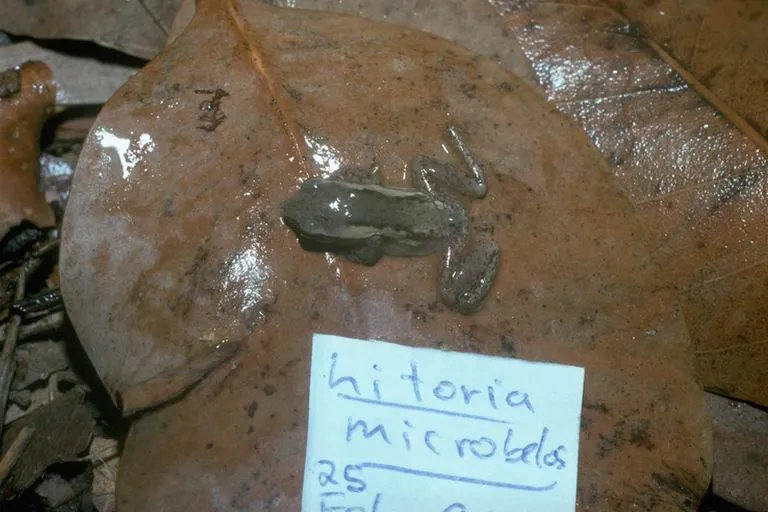
Litoria microbelos, known as the javelin frog, is a tiny treefrog endemic to Australia, occurring across parts of Western Australia, the Northern Territory and Queensland. It was first described by Harold Cogger in 1966 and placed in the family Pelodryadidae alongside the continent’s other tree frogs. What sets it apart from its relatives is its size: it is the smallest known tree frog in Australia, easily overlooked among the grasses and sedges of the lowland wetlands it inhabits. Despite that, it is not a rare animal: its range runs across three states and several different wetland types, and it has carried an unbroken taxonomic identity since Cogger’s original 1966 description.
Identification
The javelin frog is typically brown, with a light-brown dorsal surface, dark-brown lateral stripes and a light, almost white, ventral surface; a white stripe runs along the lip and the side of the body, a useful field mark against the darker flanks. Size is the clearest giveaway: males reach about 16 mm and females about 18 mm in length, making it only a little larger than some of the smallest frogs known worldwide — for comparison, Papua New Guinea’s Paedophryne amauensis, the smallest known vertebrate, averages about 7.7 mm in snout-to-vent length, less than half the javelin frog’s length, though the two belong to entirely different families on opposite sides of the Coral Sea. Among Australia’s own tree frogs the javelin frog stands at well under half the length of many familiar species, a difference large enough that size alone usually settles an identification once a ruler, or a steady eye, is brought to bear.
Habitat and range
The species lives in subtropical or tropical dry lowland grassland, swamps and intermittent freshwater marshes, habitats that flood seasonally and dry out between rains. Its range spans the northern half of the continent, taking in parts of Western Australia, the Northern Territory and Queensland rather than a single tight pocket, which likely reflects how widely this kind of lowland wetland grassland occurs across northern Australia. That spread across three states and a habitat type that is itself common and widespread, rather than confined to a single catchment or reserve, is also the main reason the species is not considered at risk.
Behaviour and breeding
At under 20 mm, the javelin frog is easy to miss in the grass and sedge cover of the marshes and swamps it occupies, and its small size makes it harder to study in the field than Australia’s larger, more conspicuous tree frogs; the pale lip and side stripe described above is often the easiest way to pick one out against the stems it clings to. Detailed breeding behaviour — call structure, breeding season and egg-laying habits — has not been documented in any source open to this guide; it is omitted here rather than guessed at. The intermittent freshwater marshes that make up part of its habitat suggest a life tied to seasonal rain, as in many northern Australian frogs, but that inference is not substituted here for a documented fact.
Conservation
The facts box gives the species’ IUCN category. The javelin frog is assessed as Least Concern, consistent with a range that spans three states and several different protected and unprotected wetland habitats rather than a single vulnerable site. Its reliance on lowland grassland, swamp and intermittent marsh — all habitat types that remain widespread across northern Australia — further reduces the chance that the species depends on any one threatened locality.
Similar species
Within the genus Litoria, the javelin frog is dramatically smaller than most of its relatives. Litoria ewingii, the brown tree frog of southeastern Australia, reaches up to about 45 mm — more than double the javelin frog’s length — and that is among the smaller members of the genus. Further up the scale, Litoria chloris, the red-eyed tree frog, reaches about 65 mm in body length, and Litoria moorei, the motorbike frog of south-west Western Australia, grows to about 75 mm — roughly four times the javelin frog’s length. That size gap, combined with the javelin frog’s restricted lowland grassland and swamp habitat across the north of the continent, makes it unlikely to be confused with any other treefrog once its size is appreciated in the field; where ranges overlap with larger relatives, the javelin frog’s pale lip stripe and near-white underside offer a second, more visible check.