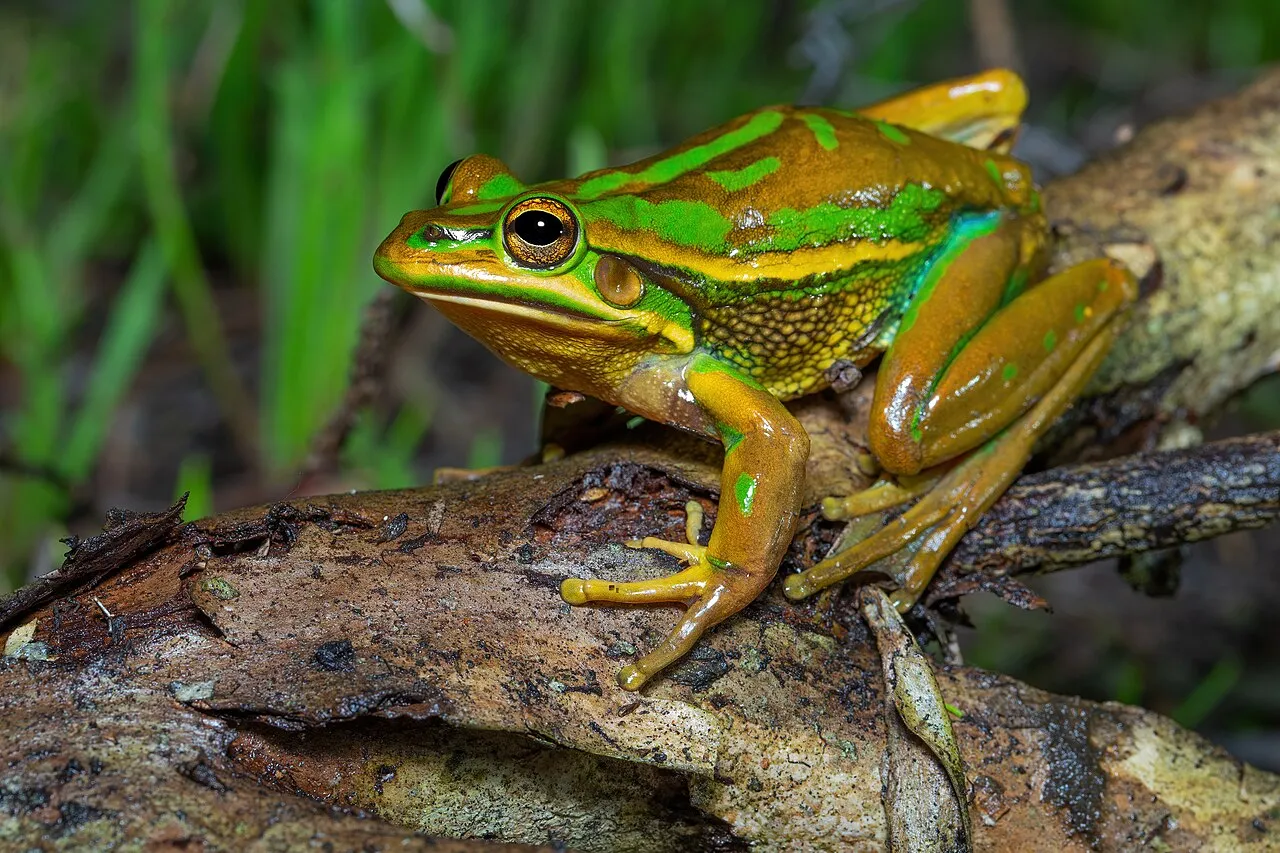
Litoria aurea, the green and golden bell frog, is one of Australia’s largest frogs and was once common across much of its range. It is native to southeastern Australia, historically ranging from Brunswick Heads in northern New South Wales south to East Gippsland in Victoria, a stretch of coast that gave it its common name from the metallic green and bronze-gold patches on its back.
Identification
It is a large species: adults typically measure 60-80 mm in body length, with a recorded range of about 45-110 mm, making it one of the biggest frogs native to Australia. Despite belonging to the tree frog family, it behaves more like a ground-dwelling frog in build and habit, a point that matters for telling it apart from smaller, more arboreal relatives (see Similar species below).
Habitat and range
The species has vanished from about 90% of its former range and now occurs mostly in coastal populations between Byron Bay, New South Wales, and East Gippsland, Victoria. It was also introduced to New Zealand in the 1860s, where it is now common in parts of the North Island, giving it a naturalised foothold well outside its native Australian range.
Within that range it inhabits freshwater ponds and wetlands, preferring water bodies that are short-lived, still, shallow, unshaded and unpolluted, and it tends to avoid waters holding predatory fish, whether native or introduced. Although classed as a tree frog, it spends most of its time near ground level and rarely climbs, keeping close to the open, sunlit ponds it depends on for breeding.
Conservation
The facts box gives the species’ IUCN category. Numbers are estimated to have declined by more than 30% over the past 10 years, and the frog is listed as endangered in New South Wales despite its wider distribution across two states and New Zealand. The main pressures are habitat loss, introduced predatory fish such as mosquitofish, and infection by chytrid fungus, the same combination of drained or fish-stocked wetlands and disease behind declines in many other Australian frogs.
Similar species
Its size and preference for still, unshaded, fish-free ponds set Litoria aurea apart from most other Australian tree frogs, which tend to be smaller and more strongly arboreal. Populations are now patchy and coastal rather than continuous, so a green and gold bell frog seen well inland or well away from the current coastal strongholds between Byron Bay and East Gippsland is worth double-checking against local records.