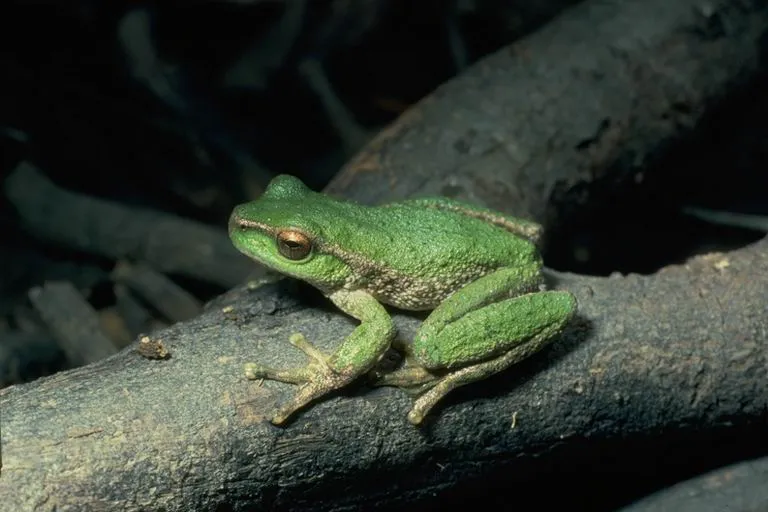
Litoria spenceri, the spotted tree frog, is a stream-dwelling frog of the Great Dividing Range in south-eastern Australia. It is confined to a roughly 250 km stretch of range between the Central Highlands of Victoria and Mount Kosciuszko in southern New South Wales, a narrow and fragmented foothold for a species now reduced to a handful of surviving populations. It was formerly found across a wider area of the Snowy Mountains in Victoria and New South Wales before contracting to its present range, a retreat driven largely by the spread of amphibian chytrid fungus through its stream habitat. The species belongs to the family Pelodryadidae and the genus Litoria, per its Wikidata taxonomic entry.
Identification
It is a modest-sized frog, reaching up to about 5 cm in body length, with females growing to about 60 mm snout-to-vent and males smaller, to about 45 mm. The back is brown or green with brown or olive-green mottling, with a gold or brown stripe running from the tip of the snout to past the arm and breaking into spots along the side; frogs with a brown back often also show a green stripe along the upper lip. The underside is white or yellow, with the backs of the thighs and the groin yellow or orange. The eye has a horizontal pupil and a gold iris. Fingers are slightly webbed while the toes are fully webbed, both tipped with large discs for gripping wet rock. Tadpoles are dark brown with many small gold spots, growing to a total length of up to 4 cm before they complete metamorphosis.
Habitat and range
Within its narrow range the species sticks to large, rocky, swift-flowing streams wider than about 3 m, with open canopy and limited riparian vegetation, typically near rocky streams in mountainous country with wet or dry forest nearby. Adults shelter and bask on rocks, logs and streamside shrubs, recorded up to 6 m above the stream and as far as 30 m from the stream bank, rather than staying pinned to the waterline. Records go back to 21 streams in Victoria and two in New South Wales, though the species no longer holds all of that former ground.
Behaviour and breeding
Males call during the southern spring and summer, from October through December, from the rocks and banks of their home streams. Eggs are laid as a single cluster attached to rock crevices under the water’s surface rather than scattered freely, anchoring the clutch against the current. The tadpoles that hatch often remain at the bottom of the stream and take around three months to develop into frogs, growing up through the warmer months before the stream cools again and reaching up to 4 cm in total length by the time they are ready to leave the water.
Conservation
The facts box gives the species’ IUCN category. Disease, particularly chytridiomycosis, predation by introduced fish, and the loss and degradation of streamside habitat have driven the decline, and the species now survives as several small populations in Victoria and one in New South Wales, with a captive breeding program in place to back up the wild stock. The frog’s decline has carried it through several listing changes: it is listed as Endangered under Australia’s Environment Protection and Biodiversity Conservation Act 1999, as Critically Endangered in New South Wales and as Threatened in Victoria, state and national categories that sit a notch below its current global IUCN status and reflect how recently the steepest losses have happened. A species once known from 21 Victorian and two New South Wales streams is now a conservation-dependent remnant of that range, kept going as much by captive-bred releases as by what is left in the wild.
Similar species
The closest look-alike is Litoria nudidigita, the leaf-green tree frog, which shares its rocky-stream habitat across part of the same range. L. spenceri is told apart by rougher, more granular skin and by the side colouring that breaks into spots rather than running as a continuous band on L. nudidigita. The gold iris and the yellow or orange flash on the back of the thighs and groin are useful field marks to check alongside skin texture where the two species overlap. Because both frogs favour the same large, rocky streams described above, a close look at these details is usually more reliable than habitat alone for telling the two apart.