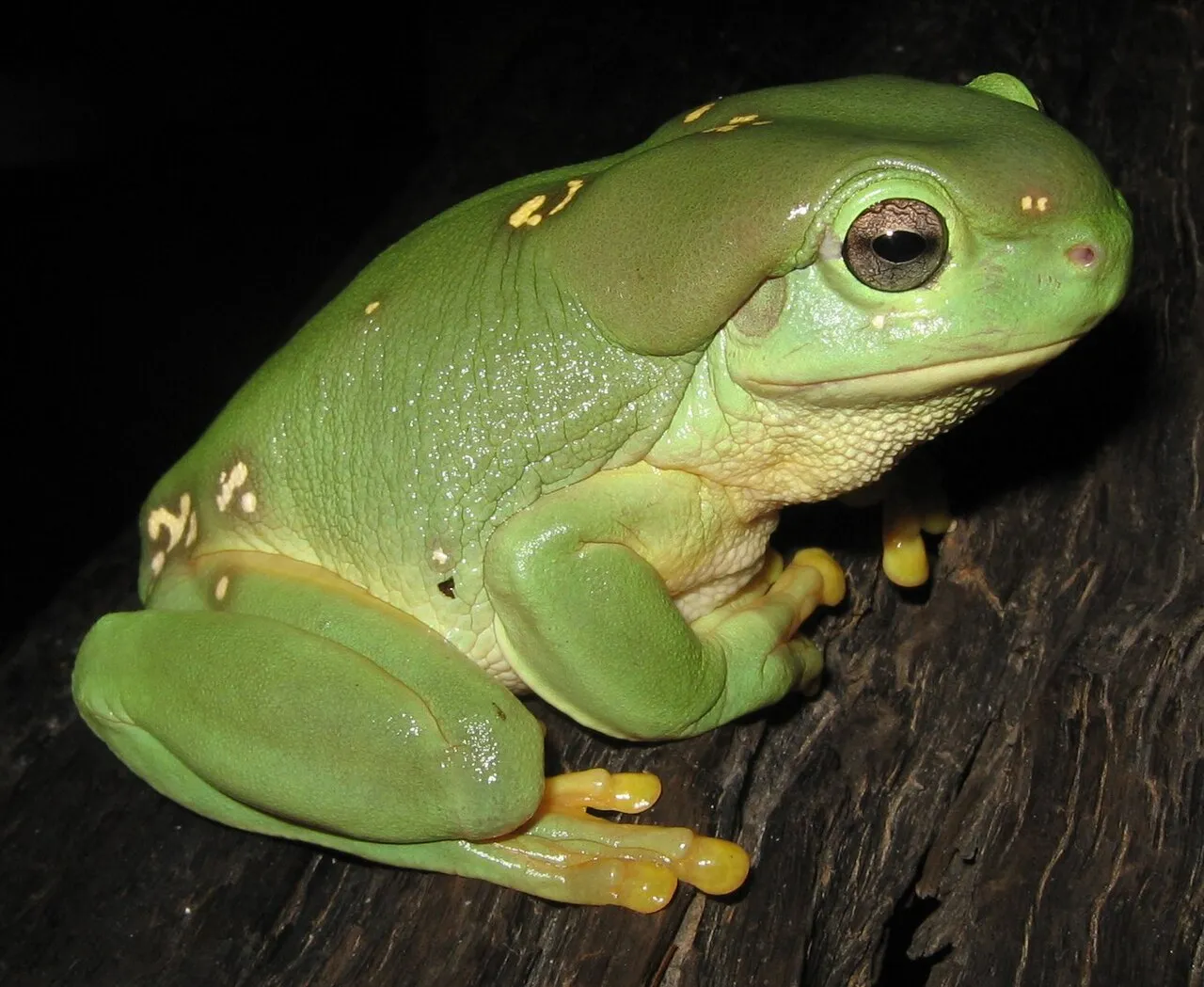
Litoria splendida, the magnificent tree frog, is a large, warty-skinned treefrog restricted to north-western Australia, in the Kimberley region of Western Australia and a small adjoining part of the Northern Territory. It is one of the largest treefrogs in Australia and is easily recognised by the prominent parotoid glands that sit behind each eye.
Identification
Females are the larger sex, with a snout-vent length of about 106 mm, while males reach about 104 mm, a difference small enough that both sexes look similarly bulky in the hand. The back is olive to bright green, usually carrying white or sulphur-coloured spots of varying density, over a white belly and bright yellow undersides to the legs and feet. The most distinctive feature is the pair of large parotoid glands, which in older individuals spread across the whole crown of the head and drape down over the eardrum, visible in the photograph above; that eardrum is itself large, nearly the size of the eye, and partly hidden by the gland. A rare blue colour morph, caused by a loss of yellow pigment, was documented in the species in July 2024.
Habitat and range
The species is confined to rocky Kimberley sandstone country, where it is nocturnal and shelters by day in caves and rock crevices. It has adapted readily to buildings within its range and is frequently found around toilets, showers and water tanks, making it one of the more familiar frogs to people living in the towns of the Kimberley.
Behaviour and breeding
Males call with a deep “crawk-crawk-crawk” repeated many times over, a sound close enough to White’s tree frog’s call that the two are easily confused by ear. Breeding is thought to follow the wet season, though its breeding habits have not been studied in detail. Outside the breeding season the frog’s reliance on caves, crevices and plumbing fixtures for shelter keeps it close to permanent moisture in an otherwise seasonally dry landscape.
Conservation
The facts box gives the species’ IUCN category. A restricted but remote range in rugged sandstone country, much of it with little human disturbance, together with a tolerance for buildings and artificial water sources, works in the species’ favour.
Similar species
The magnificent tree frog is most often confused with White’s tree frog (Ranoidea caerulea), which shares its heavy build and pale, warty look. The two are best told apart by the parotoid glands: in an older magnificent tree frog, the gland spreads across the whole top of the head and drapes down over the eardrum, a feature White’s tree frog lacks. The magnificent tree frog’s restricted range in the Kimberley and adjoining Northern Territory also sets it apart from White’s tree frog, which is far more widespread across northern and eastern Australia.
AnuraAnswers Editor is an editorial pseudonym. Texts are AI-generated and checked according to our published methodology.