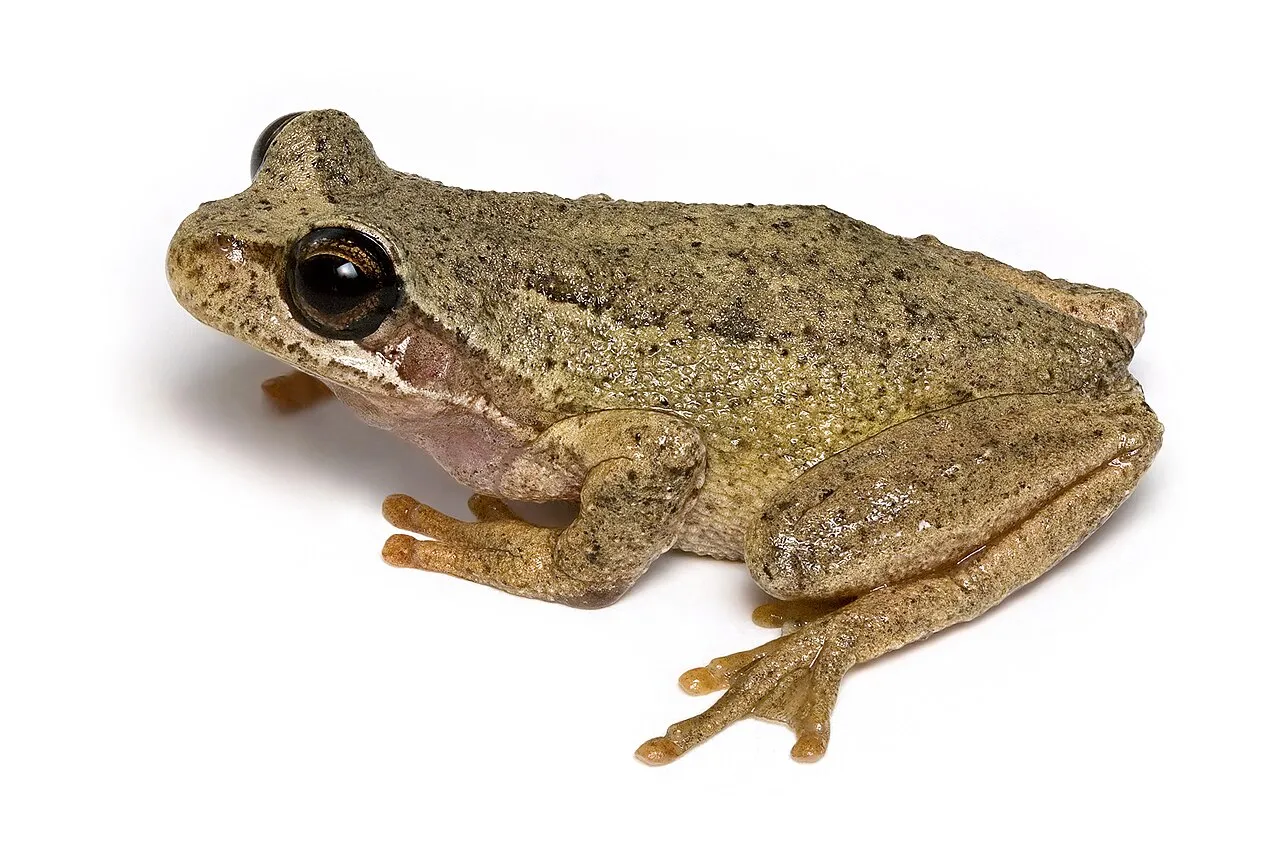
Litoria ewingii, the southern brown tree frog (also called Ewing’s tree frog), is a small, adaptable treefrog of cool-temperate Australia, first described in 1841 by the French naturalists André Duméril and Gabriel Bibron. It is native to South Australia, Victoria, New South Wales south of about Ulladulla, and Tasmania, and was introduced to Greymouth, New Zealand, in 1875, where it has since become widely established on the North and South Islands and the Chatham Islands.
Identification
It is a modest-sized frog, reaching up to 45 mm in length. The back ranges from pale to dark brown, with a broad darker patch starting at the eyes and covering most of the back; pure green and green-striped colour morphs also occur. A dark band runs from the nostril across the eye and tympanum to the shoulder, with a pale stripe below it running from the mouth to the arm. The backs of the thighs are orange and the belly is cream-coloured.
Habitat and range
The species turns up across forests, farmland, heathland, semiarid areas, alpine regions and suburban areas, frequenting dams, ditches, ponds and stream-side pools wherever still or slow water collects. It is the most frequently encountered frog in Tasmania and particularly common in parts of suburban Adelaide, Melbourne and Hobart, where it is often seen on window panes at night, drawn by insects attracted to the light. That tolerance for gardens and farmland, alongside wilder alpine and heath country, gives it one of the broadest habitat ranges of any Australian treefrog. In its introduced New Zealand range the species is locally abundant, a sign that the same adaptability which suits it to suburban Australia has carried over to the new environment.
Behaviour and breeding
Males call with a whistling “weep-weep-weep” from beside or floating in the water of dams, ditches, ponds and stream-side pools, calling all year round and especially after rain, rather than being restricted to a single spring breeding season. Eggs are easy to identify, wound around submerged grass stems, aquatic vegetation and sticks rather than laid as a loose floating mass. The species also copes with its cool range better than most frogs: individuals can freeze and survive, although freezing is costly to them, a trait that helps explain its spread into Tasmania’s highlands and New Zealand’s cooler islands.
Conservation
The facts box gives the species’ IUCN category. A wide native range across four Australian states, an established population in New Zealand, and comfort in suburban and farmed habitat all work against any near-term decline; the species’ use of garden ponds and ditches in major cities is itself a sign of how little it depends on undisturbed habitat. Taxonomy has shifted more than the frog’s fortunes: the species is now also classified under the genus Rawlinsonia, as Rawlinsonia ewingii, though it remains widely known by the older name used here.
Similar species
Within its range, the whistling tree frog, Rawlinsonia verreauxii, is the main source of confusion. Away from the Adelaide region, Litoria ewingii lacks the black marbling on the backs of the thighs that marks Rawlinsonia verreauxii, leaving its plain orange thighs as the clearest field mark between the two.