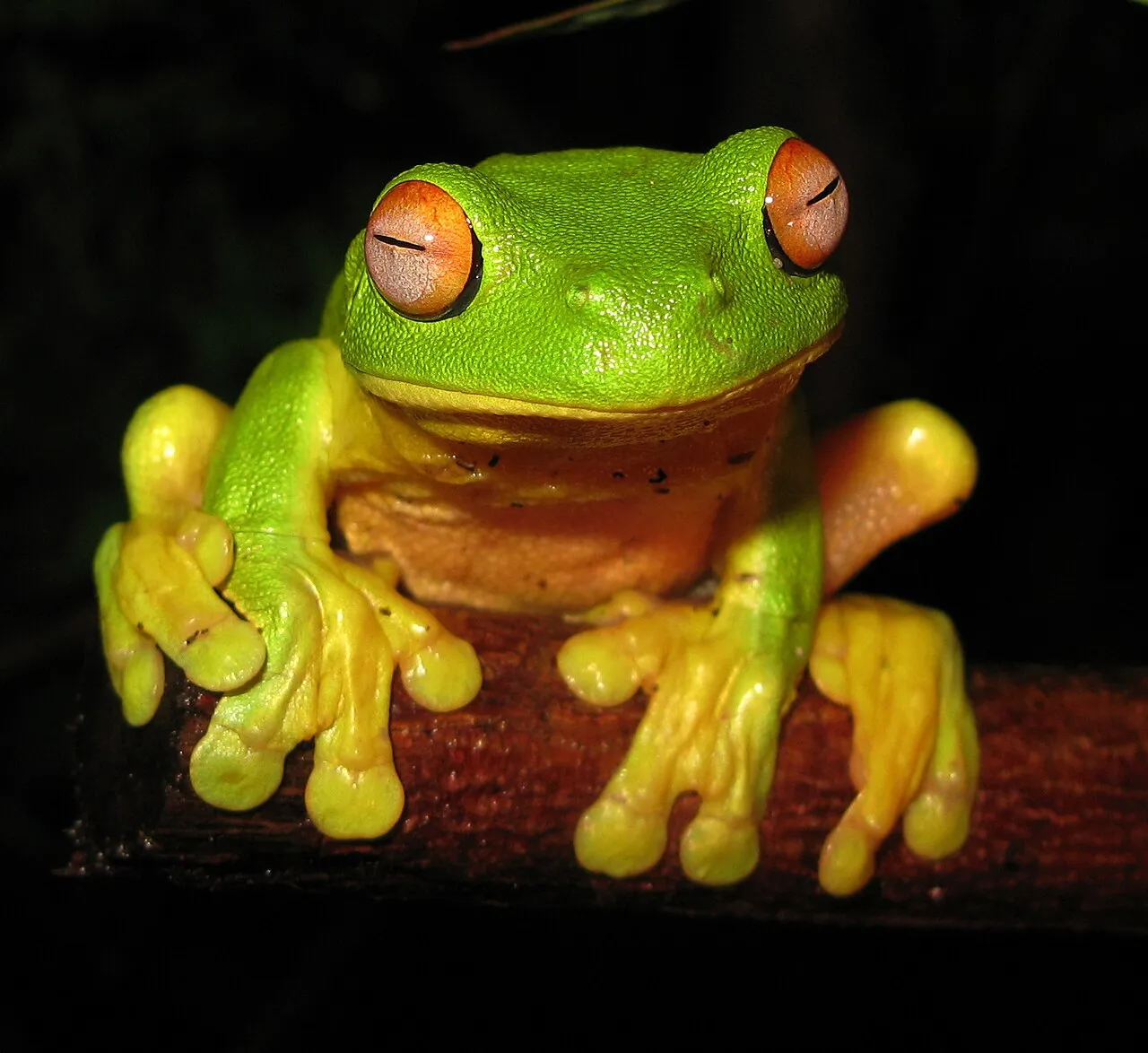
Litoria chloris, the red-eyed green treefrog, is a large, bright-green treefrog of Australia’s east coast. It is endemic to eastern Australia, ranging along the coast and nearby ranges from the Mackay region of Queensland south to the Gosford/Nowra area of New South Wales, a span of rainforest and wet forest country that gives the species its common name: an iris that runs gold at the centre to red at the edge.
Identification
It is a sizeable frog, with mature adults reaching about 65 mm in body length. The back is uniform bright green, occasionally with small yellow spots, over a bright yellow belly, and the backs of the thighs are purple, with yellow hands and feet. The eye is the clearest mark: a horizontal pupil set in an iris that is golden in the centre and red toward the rim, with the balance of the two colours varying between individuals. Fingers are three-quarters webbed and toes nearly fully webbed, both tipped with large discs for climbing. Tadpoles are grey or brown, sometimes with gold flecks along the side, and reach a total length of up to 50 mm.
Habitat and range
Within that Mackay-to-Gosford/Nowra range the species lives in rainforests, wet sclerophyll forests and woodlands. It breeds away from permanent streams, favouring temporary pools, roadside ditches, dams, ponds and slow-moving creek offshoots rather than flowing water, which keeps it tied to forested lowlands and foothills near the coast where such pools form after rain.
Behaviour and breeding
Males call with several long, moaning “aaa-rk” sounds followed by soft trills, typically from vegetation at or near the water’s edge. Breeding follows heavy rain in spring and summer, when pairs gather at the temporary and semi-permanent waters described above. Eggs are laid in small clusters attached to vegetation at or near the water’s surface. The tadpoles that hatch often stay near the bottom of the pool and take at least two months to develop into frogs, well past the short life of the temporary pools they sometimes use, so many breeding attempts depend on the water lasting long enough.
Conservation
The facts box gives the species’ IUCN category. A wide coastal range across two states and a tolerance for secondary and disturbed forest, alongside intact rainforest, work in the species’ favour. The risk sits with its temporary breeding pools, which depend on a rainfall pattern that is now changing.
Similar species
Three other Australian treefrogs are the usual source of confusion. The white-lipped and green Australian green treefrog, Litoria caerulea, grows much larger, to 10 cm or more, and its iris is plain gold rather than gold-to-red; it also carries a fatty ridge above the eye that L. chloris lacks.
The dainty green treefrog, Litoria gracilenta, overlaps most of L. chloris’s range but is much smaller, to about 45 mm, with bright orange eyes and a thin yellow or white line running from the nostril to the eye that L. chloris does not have; its thighs are purple-brown or maroon underneath rather than the brighter purple of L. chloris.
Further north, the orange-thighed treefrog, Litoria xanthomera, replaces L. chloris from around Proserpine northward and is told apart by orange rather than purple colouring on the backs of the thighs; the two species’ ranges meet but barely overlap along the Queensland coast.