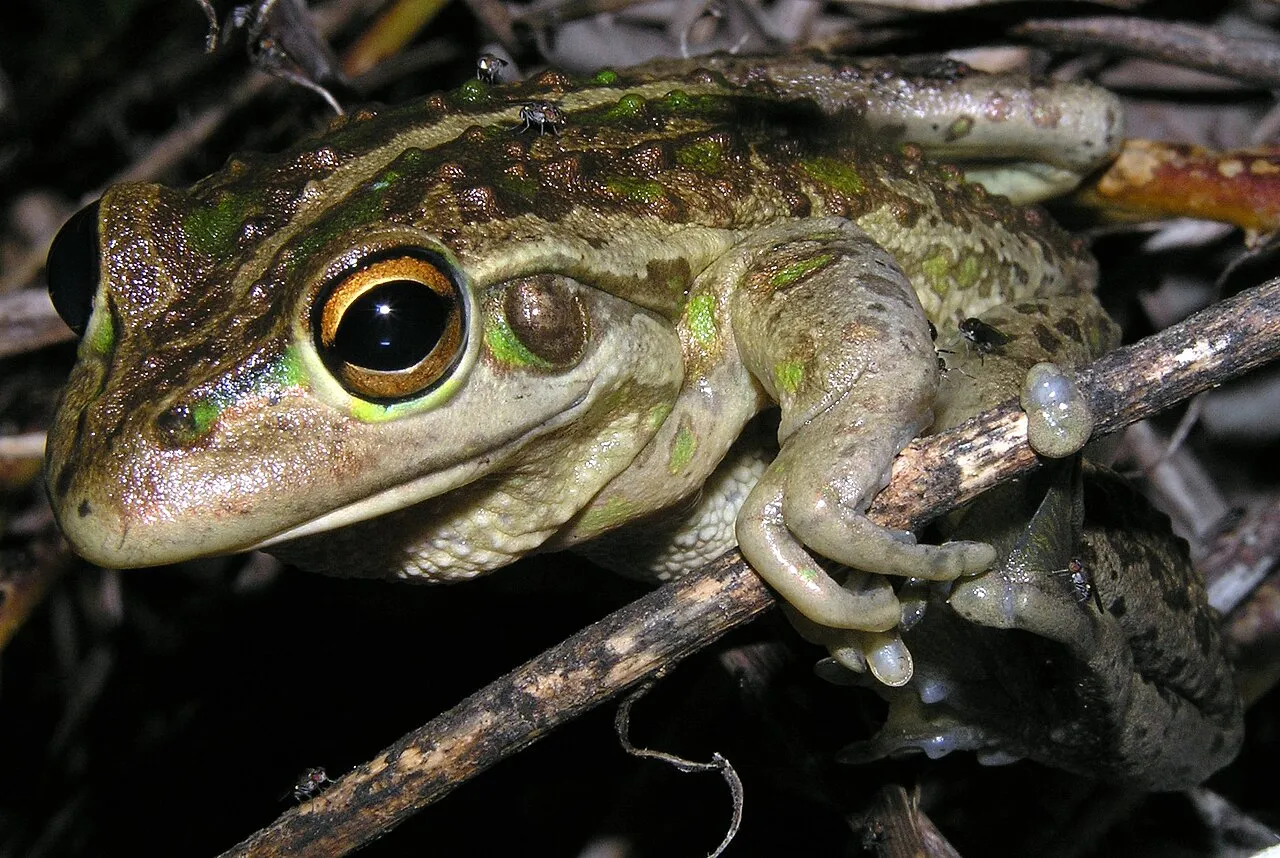
Litoria moorei, best known as the motorbike frog for its distinctive call, is a common treefrog of south-west Western Australia also called Moore’s frog, the western bell frog or the western green and golden bell frog; the Noongar people of the region know it as Kyooya. It is endemic to the south-west corner of Western Australia, ranging from the Geraldton Sandplains in the north to the Esperance Plains on the southern coast, including Rottnest Island, and is common throughout urban Perth. Taxonomically it is placed in the Ranoidea aurea species complex, alongside the growling grass frog (Litoria raniformis) and the southern bell frog (Litoria castanea), reflecting a shared ancestry with its better-known eastern relatives.
Identification
Colouring is variable and provides good camouflage, ranging from dark brown through green to gold, with a paler, pale-green to light-brown underside and a distinctive light green patch on the groin and thigh that helps separate it from related species. Adults reach up to about 75 mm in body length, with tadpoles growing to roughly 80 mm before metamorphosis; males develop black nuptial pads during the breeding season, while the species’ powerful hind legs and webbed, adhesive toe pads are typical treefrog features used for both swimming and climbing smooth vertical surfaces. Tadpoles are a uniform dark brown above with a silvery sheen below, and tend to crowd together in schools, hiding amongst vegetation when not basking; like the adults, they sunbathe for one or two hours each day, a habit that appears to support healthy growth.
Habitat and range
The species is found around lakes and swamps from sea level to about 600 m elevation, and has adapted well to human environments such as garden ponds and farm dams. Despite being a tree frog, it rarely climbs more than 1-2 m up vegetation, walls or windows, staying close to the ground and water rather than high in the canopy. Within its south-west Western Australian range it is one of the most familiar frogs of suburban Perth gardens as well as of the surrounding wetlands and coastal plains, and its tolerance of modified, well-watered habitat is a large part of why it remains so widespread close to a major city.
Behaviour and breeding
The male’s call is the species’ best-known trait: it sounds like a motorbike changing gears, the source of the common name “motorbike frog.” Breeding runs from early spring through late summer, with males calling from reed clumps and gripping females with their nuptial pads during amplexus. Large clumps of eggs, encased in transparent jelly, are attached to floating vegetation and debris. Outside the breeding season the adult frog feeds mainly on arthropods, but also takes smaller frogs, including juveniles of its own species, while the tadpoles graze mostly on algae, supplemented with animal matter when it is available. The adult frog can survive without water for extended periods, an adaptation that suits the warm, seasonally dry south-west Australian climate.
Conservation
The facts box gives the species’ IUCN category. Unlike several of its eastern relatives, the motorbike frog has not suffered dramatic population declines, even in areas affected by chytrid fungus, and it remains widespread and common across its native range, including within the city of Perth itself. Its ability to use artificial water bodies such as garden ponds and farm dams, and to go without permanent water for long stretches, likely buffers it against the habitat loss and disease pressure that have hit similar species elsewhere in Australia harder.
Similar species
The motorbike frog’s closest well-known comparison within Western Australia is Litoria splendida, the magnificent tree frog, a much larger species whose males and females reach snout-vent lengths of about 104 mm and 106 mm respectively, far exceeding the motorbike frog’s 75 mm, and adults develop large parotoid glands that cover the top of the head and droop over the tympana, a feature the motorbike frog lacks. Geographically the two barely meet: the magnificent tree frog is restricted to the Kimberley region of Western Australia and the adjoining Northern Territory coast, far to the north of the motorbike frog’s south-west range. Among the eastern bell frogs, Litoria aurea, the green and golden bell frog, shares the greenish-gold colouring and a broadly similar size range of about 45-110 mm, but it is now confined to scattered coastal sites between Byron Bay in northern New South Wales and East Gippsland in Victoria, having disappeared from an estimated 90 percent of its former range on the opposite side of the continent, so geography alone separates the two. Within its own south-west Western Australian range, the motorbike frog’s distinctive gear-changing call is usually the simplest way to confirm an identification.