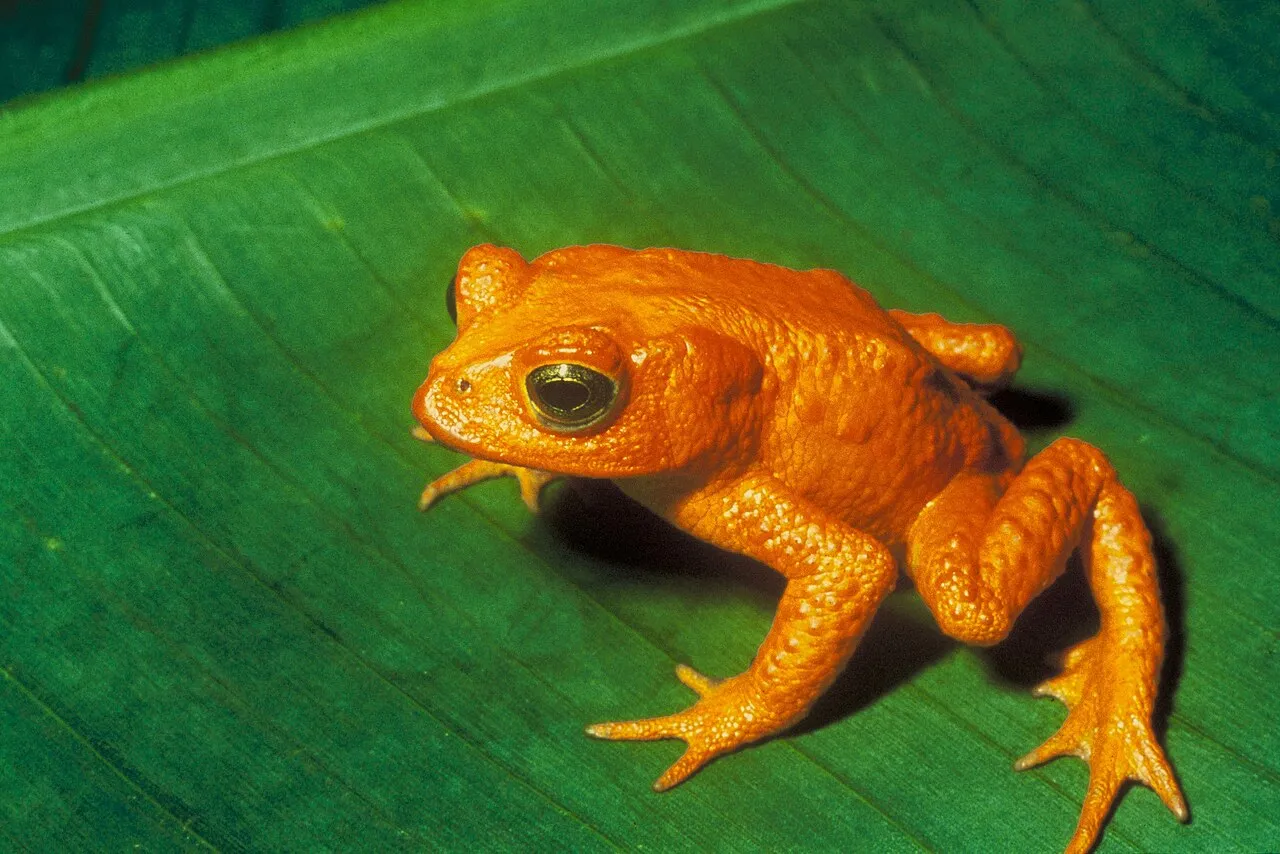
The golden toad (Incilius periglenes) is a small bufonid toad known only from a single patch of Costa Rican cloud forest. First described in 1967 by Jay Savage, it was studied for barely two decades before disappearing: the last confirmed sightings were in 1991, and the IUCN now lists it as Extinct. It remains one of the most cited examples of a modern amphibian extinction.
Identification
Males and females of Incilius periglenes look so different that early observers sometimes mistook them for two species. Males are a uniform, waxy orange, 39–48 mm long; females are larger, 42–56 mm, and patterned in black with scarlet blotches edged in yellow rather than orange. This split by sex is only visible once toads reach adulthood — juveniles cannot be sexed on colour alone. Like other toads in the genus Incilius, it has dry, warty skin and prominent parotoid glands, but no other species in its range shares the male’s solid orange colouring, which made it easy to identify in the field.
Habitat and range
The golden toad was endemic to about 4 km2 of elfin cloud forest on the Cordillera de Tilarán in northern Costa Rica, an area that now sits inside the Monteverde Cloud Forest Preserve. It lived at 2,000–2,100 m elevation, in wet montane forest that receives heavy rain during the breeding season from April to June. Outside that narrow window, adults were rarely seen, spending most of the year sheltering underground or under leaf litter and root systems where the constant moisture of the cloud forest kept their permeable skin from drying out.
Behaviour and breeding
Incilius periglenes was an explosive breeder: nearly the entire population converged on the same shallow, temporary pools within days of the first heavy rains. Males arrived in far greater numbers than females, with a reported ratio of about eight males to every female, and competition for mates was intense enough that males regularly formed “toad balls” of four to ten individuals clasping the same female or each other. A successful pairing produced 200–400 eggs about 3 mm across, laid in strands in the temporary pools. Tadpoles developed quickly, metamorphosing into toadlets in as little as five weeks to complete their life cycle before the pools dried out. Because males were bright, active by day and easy to see against the leaf litter, the species appears to have leaned on sight more than sound to find mates: it is reported to have had only two call types, both of limited range, simpler than the calls of many related bufonids. Outside the breeding window the toads were rarely seen at all, and their off-season habits are largely inferred from the closely related Monteverde harlequin toad, which is thought to shelter underground for most of the year. Diet is poorly documented, but based on its size the golden toad is presumed to have taken small invertebrates, as most bufonids do.
Conservation
The golden toad’s population collapsed suddenly. During the 1987 breeding season, erratic weather dried the temporary pools before that year’s tadpoles could mature: of a potential 30,000 toads expected from that season’s spawning, only 29 individuals survived. Scattered adults kept turning up for a few more years, but no toad was reported after 1991. Wikidata’s own record places the disappearance slightly earlier, in 1989, with the formal IUCN extinction declaration following only in 2004, once decades had passed without a confirmed sighting. Researchers have debated the cause ever since — proposed explanations include a drying trend in the cloud forest linked to global climate patterns, habitat disturbance, and the chytrid fungus Batrachochytrium dendrobatidis, which devastated many Central American amphibians around the same time. None of these fully explains why the decline was so fast and so total, and the species’ true cause of extinction is still considered unresolved. Its status is shown in the box above.
Similar species
Within the same cloud forest, the Monteverde harlequin toad (Incilius holdridgei) shares the golden toad’s habitat and similarly explosive breeding pattern. Unlike Incilius periglenes, though, it has not been declared extinct: Wikidata currently lists it as Critically Endangered rather than Extinct. Because no other amphibian in the region combines the male golden toad’s solid orange colour with its size and cloud-forest range, historical records of Incilius periglenes are rarely confused with another species — its disappearance simply removed the only toad that looked like it.