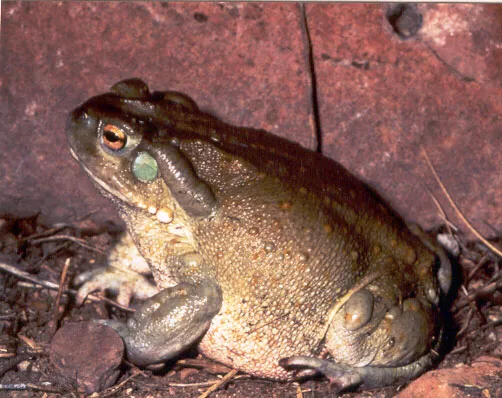
The Colorado River Toad, or Sonoran Desert Toad (Incilius alvarius), is a large bufonid of the North American Southwest. It ranges across the lower Colorado and Gila River catchments, southern Arizona, extreme southwestern New Mexico and the southeastern corner of California, where it may already be extirpated, and south into Sonora, Sinaloa and Chihuahua in Mexico. Its size alone sets it apart from every other toad sharing its range: at up to 190 mm long, it is the largest toad native to the United States, surpassed in the country only by the introduced cane toad. Unlike most of its relatives in the mostly tropical genus Incilius, it lives almost entirely within reach of the desert’s scarce permanent water, which shapes nearly everything about how and when it feeds and breeds.
Identification
Adults typically measure 110–187 mm, with the biggest individuals reaching about 190 mm. The skin is smooth and leathery rather than warty, in olive green or mottled brown, with raised warts confined mostly to the hind legs. The head carries pronounced cranial crests and large, elongate parotoid glands behind each eye, the source of its defensive skin secretions. Other field marks include a golden eye with a horizontal pupil, a large pale-green tympanum, a white wart at the corner of the mouth and white glands on the legs. No other toad sharing its range approaches this combination of size and gland size, which makes an adult Colorado River Toad hard to mistake for anything else.
Habitat and range
Within its southwestern US and northwestern Mexican range, the species favours arid and semi-arid desert and semi-arid grassland or woodland from sea level to about 1,600 m. It is semiaquatic and stays close to permanent water: large streams, springs, canals and irrigation ditches all support populations, since its skin cannot tolerate prolonged drying. This dependence also explains why irrigated farmland and canal networks, not just wild desert, can hold viable populations: any permanent water source in otherwise dry country will do. By day it shelters in rodent burrows or other cover, emerging to forage and breed at night.
Behaviour and breeding
The Colorado River Toad is nocturnal and an active forager, taking snails, beetles, spiders, grasshoppers, lizards, mice and even smaller toad species with a specialised sticky tongue. Activity peaks with the summer rains, roughly from May to September, and breeding itself is concentrated in July and August once the rainy season starts. Toads typically spawn one to three days after rain in temporary pools, ponds, streams or man-made water bodies. Males call to attract mates, though their calls are relatively weak compared with other toads and frogs. A female can lay up to 8,000 eggs in a single long jelly strand, with individual eggs about 1.6 mm across and spaced 5–7 mm apart. The resulting tadpoles are quick to develop, completing their larval stage in roughly one month before the temporary pools they hatched in dry up. In the wild, individuals are documented living two to four years, though captive animals have reached an average of 9.2 years.
Conservation
The species is shown as Least Concern in the box above, and its wide range across the Southwest and northwestern Mexico, together with its tolerance of canals and irrigation ditches as substitute habitat, supports that picture for now. Even so, populations at the edges of its range — including California, where it may already be gone — show that a species-wide status can mask local decline, and continued loss of the permanent water sources it depends on remains the main pressure worth watching.
Similar species
Within its own range, no other toad matches the Colorado River Toad’s combination of great size and greatly enlarged parotoid glands: it is the largest toad native to the United States, a distinction that leaves little room for confusion with the smaller native toads it shares desert streams and irrigation canals with. Its closest relatives are other members of the genus Incilius, a group of Central American toads that share its glandular skin and prominent parotoid glands but occupy tropical rather than desert habitats, so their ranges do not overlap with this species in the field.