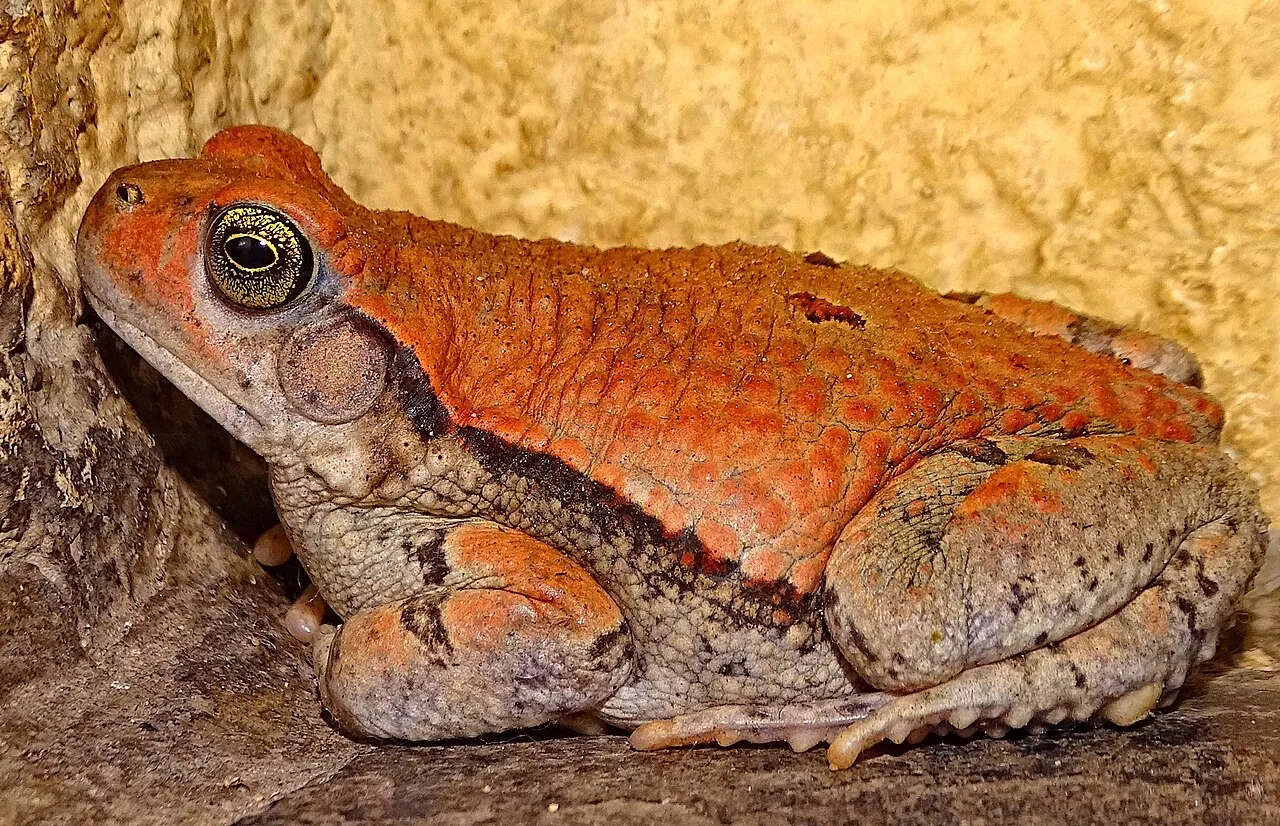
The African red toad, Schismaderma carens, is a mid-sized toad of southern and east Africa, named for the reddish-brown colouring across its back. It is the only species in the monotypic genus Schismaderma, within the family Bufonidae, and is most often noticed at night around the still waters where it breeds.
Identification
The upper surface is reddish-brown with a pair of dark brown spots on the shoulders and another pair on the lower back. A dorso-lateral ridge of glands runs from the tympanum to the back leg on each side, with the outer part of this ridge darker along its lower edge — a useful field mark that separates it from other toads sharing its range. The flanks vary between individuals, dark in some and pale in others. Adults reach about 90 mm in snout-vent length, with females slightly larger than males; the facts box above carries the full size range.
Habitat and range
Schismaderma carens is widespread across southern and east Africa, recorded in Angola, Botswana, DR Congo, Eswatini, Kenya, Malawi, Mozambique, Namibia, South Africa, Tanzania, Zambia, Zimbabwe, and possibly Lesotho. Outside the breeding season it occupies grassland, wooded savannah and agricultural land, habitat broad enough to let it persist alongside farmland and settlements across much of its range. For breeding it moves to deep lakes, ponds and pools, favouring more permanent standing water than many of the region’s other toads, which typically spawn in shallow, temporary pools.
Behaviour and breeding
Males call from the surface of deep still water in mid-summer, gathering at the lakes and ponds the species depends on for reproduction. Females lay double strings of eggs in the water, which may become tangled in submerged vegetation. Once hatched, the tadpoles are gregarious and often form dense swarms, a schooling habit that may help them avoid predators in open water. Development from egg to metamorphosed juvenile takes 37 to 52 days, a span that lets the species breed successfully in the deeper, longer-lasting pools it favours rather than racing against the rapid drying that shapes breeding in more temporary-pool specialists.
Conservation
The species’ facts box above carries its current IUCN Red List category, Least Concern, which reflects its wide distribution across southern and east Africa and its tolerance of farmed and settled landscapes. No further detail on population trend or specific threats is available from the sources checked for this profile.
Similar species
As the sole member of its genus, Schismaderma carens has no close relative to be confused with directly, but it shares its range with several other African bufonid toads. Its reddish-brown back marked with paired dark spots on the shoulders and lower back, and the distinctive dorso-lateral gland ridge running from tympanum to back leg, set it apart from these at a glance. Its choice of breeding site is a further clue: a toad calling from the surface of deep, still, permanent water rather than a shallow temporary pool is more likely to be this species than one of its shallow-water-breeding neighbours.