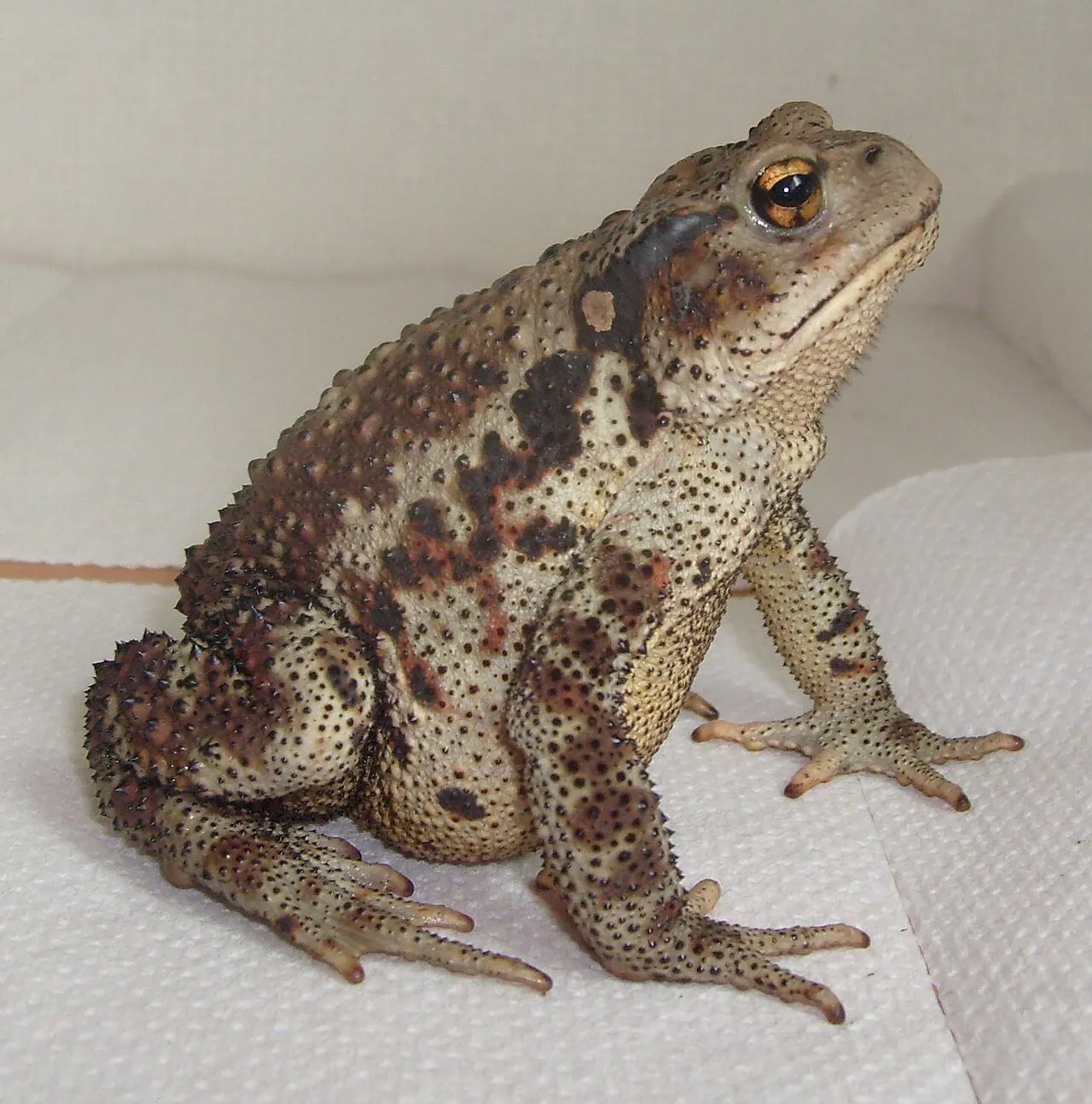
Bufo gargarizans, the Asiatic toad, is a member of the “true toad” family Bufonidae, endemic to East Asia. It is also known by an older name, the Chusan Island toad, and for decades it had no name of its own at all: taxonomists long treated it as Bufo bufo gargarizans, a subspecies of the common toad, before it was split out as a distinct species.
Identification
Reliable, openly reachable sources for this guide do not give a snout-vent length or colour description specific to this species: AmphibiaWeb and the detailed herpetological databases that usually carry this kind of measurement answer automated requests with a bot challenge rather than a page, so this guide does not cite them and leaves the figure out rather than guess. What is documented is the toad’s identity and a recurring source of confusion with its name: Wikipedia’s entry on the species warns readers not to confuse it with the Asian common toad or the Asian giant toad, two differently named but unrelated toads that overlap part of its range (see Similar species, below).
Habitat and range
The Asiatic toad is endemic to East Asia: widespread across China, extending into the Russian Far East (the Amur River valley, Sakhalin Island and Transbaikalia), relatively rare on the Korean Peninsula, and present on the Miyako Islands of southern Japan. Within that range it avoids dense forest but is found in most other habitats, including grasslands, open forests, meadows and cultivated land; it favours humid conditions and is rarely found at altitudes above 800 m.
Behaviour and breeding
Specific, citable facts about this species’ diet, calls or breeding biology are not available from the open sources this guide can reach: the databases that document Asiatic toad courtship and tadpole development answer automated requests with a bot challenge rather than a page, and this guide does not repeat facts it could not verify directly. This entry will be updated if an openly reachable source becomes available.
Conservation
The facts box above carries the species’ current IUCN Red List category, Least Concern. The toad also has a long-standing economic use that sits alongside its conservation picture: an extract of the toxins secreted by its skin, known as toad venom or chan-su, is used in traditional Chinese medicine, and in 1998 an antimicrobial peptide isolated from its secretions was patented by researchers investigating the toad’s biochemistry. Whether this harvesting pressure affects wild populations is not addressed in the sources available to this guide.
Similar species
Two other toads share parts of the Asiatic toad’s range, and its common name, closely enough to cause confusion. Wikipedia’s entry on the species explicitly warns against confusing it with the Asian common toad, Duttaphrynus melanostictus, or the Asian giant toad, and the Asian common toad’s own entry returns the warning, telling readers not to confuse that species with the Asiatic toad. The two are not close relatives: the Asian common toad belongs to a different genus, Duttaphrynus, distinguished by bony ridges on top of the head and a tympanum at least two-thirds as wide as the eye.
Closer to home taxonomically, the Asiatic toad was itself classified for decades as a subspecies of the common toad, Bufo bufo, before being recognised as a distinct species — making Bufo bufo its nearest relative by lineage, even though the two now occupy largely separate continents.