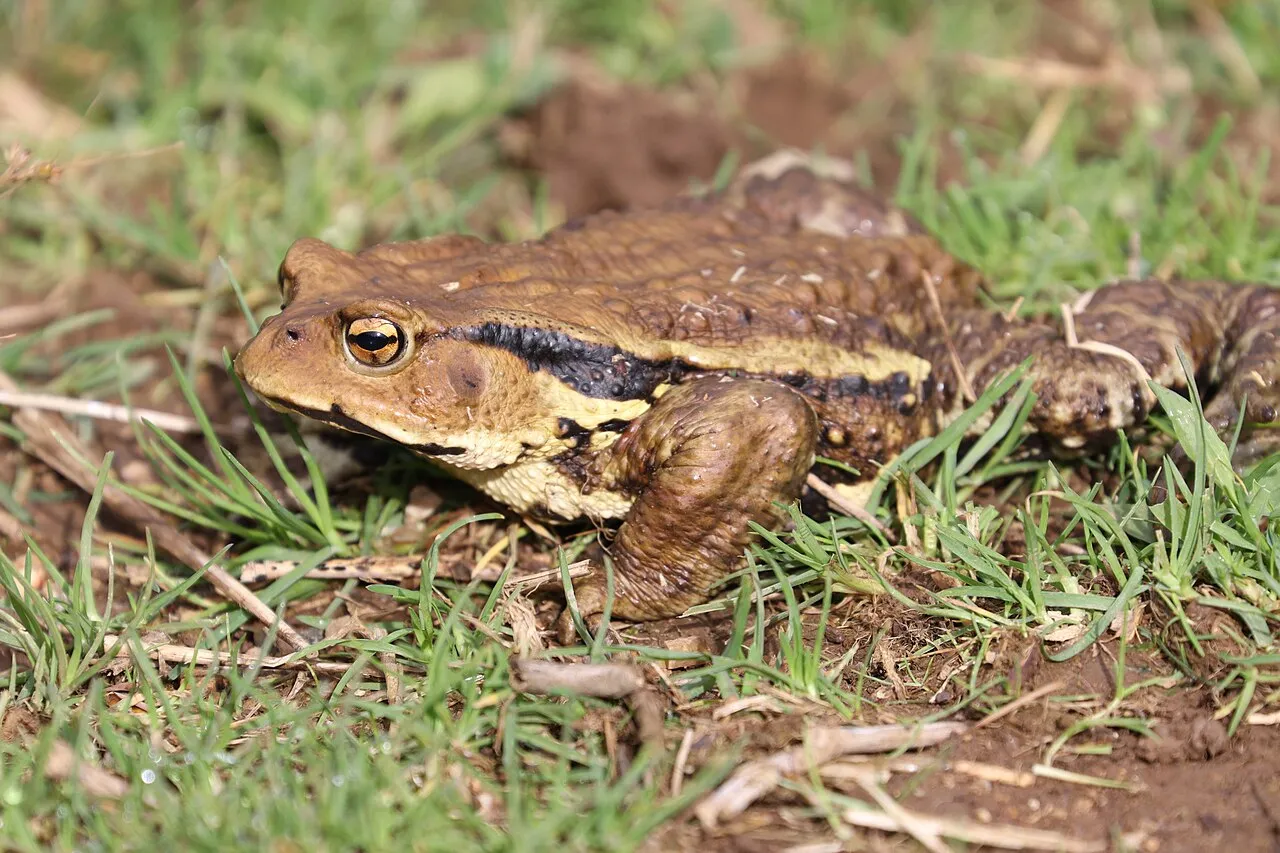
The Japanese common toad, Bufo japonicus, is a stout, warty toad native to Japan, where it is one of the most familiar amphibians across the main islands. It belongs to the true toad family Bufonidae, in the genus Bufo, and is known in English simply as the Japanese common toad. The species was first described in 1826 as Bufo praetextatus, though that original specimen has since been lost. Two subspecies are traditionally recognised, the western-Japanese B. j. japonicus and the eastern-Japanese B. j. formosus, separated mainly by the size of the tympanum (eardrum); some taxonomists instead treat formosus as its own species, which would leave B. japonicus with no subspecies at all.
Identification
Adults can reach a snout-to-vent length of up to about 175 mm (7 in), with females running a little larger than males, and individuals from warmer parts of its range growing larger than those from colder ones. The head is pointed and roughly triangular, with a robust body and relatively short forelimbs. The elliptical tympanum sits behind the eye, at roughly the same distance as its own longest diameter, a detail that distinguishes the two subspecies from one another. The skin is covered in small warty outgrowths in shades of greenish-brown, yellowish-brown or darker tones. During the breeding season the skin turns paler and noticeably smoother, a useful cue for telling breeding adults apart from toads encountered at other times of year.
Habitat and range
Bufo japonicus is native to Japan, occurring on the islands of Honshu, Kyushu and Shikoku, with introduced populations established on Hokkaido and Sado Island. Within that range it is a generalist, found in subarctic and temperate forests, temperate shrubland, swamps, permanent and intermittent freshwater marshes, freshwater springs and ponds, irrigated and arable land, rural gardens and urban areas. The two subspecies broadly split this range between western and eastern Japan, which is also reflected in their common names, the western-Japanese and eastern-Japanese common toads.
Behaviour and breeding
Outside the breeding season the toad lives mainly on land, feeding on earthworms and small arthropods, including ants and some species of beetle. It hibernates underground once temperatures drop below about 6°C, re-emerging as the ground warms.
Breeding takes place in spring, when toads gather in the shallow ponds, marshes and springs that make up their aquatic habitat. The species is an explosive breeder: large numbers arrive at breeding sites over a short window, and courtship relies on tactile and visual cues rather than prolonged calling. Males clasp females in amplexus, and competition for mates is intense: in this size-assortative scramble, larger males repeatedly displace smaller ones that have already paired up. Long strings of eggs are laid and become tangled among underwater plants. The resulting tadpoles are dark-coloured and grow to 30 or 40 mm before leaving the pond as juvenile toads, typically by June.
Conservation
The Japanese common toad is assessed as Least Concern. Its broad tolerance of both natural and human-altered habitats, combined with a large population showing no sign of overall decline, supports that status.
Similar species
Within its range, Bufo japonicus can be confused with the Japanese stream toad, Bufo torrenticola, a close relative restricted to fast-flowing mountain streams. The two occasionally hybridise where their ranges meet, and the subspecies B. japonicus formosus is the form most often involved. Away from torrent habitat, the pointed head, variable brown colouring and tolerance for still water, gardens and farmland of B. japonicus help separate it from stream-dwelling relatives, which are far more tied to fast-flowing water. The two B. japonicus subspecies themselves are best told apart by tympanum size rather than colour or body shape, so a confident identification in the field usually relies on knowing which half of Japan the animal was found in.