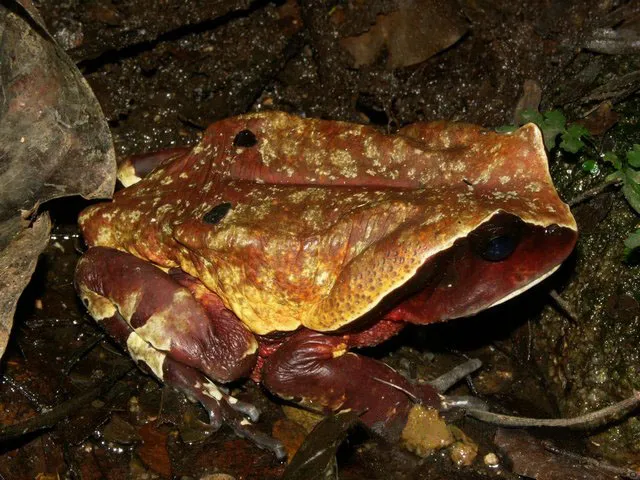
Sclerophrys superciliaris, the African giant toad, is a true toad of the family Bufonidae, found across western and central Africa, with confirmed records from Cameroon, the Central African Republic, the Republic of the Congo, the Democratic Republic of the Congo, Ivory Coast, Equatorial Guinea, Gabon, Ghana and Nigeria, and a possible presence in Liberia and Sierra Leone. That spread across two regions of the continent makes it one of the broader-ranging members of its genus.
The common name reflects its size among African toads, and the species is split into a nominate form and the subspecies Sclerophrys superciliaris chevalieri, which differ slightly in average body size.
Identification
The species is sexually dimorphic, with females somewhat larger than males. Adult male snout-vent length averages about 121 mm in the nominate subspecies and about 127 mm in Sclerophrys superciliaris chevalieri, sizes that place it among the larger true toads of the region, in keeping with the “giant” in its common name.
Like other members of its genus it carries a prominent parotoid gland behind each eye, the gland that gives bufonid toads their main chemical defence against predators, along with the warty skin typical of the family. Separating the two subspecies in the field relies mainly on the average size difference noted above rather than on colour or pattern.
Habitat and range
The African giant toad lives in subtropical and tropical moist lowland forest, freshwater marshes and intermittent freshwater marshes, as well as plantations and degraded former forest. Its habitat use shifts across its range: in the western part of its distribution it occurs mainly in primary forest along rivers, while further east it also turns up in secondary forest with dense undergrowth and in cocoa plantations. That tolerance of plantations and degraded forest, alongside untouched riverine forest further west, helps explain why the species holds on across so many countries despite ongoing forest loss in parts of its range.
Behaviour and breeding
Breeding probably takes place in the dry season, from January to March, in calm stretches of streams. Females deposit long strings of eggs wrapped around underwater vegetation, a laying style shared with many other true toads. Juveniles have been recorded from January to October depending on the region, a broader window than the breeding season itself, reflecting variation in timing across its wide range.
Outside the breeding season, the diet includes ants, snails, other insects, frogs and tadpoles, including other amphibians, which marks it out as an opportunistic predator among the typically insect-eating true toads.
Conservation
The IUCN category is in the facts box above. The species’ wide distribution across western and central Africa, together with its use of degraded forest and plantations alongside primary habitat, likely supports its current status, though the full extent of its range and population trends are not described in detail in the sources consulted here.
Similar species
Sclerophrys gutturalis, the guttural toad, is a related true toad with similarly prominent parotoid glands, though it ranges from Kenya west to Angola and south to South Africa, well to the south and east of the African giant toad’s western and central African distribution, and is smaller, with males reaching up to about 90 mm and females up to about 120 mm snout-vent length against the African giant toad’s roughly 121-127 mm average male snout-vent length. Within its own range, the African giant toad’s larger size among true toads remains the most useful field clue for telling it apart from smaller relatives in the genus.