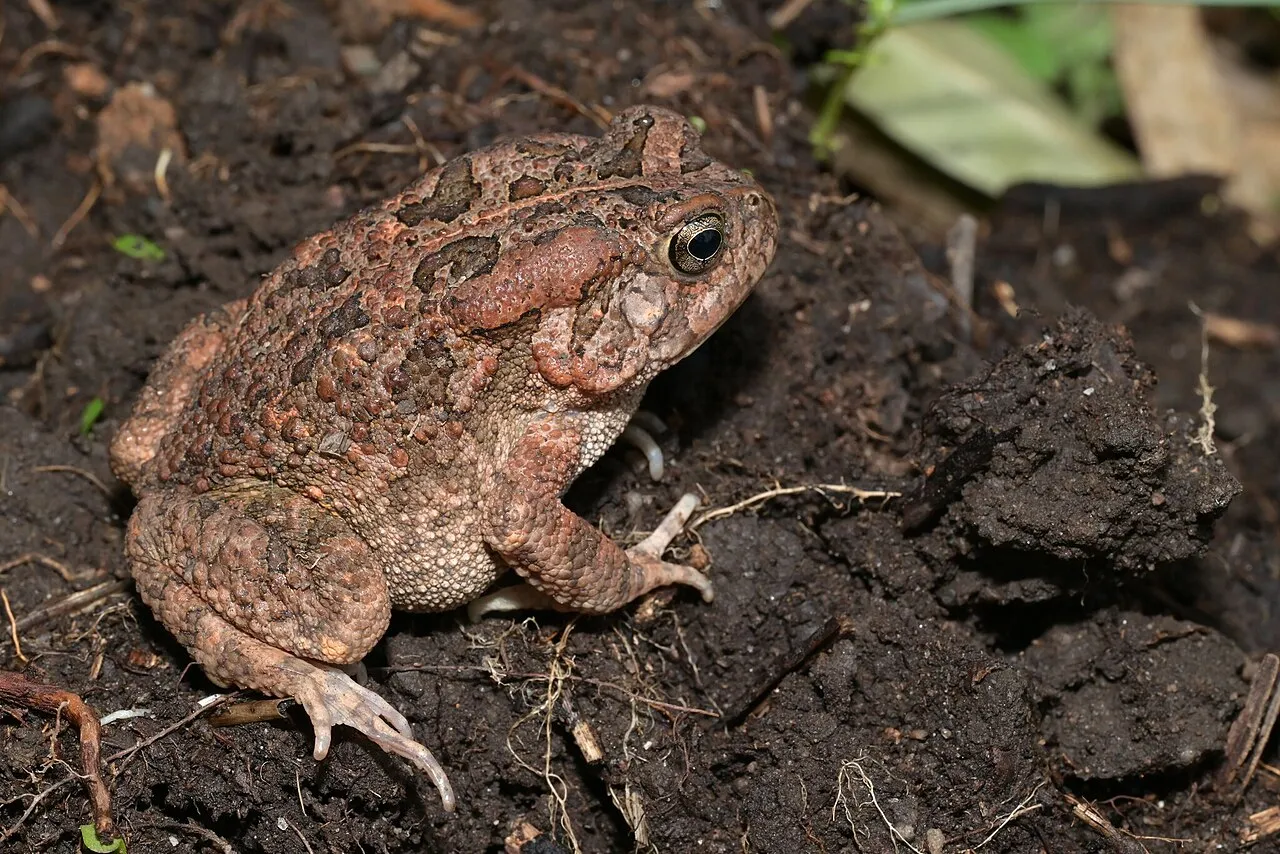
Sclerophrys gutturalis, the guttural toad, is a true toad of the family Bufonidae, widespread across sub-Saharan Africa from Kenya west to Angola and south to South Africa, with records from at least 15 countries including Botswana, Ethiopia, Malawi, Mozambique, Namibia, Tanzania, Zambia and Zimbabwe. It is one of the continent’s most familiar toads, equally at home in wild habitat and in people’s gardens.
The species was first described in 1927 and for much of its taxonomic history was treated as a form of the much wider-ranging Bufo regularis, today’s Sclerophrys regularis; the old designation still turns up as a synonym in species catalogues. It now stands as its own species.
Beyond the African mainland, the toad’s range also extends to Mauritius and Réunion in the Indian Ocean.
Identification
Males reach a snout-vent length of up to 90 mm; females grow larger, up to about 120 mm. The back is buffish brown with irregular dark brown markings, and most individuals show two pairs of brown spots between the eyes that together form a cross-like mark, often with a pale stripe running down the spine. The underside is pale and granular, with males showing a dark throat that females lack.
A few features help confirm the identification in the field: white tubercles edge the arms, and a red patch marks the back of the thighs. Like other members of its genus it carries a prominent parotoid gland behind each eye, the gland that gives bufonid toads their main chemical defence against predators. The toes are only slightly webbed, consistent with a toad that spends most of its life on land rather than in water, returning to it mainly to breed.
Males and females are straightforward to tell apart outside the breeding season too: besides the dark throat, males are on average the smaller sex, a pattern common across Bufonidae even though the female’s size advantage here, up to 120 mm against the male’s 90 mm, is more pronounced than in many relatives.
Habitat and range
The guttural toad tolerates an unusually broad span of environments. Wikipedia and the facts box above record it from forest, savanna and wetland habitats, including both dry and moist forest, grassland and shrubland, and it has also taken readily to farmland and urban areas. That willingness to live alongside people, rather than any single favoured wild habitat, explains why the species turns up across so much of the African map, and it breeds just as readily wherever it settles.
Behaviour and breeding
Males call from the water’s surface with a guttural “snore” repeated at intervals of about three seconds, the sound that gives the species its common name. The main breeding period falls in October and November, when males gather at ponds and other standing water to call for mates.
A female lays her eggs in double strings, which may be wound around submerged vegetation. The tadpoles develop for about 75 days before metamorphosing into toadlets. In a good season they can hatch in such numbers that newly emerged toadlets leaving the ponds carpet the surrounding ground, though many of these are quickly taken by predators.
Conservation
The IUCN category is in the facts box above. The guttural toad owes its secure status to the same traits that make it so widespread: Wikipedia describes it as very common and very adaptable, with no major predators and little impact from habitat loss. Its tolerance of farmland and cities means land conversion that threatens many other amphibians tends to leave this toad largely unaffected.
Similar species
The closest confusion risk is with Sclerophrys regularis, the toad this species was once lumped with as a subspecies; the old combination Bufo regularis gutturalis still appears in taxonomic indexes. Within its own range, the cross-shaped mark between the eyes, the red patch on the back of the thighs, the male’s dark throat and the distinctive three-second “snore” call are the most reliable field marks for telling Sclerophrys gutturalis apart from other African toads it shares habitat with.