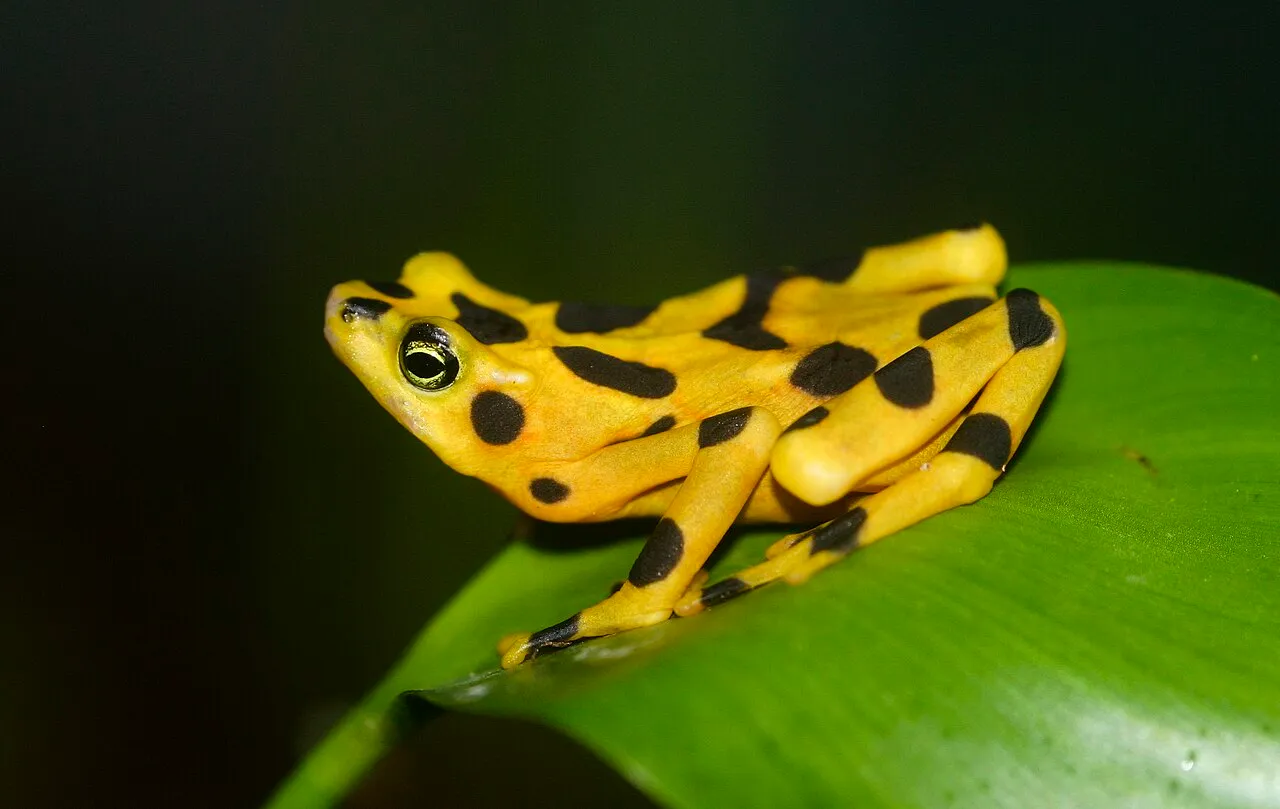
Atelopus zeteki, the Panamanian golden frog, is a small, brightly coloured toad in the family Bufonidae, genus Atelopus. It is endemic to Panama, historically found along mountain streams on the eastern slopes of the Tabasará range in Coclé and Panamá provinces, including the area around El Valle de Antón and, formerly, El Copé before a chytrid fungus outbreak collapsed that population in 2004. It is a national symbol in Panama, appearing on state lottery tickets and, since 2010, celebrated each 14 August as National Golden Frog Day with parades in El Valle de Antón.
Identification
Males and females differ noticeably in size. Males measure about 35-48 mm snout-vent length and weigh 3-12 g; females are larger, about 45-63 mm snout-vent length and 4-15 g. Adults are typically bright yellow to gold, sometimes with dark blotches, a warning colouration (aposematism) that advertises the potent toxins in their skin, among them zetekitoxin AB, a sodium-channel blocker far more potent than its relative saxitoxin.
Habitat and range
Atelopus zeteki lives in the Cordilleran cloud forests of west-central Panama, along streams and rivulets. Within that range it stays close to water at every life stage: tadpoles develop in shallow pools of moving streams, in water 5-35 cm deep and 20.4-21.3 degrees C, feeding on algae growing on the streambed, while juveniles remain within about 2 m of the stream and adult males move into the surrounding trees at night. This tight dependence on clean, cool streamside habitat makes the species sensitive to both habitat disturbance and disease that spreads through water; the same fungal pathogen described below thrives in cooler stream conditions, which is part of why streamside specialists like this one have been hit so hard.
Behaviour and breeding
Unusually for a frog, Atelopus zeteki relies heavily on visual signalling rather than calls, likely because the noise of its fast-flowing stream habitat drowns out vocalisations. Males raise and flick a forefoot as a defensive, warning-colouration display toward rival males and predators, a substitute for the calls most frogs rely on, and territorial males add pulsed vocalisations of their own, even though the species lacks eardrums and instead hears directionally through other means. Courting males give a soft call before pairing up, and the resulting mating clasp (amplexus) can last anywhere from a few days to a few months, ending with the eggs laid in a shallow stream. Eggs and tadpoles then develop in the same shallow, moving stream pools described above, and juveniles stay close to the water until large enough to range further into the surrounding forest.
Conservation
Atelopus zeteki is listed as Critically Endangered on the IUCN Red List. The chytrid fungus Batrachochytrium dendrobatidis collapsed the El Copé population in 2004 and reached El Valle de Antón by 2006; the species has since been considered possibly extinct in the wild from 2007 onward. As the disease spread, keepers raced to save breeding stock: in 2006, for example, two rooms of a hotel in El Valle were converted into makeshift frog housing, holding over 300 rescued animals until dedicated facilities were ready. That rescue effort grew into the wider conservation network the species depends on today, and its survival now rests on captive-breeding programs run by more than 50 institutions across Panama and North America, holding assurance populations against the day a wild release becomes possible.
Similar species
Atelopus zeteki belongs to a large genus of small, brightly coloured Neotropical toads known as harlequin frogs, most of which share the same stream-side cloud-forest habitat and warning colouration. Its closest look-alike is Atelopus varius, under which A. zeteki was originally described as a subspecies before later taxonomic work separated the two; the pair share similarly extreme territorial behaviour. Other Panamanian members of the genus occupy comparable terrain, but none carries the same cultural profile as A. zeteki, which became a national symbol of Panama even as its wild population disappeared.