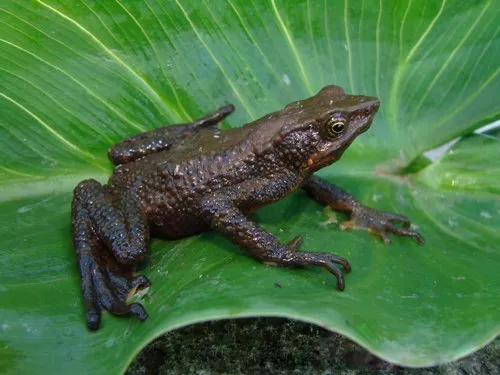
Atelopus nahumae, the San Lorenzo harlequin frog, is a small toad in the family Bufonidae, genus Atelopus. It is endemic to Colombia, known only from the Sierra Nevada de Santa Marta across the departments of Magdalena, La Guajira and Cesar, including sites within Parque Nacional Natural Sierra Nevada de Santa Marta and the adjacent El Dorado Nature Reserve. Only four known populations have been recorded, each highly localized, which leaves the species vulnerable to any single threat that reaches one of its isolated patches of forest. The genus name Atelopus groups together the Neotropical harlequin frogs found across Central and South America; within that genus, A. nahumae’s muted brown tones and tightly restricted range set it apart from more brightly patterned relatives such as A. varius and A. zeteki, discussed below under Similar species.
Identification
The frog has an acuminate (pointed) snout, no visible tympanum, and webbed digits. Its dorsal skin is mostly smooth but carries granules along with small conical tubercles and small warts, and its coloration ranges from dark to light brown, often with a brown X-mark across the shoulders and sometimes a dark mid-dorsal stripe. Size differs markedly between the sexes: males measure about 32-37 mm in snout-vent length, while females reach about 45-51 mm, the larger body of the female likely reflecting the demands of egg production typical of the genus.
Habitat and range
Atelopus nahumae lives in sub-Andean humid montane forest at elevations of 1,900-2,800 m, favouring closed-canopy secondary forest and riparian zones, with breeding taking place in streams. That narrow elevation band, combined with the species’ restriction to the Sierra Nevada de Santa Marta, means its entire known range sits within a single isolated massif on Colombia’s Caribbean coast, separated from the main Andean cordilleras. Within that massif, the frog has so far been found only in four distinct localities across Magdalena, La Guajira and Cesar, including ground protected by Parque Nacional Natural Sierra Nevada de Santa Marta and the nearby El Dorado Nature Reserve.
Behaviour and breeding
Like other harlequin frogs, A. nahumae depends on the streams of its montane forest habitat for reproduction, breeding in streams within the closed-canopy and riparian zones it favours. That riparian habit ties the frog’s daily life to the shade and moisture of the closed-canopy forest it favours, rather than to open or disturbed ground. The species’ reliance on flowing water for breeding ties its fortunes closely to the condition of the forest along those streams: any clearing of the canopy upstream or along the banks can alter the water conditions tadpoles need to develop, which is part of why the species’ presence inside Parque Nacional Natural Sierra Nevada de Santa Marta and the El Dorado Nature Reserve matters for its long-term survival.
Conservation
Atelopus nahumae is listed as Endangered. The principal pressure on the species is habitat loss from agriculture and logging within its small, fragmented range. Chytridiomycosis, the fungal disease that has devastated other Atelopus species across the Americas, is a potential threat, though the pathogen had not been detected within the species’ range as of 2014. That absence offers a narrow window for conservation action, but the frog’s confinement to just four localized populations in a single mountain range leaves it with little room to absorb further losses from either habitat clearing or disease.
Similar species
Atelopus nahumae belongs to the same genus of Neotropical harlequin frogs as Atelopus varius, the variable harlequin toad of Costa Rica and Panama, and Atelopus zeteki, the Panamanian golden frog. All three share the genus’s characteristic pointed snout, webbed digits and reliance on streams for breeding, but A. nahumae is separated from its Central American relatives by a wide geographic gap and by a brown, mottled coloration rather than the bright aposematic patterns seen in A. varius and A. zeteki.