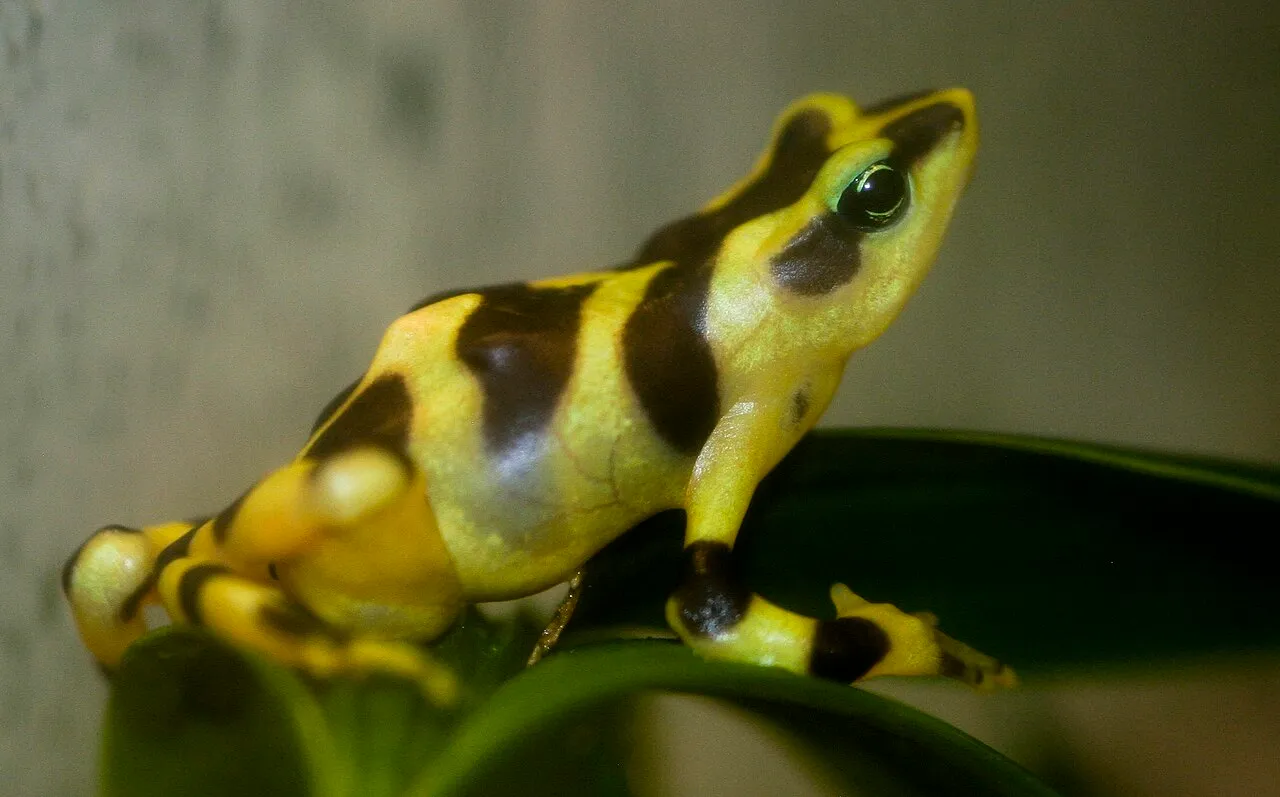
Atelopus varius, the variable harlequin toad, is a small, brightly coloured toad in the family Bufonidae, genus Atelopus. It historically ranged along the Pacific and Atlantic slopes of the Cordillera de Tilarán in Costa Rica into western Panama, but the species has since collapsed to a single remnant population near Quepos, Costa Rica, with only relict populations remaining in western Panama. Its skin carries tetrodotoxin, a potent neurotoxin, and its bold colours serve as a warning to predators rather than camouflage.
Identification
Adults are small, measuring about 24-38 mm in body length, with a slim body, pointed snout and toes that are pointed and lack discs. The name varius (“variable” in Latin) reflects a coloration that differs widely between individuals: black or brown overlaid with a mosaic of spots and streaks in combinations of orange, red, yellow, blue or green, with an underside marbled in white, yellow, orange and/or red. That aposematic pattern advertises the toxins in the skin rather than hiding the animal from view. In captivity, individuals have lived to around 10 years on average, a useful benchmark for the assurance colonies now holding the species.
Habitat and range
Atelopus varius is terrestrial, found on rocks or in crevices along rocky streams in humid lowland and pre-montane to lower-montane forest, at elevations from about 6 to 2,000 m. Historically the species occupied the Pacific and Atlantic slopes of the Cordillera de Tilarán from Costa Rica into western Panama, but that range has collapsed: a once-large population of 751 adults near Monteverde had disappeared entirely by 1992, and the species was feared gone until a remnant population was rediscovered near Quepos, Costa Rica, in 2003, alongside a handful of relict populations in western Panama. Across that range the species favours the moist rainforest floor from the lowlands up into the cloud forest, generally staying near the streams where it also breeds.
Behaviour and breeding
The toad is diurnal and primarily terrestrial, entering water mainly during the breeding season and otherwise relying on spray from streams for moisture. It is slow-moving and shows high site fidelity, staying in the same patch of forest for extended periods, and it feeds on small arthropods, which are most abundant during the dry season; Animal Diversity Web more specifically records flies and gnats among its prey. To attract a mate, males perform a visual display of leg and head twitching, stamping the ground and hopping in place rather than relying on the calls most frogs use. During amplexus, females lay 30-75 eggs in long strings in shallow water, which hatch after about 36 hours into tadpoles with a flattened body and an abdominal sucker that lets them cling to smooth, current-swept rocks while they grow toward their striking adult form.
Conservation
Atelopus varius is listed as Critically Endangered. The species’ collapse has been driven chiefly by the chytrid fungus Batrachochytrium dendrobatidis, which spreads between individuals through shed skin cells and infects keratinised body surfaces, impairing cutaneous respiration and osmoregulation and causing mortality, compounded by rising temperatures in the late 1980s and early 1990s and continuing habitat loss from forest destruction. The species is also listed as Endangered by the U.S. Fish and Wildlife Service, with one subspecies on CITES Appendix I, restricting international trade. Conservation efforts now centre on assurance colonies: in March 2021 the species was bred in captivity outside Panama for the first time, a milestone for programmes working to hold breeding stock against further wild declines while the fungus persists in its former range.
Similar species
Atelopus varius belongs to the same genus of Neotropical harlequin toads as Atelopus zeteki, the Panamanian golden frog, which was originally described as a subspecies of A. varius before later taxonomic work separated the two. The two share a similar build, stream-side habitat and toxin-backed warning coloration, though A. zeteki’s population is more uniformly gold and it has since been reduced to captive assurance colonies rather than the isolated wild remnants that still persist for A. varius.