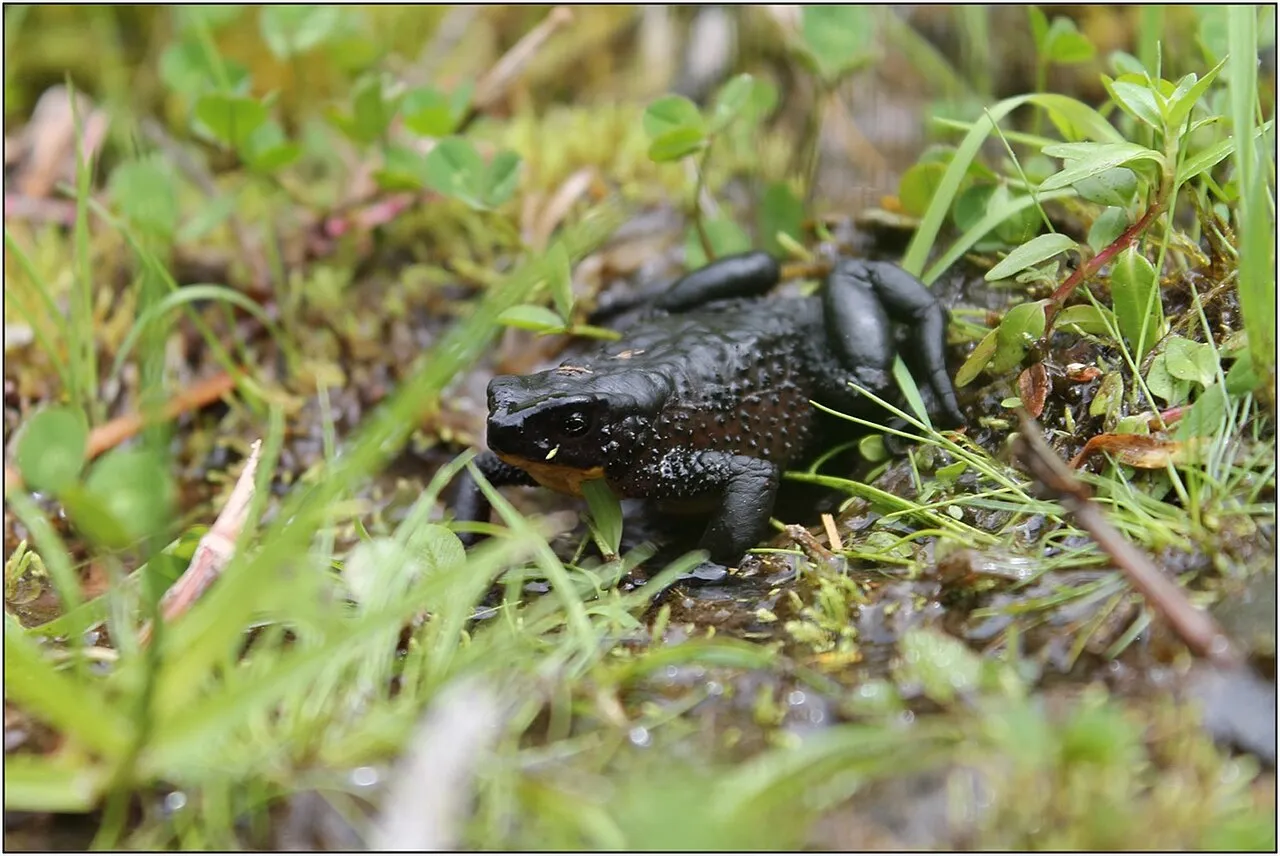
Atelopus ignescens, the Jambato toad, is a robust toad in the family Bufonidae, genus Atelopus — the harlequin toads of the Neotropics, a group known for bold warning colours and, in many species, a precarious conservation status. It is endemic to the northern Andes of Ecuador and was once one of the most common high-Andean amphibians, historically abundant around the streams, rivers and ponds of the paramo surrounding Quito. A near-total collapse through the 1980s left it presumed extinct for nearly three decades, until a single relict population turned up in 2016.
Identification
Females reach about 36-48 mm in snout-vent length, with males somewhat smaller at about 34-41 mm; the body is robust, with long limbs and a blunt, truncate snout, giving the toad a sturdier build than many of its slimmer harlequin-toad relatives. The dorsal surface is uniformly black, including the iris, while the underside is orange-red with a yellow suffusion toward the lighter-coloured belly, a bold contrast shared with several other Atelopus species. In the field, that stark black-and-fire-orange pattern is the single most reliable mark separating the species from the region’s other high-Andean amphibians, most of which run to browns and greens.
Habitat and range
The species occupies high-altitude paramo grassland of the northern Ecuadorian Andes, historically tied to the streams, rivers and ponds on the paramo around Quito. Before the collapse it was abundant and widespread across that range, common enough to be a familiar sight around the Ecuadorian capital; it was last recorded in 1988 and not seen again until a relict population was rediscovered in early 2016 in Angamarca parish, Cotopaxi Province. That single site, which persists in a similar high-altitude paramo setting to the species’ historic range, remains the only locality anywhere where the Jambato toad is currently known to survive, making its entire known distribution today a fraction of what it once was.
Behaviour and breeding
Before the 1980s collapse, the Jambato toad lived in close association with the streams, rivers and ponds that lace the paramo around Quito. Detailed behavioural and breeding records from that period are sparse, and the species’ near-disappearance between 1988 and its 2016 rediscovery has left a long gap in direct observation; current attention instead centres on monitoring the single surviving population in Cotopaxi Province.
Conservation
Atelopus ignescens is listed as Critically Endangered, a status that reflects just how narrow its margin for survival now is. Its decline through the 1980s came from a combination of chytridiomycosis, habitat destruction, pollution, climate change and introduced rainbow trout, pressures that drove what was once a common species out of its entire known range within a decade. The rediscovery of a relict population in Angamarca parish, Cotopaxi Province, in early 2016 ended 28 years without a confirmed sighting and now anchors ongoing conservation attention, though the species survives at only that single site, leaving it exposed to any single localised threat.
Similar species
A closely related, possibly undescribed Atelopus species may occur in Colombia, and several other black-and-orange harlequin toads of the Ecuadorian Andes share a similarly dark body with warning-coloured underparts, though each occupies a separate, mostly non-overlapping range from the Jambato toad.