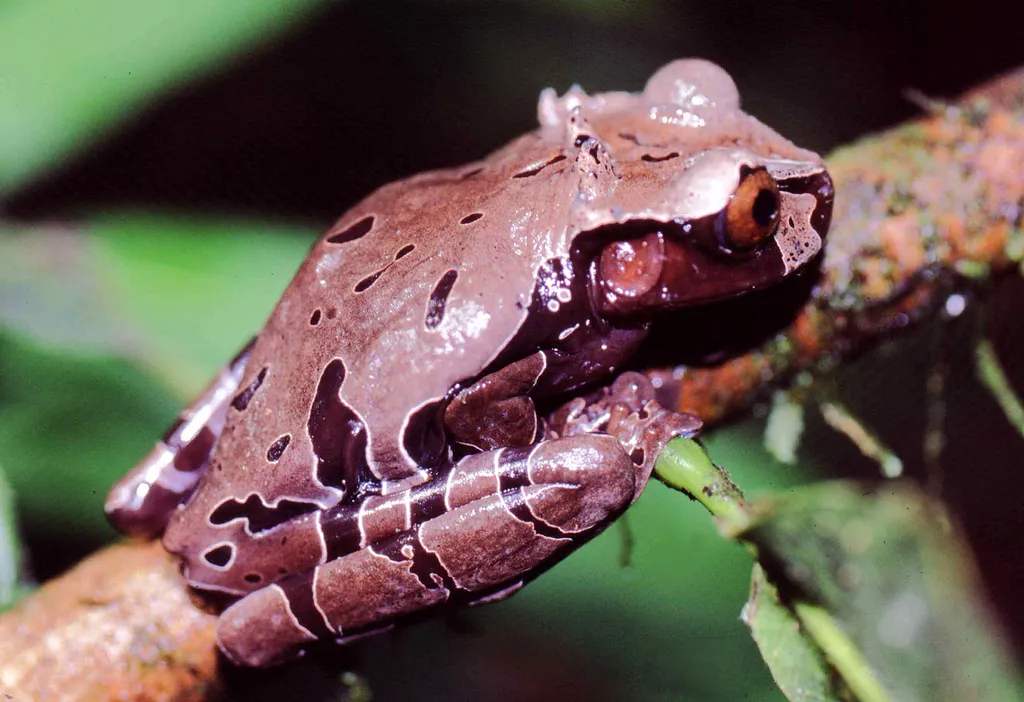
The spiny-headed tree frog, Triprion spinosus, is a large, distinctively armoured hylid found in southern Mexico, Honduras, Costa Rica and Panama, with a spotty distribution across this range rather than a continuous one. Its common and scientific names both point to the feature that sets it apart from almost every other tree frog it shares its forests with: a bony, spine-tipped casque fused across the top of its head.
Identification
This is a relatively large frog, 58-80 mm in snout-vent length, with the facts box carrying the full measured range. The head itself is the clearest field mark: it carries bony, pointed projections across the skull, a casque the frog is believed to use to plug the entrance of the tree holes it shelters and breeds in, sealing out predators and reducing water loss. No other hylid within its Central American range combines that armoured, spine-tipped head with its size.
Habitat and range
The species occupies lowland rainforest and montane humid forest at elevations of 95-2,000 m, a broad altitudinal spread that takes it from near sea level well into cloud forest. It is not confined to pristine habitat: it also tolerates young secondary growth and coffee plantations, provided they lie away from intact forest, which gives it more room to persist in a landscape under agricultural pressure than many of its forest-bound relatives.
Behaviour and breeding
T. spinosus breeds in tree holes and other water-filled tree cavities, including bromeliads, a strategy that keeps eggs and tadpoles off the forest floor and away from ground-level predators. Its bony head casque is thought to serve the same cavity-nesting habit, letting the frog block the entrance to its chosen hole with its own skull once inside.
Conservation
The facts box carries the species’ current IUCN Red List category, Near Threatened. That listing reflects a species threatened by the clearance and transformation of its original habitat into open land, even though it persists in some protected areas and is held in captive breeding insurance populations established as a hedge against further decline.
Similar species
Its closest look-alikes are other casque-headed hylids of Central America, such as the milk frogs of the genus Trachycephalus, but none matches its combination of a sharply spine-tipped, bony skull and tree-hole breeding habit. Within its own range, the spiny head alone is usually enough to separate T. spinosus from every other tree frog sharing its forest canopy.