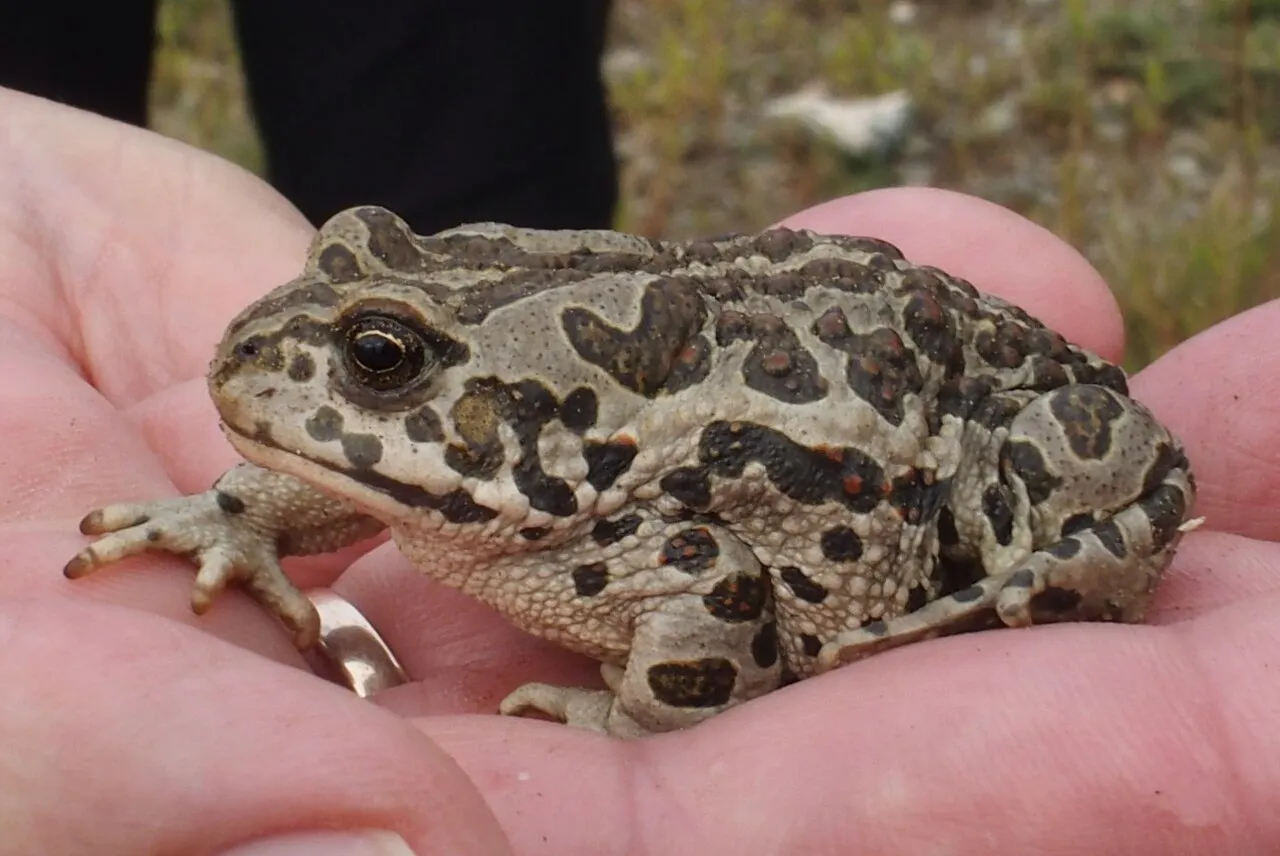
Strauchbufo raddei, the Mongolian toad, is a true toad of the family Bufonidae found across northern China, Mongolia, the Russian Far East and North Korea, with one of the most northerly ranges of any Asian toad. It is particularly common in the Amur River basin shared by China and Russia, and its northernmost known population lives far outside that core range, on Olkhon Island in Lake Baikal, Russia, a long way north of the steppe and desert country that makes up most of the species’ range. Two other common names travel with it: the piebald toad and the Siberian sand toad, both nods to features covered below.
Identification
Adults reach a snout-to-vent length of up to 9 cm (about 90 mm), making it a relatively large toad by the standards of the genus and of Bufonidae generally, many members of which stay well under that size. One of its alternative common names, the piebald toad, points to a mottled or patchy colour pattern, and the other, the Siberian sand toad, points to the sandy ground it is usually found walking across (see Habitat and range, below). A fuller description of its colouring and skin texture is not given in the openly reachable sources this guide can cite, so this entry leaves that detail out rather than guess at it; the size figure above, and the facts box, are what can be stated with confidence.
Habitat and range
The species tolerates a wide range of habitats and is often found in dry regions with sandy soil, from lowlands up to elevations between about 600 m and 2,700 m — a span of more than 2 km that takes in everything from the Amur River lowlands to high steppe. Unusually for an amphibian, it is sometimes found venturing into salt water, a tolerance shared by only a handful of frog and toad species worldwide and one that likely helps it survive in the arid, salt-affected basins common across its Mongolian and Central Asian range, where fresh water is scarce and often mineral-rich. That same flexibility explains how a single species can hold on from the Amur basin’s river valleys all the way out to an island in Lake Baikal, more than a thousand kilometres from the core of its range.
Behaviour and breeding
The toad mates between March and July, depending on local climate, laying its eggs in shallow puddles that often dry up before the tadpoles can mature — a gamble typical of amphibians breeding in arid, unpredictable landscapes, where a pool that holds water long enough to raise a generation of tadpoles cannot be counted on every year. Outside the breeding season it hibernates in groups, in burrows up to 2 m deep, deep enough to escape the hard frosts of a Mongolian or Siberian winter, and the communal habit suggests the same burrows, or the same stretches of suitable sandy ground, are reused by many individuals year after year. Adults feed mainly on ants, especially in the more arid parts of their range, along with spiders and beetles; a diet weighted toward ants is typical of toads working dry, open ground where colonial insects are often the most reliable prey on offer.
Conservation
The facts box above carries the species’ current IUCN Red List category, Least Concern. Its wide range across Mongolia, northern China and the Russian Far East, and its tolerance of dry, disturbed and even saline ground, likely help keep it off a more threatened listing: a toad able to breed in temporary puddles, dig deep to escape winter, and tolerate salt water has more margin against local habitat loss than a species tied to one narrow wetland type. The sources available to this guide do not discuss population trends or specific threats directly, so this entry does not speculate further on them.
Similar species
The Mongolian toad has changed scientific names more than once. It was originally described as Bufo raddei in 1876 by Strauch, with its species name honouring the German naturalist Gustav Radde, placing it in the same genus as the common toad. In 2006 it was moved to the genus Pseudepidalea, which in 2010 was found to be a junior synonym of the green toad genus Bufotes. It was finally placed in its own genus, Strauchbufo — named after Strauch, its original describer — in 2012, in recognition of characteristics distinct enough to set it apart from both Bufo and Bufotes. None of those former genus-mates — the common toad Bufo bufo or the green toads of genus Bufotes — are close enough in range or appearance to be mistaken for the Mongolian toad today; the repeated reclassification reflects shifting ideas about toad taxonomy more than any resemblance a field observer would notice.