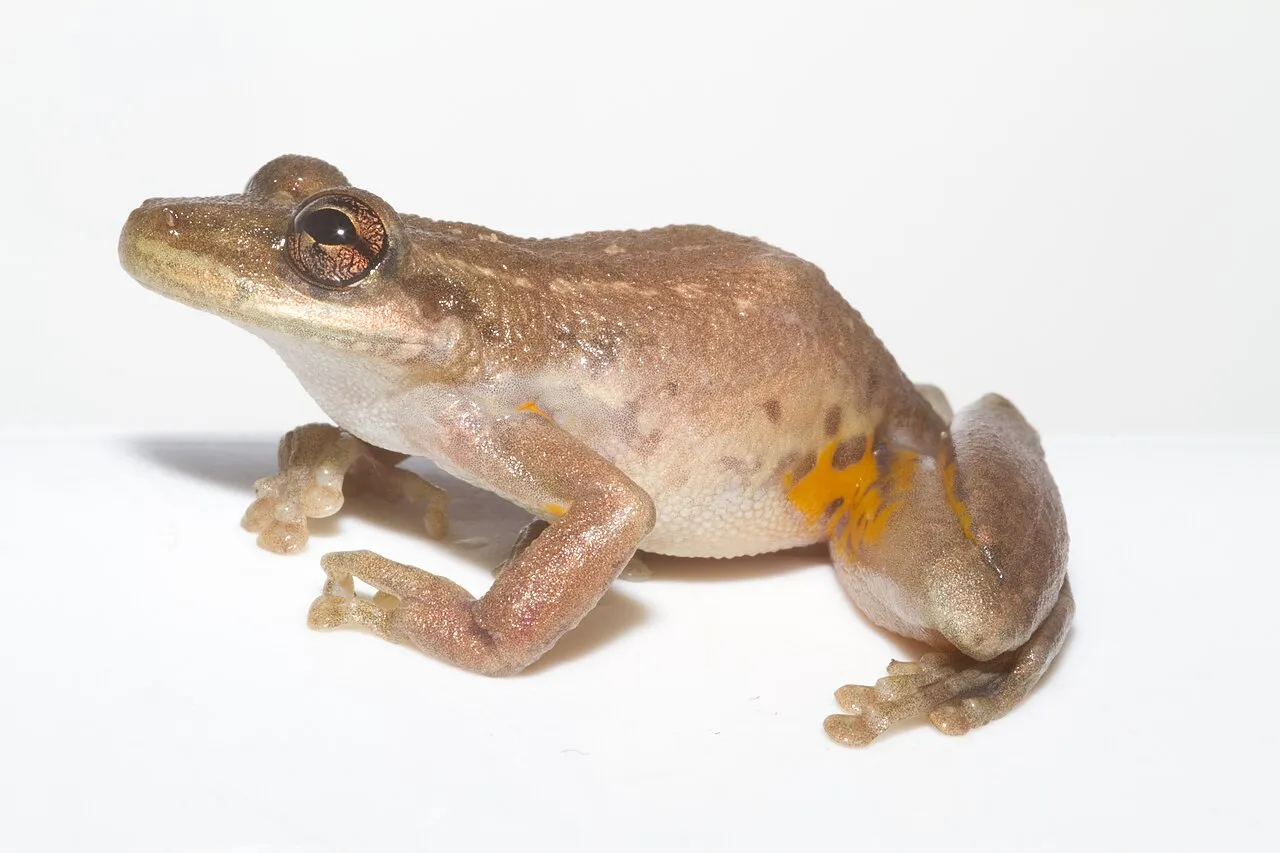
The Red Snouted Treefrog, Scinax ruber, is a small, adaptable hylid widespread in Amazonian South America — Brazil, Colombia, Ecuador, French Guiana, Guyana, Peru, Suriname and Venezuela — and also found in central Panama and Trinidad and Tobago. It belongs to the family Hylidae and the large Neotropical genus Scinax. It has also proved able to ride along with people, having been introduced and established on some Caribbean islands, including Martinique, Puerto Rico and Saint Lucia, where it is considered invasive on Martinique. The common name comes from the warm tones in its skin rather than any single bright patch, a point worth making before looking at the animal in detail.
Identification
The species shows a modest size difference between the sexes: snout-vent length runs 29–41 mm in males and 37–44 mm in females, with females the larger of the two; the facts box carries the full range. Described closely, the dorsum is tan to dull green, usually crossed by a wide, dark-bordered stripe running from eyelid to lower back, with a broken paler line down the middle of that stripe. The flanks read cream with yellow spotting, edged with black where they meet the groin, and the belly is yellow. The backs of the thighs carry brown mottled with yellow or orange, the patch that gives the frog its reddish impression in photographs such as the one on this page, rather than a uniformly red body. The snout is rounded rather than pointed, the eardrum is clearly visible, and the iris is bronze marked with fine black reticulations; the skin on the back ranges from smooth to finely bumpy. All of this is subject to the colour shift typical of treefrogs, so a single photograph never shows the full range of tan, green and yellow the species can display.
Habitat and range
S. ruber is a habitat generalist, occupying a wide range of environments from open ground to moist forest, as well as gardens and parks, from sea level to about 2,600 m elevation. That tolerance for disturbed and human-altered ground helps explain its wide Amazonian range and its success as an introduced species on several Caribbean islands. It becomes especially visible during the rainy season, when it gathers in numbers around temporary waterbodies to breed, often in places with little obvious cover: roadside pools, drainage ditches and garden ponds all count, as long as water stands long enough for eggs to hatch and tadpoles to develop.
Behaviour and breeding
By day it stays concealed among leaves; after dark it becomes active, true to its nocturnal and arboreal habits, climbing into low vegetation to call and feed. Breeding is opportunistic rather than tied to permanent water: pairs form in amplexus and lay in small temporary pools, but also in roadside ditches, a flexibility that lets the species breed wherever rain collects, including in heavily altered ground near roads and settlements. That willingness to use short-lived, human-made water is one reason the species travels well: the same behaviour that lets it colonise a flooded wheel rut in the Amazon basin lets it colonise a garden pond on a Caribbean island where it has been introduced.
Conservation
The facts box carries the species’ current IUCN Red List category, Least Concern. Wikipedia’s account of the assessment notes that this common and widespread species faces no major threats and is adaptable enough to persist in many protected areas, a status consistent with its broad native range across Amazonia, its tolerance of disturbed habitat, and its demonstrated ability to establish new populations outside that range.
Similar species
Scinax is a large and diverse genus of Neotropical treefrogs, and no other profile on this site currently covers a close relative of S. ruber. Identification is complicated further by the fact that S. ruber itself is treated as a complex containing several cryptic species that cannot reliably be told apart by eye; the dorsolateral stripe, the black-edged groin spotting and the brown-and-yellow thigh mottling described above are the features to check first, but a frog matching them from outside the confirmed range, or from a population that turns out to be genetically distinct, may not be this species at all. Breeding habit — roadside ditches and other short-lived pools, used opportunistically through the rainy season — is a useful secondary clue, though it is shared with other generalist hylids across the same range.