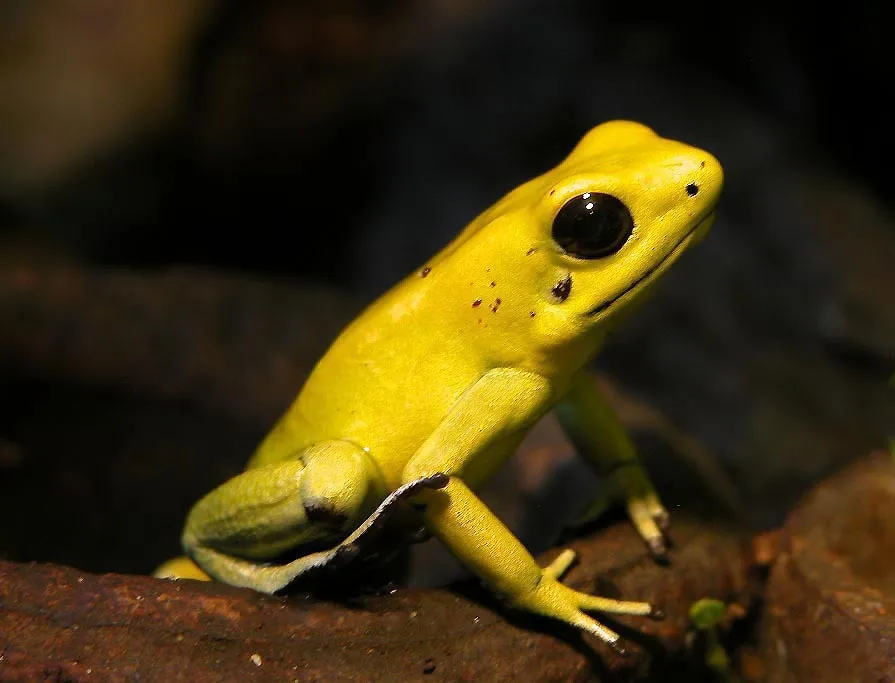
Phyllobates terribilis, the golden poison frog, is a small, brilliantly coloured amphibian of the family Dendrobatidae, and the largest poison dart frog species. It lives only in a narrow strip of Colombian rainforest, where its skin carries enough toxin to make it one of the most dangerous animals on Earth by weight.
Identification
Adults reach about 60 mm in length and nearly 30 g in weight, with females typically larger than males. Juveniles start out mostly black with two golden-yellow stripes, which fade as the frog matures, reaching full adult colouration at around 18 weeks of age. Wild adults come in four main colour morphs: yellow (pale to deep golden), mint green (metallic to pale), orange (metallic orange to yellow-orange), and a captive-bred orange form with dark “blackfoot” markings. The uniform, glossy colouring, unbroken by pattern, is itself a warning sign to predators.
Habitat and range
The species is endemic to humid forests along Colombia’s Pacific coast, in the Cauca and Valle del Cauca departments of the Chocó rainforest, with a total range of less than 5,000 square km. Within that range it favours rainforest with heavy rainfall of 5 m or more a year, at altitudes from sea level to 200 m, temperatures of at least 26°C, and relative humidity of 80-90 percent. That combination of heat, humidity and rain confines the golden poison frog to a small, humid pocket of lowland forest, unlike some of its more widespread relatives.
Behaviour and breeding
Golden poison frogs are diurnal, active during the day rather than at night, and they live evenly spaced out rather than gathering in groups. They hunt as unspecialised ambush predators, capable of taking prey disproportionately large for their own body size, feeding mainly on ants of the genera Brachymyrmex and Paratrechina, alongside a wider range of insects and small invertebrates.
Males advertise with trilling calls, and courtship is tactile: each partner strokes its mate’s head, back, flanks and cloacal area before eggs are laid. Eggs are deposited on the ground beneath leaf litter, and once hatched, the tadpoles stick to a parent’s mucus and are carried to water-filled bromeliads, where they complete their development feeding on algae and mosquito larvae.
The species’ defining trait is its toxicity: a wild adult carries roughly one milligram of the alkaloid batrachotoxin in its skin, an amount estimated to be enough to kill between 10 and 20 humans, or up to two African bull elephants. The toxin irreversibly opens sodium channels in nerve and muscle cells, causing paralysis, cardiac fibrillation and death; the estimated lethal dose for a human is 2.0 to 7.5 micrograms. Captive-bred frogs raised on commercial insects lose their toxicity over time, evidence that the poison is built from compounds in wild prey, possibly beetles of the family Melyridae.
Conservation
The IUCN category is shown in the facts box above. The main pressure on the species is habitat destruction within its already small Colombian range. Historically, wild frogs were also collected for the exotic pet trade; that pressure has eased as captive-breeding operations such as Tesoros de Colombia supply affordable, legally bred frogs as an alternative to wild-caught animals.
Similar species
Phyllobates terribilis is easily told apart from most other poison dart frogs by size alone: it is the largest species in the family. Its plain, unbroken coloration is also a useful field mark: many other brightly coloured dendrobatids show spots, stripes or mottling, while the golden poison frog’s yellow, green or orange morphs are essentially solid. Because the species is so toxic, and because captive-bred colour morphs are now widely kept, any all-yellow, all-green or all-orange dart frog seen outside its native Chocó rainforest range is far more likely to be a captive animal than a wild one.