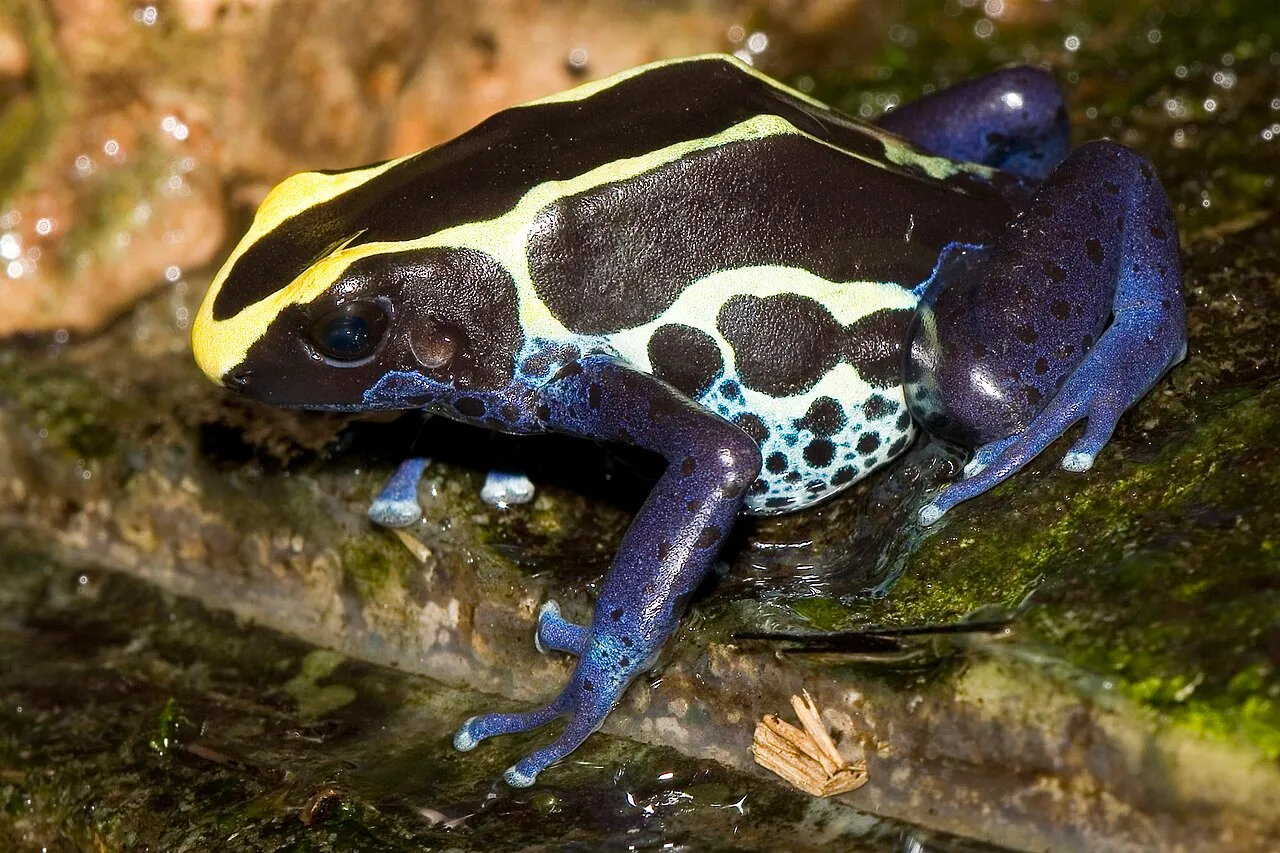
Dendrobates tinctorius, the dyeing dart frog, is a large, boldly patterned poison frog of the family Dendrobatidae, native to the eastern Guiana Shield of northeastern South America, in scattered forest patches across French Guiana, Guyana, Suriname and adjacent Brazil, from near sea level up to about 600 m. One well-studied population occupies isolated forest islands in the Sipaliwini Savannah of southern Suriname, cut off from the surrounding rainforest by dry grassland. Its common name refers to an old, unfounded belief among some Indigenous groups that rubbing the skin of a young poison frog onto the plucked feathers of a parrot would change the colour of the regrown plumage.
Identification
This is one of the larger poison frogs: most adults reach a snout-vent length of about 50 mm, with small forms around 35 mm and the largest forms up to about 70 mm, though Animal Diversity Web reports a narrower range of about 30-45 mm for the isolated Sipaliwini Savannah population, with females reaching about 45 mm and males about 40 mm. The body is patterned in bold black with yellow, white or pale blue markings that vary strikingly between populations, from a single broad yellow dorsal stripe to a network of pale spots and blotches, while the limbs are typically blue or blue-grey with black speckling. As in other dendrobatids, the bright colouring is aposematic, advertising the skin toxins the frog sequesters from its arthropod diet rather than serving as camouflage.
Habitat and range
The species lives in primary lowland and upland tropical rainforest across the eastern Guiana Shield, spanning French Guiana, Guyana, Suriname and adjacent Brazil at elevations from near sea level up to about 600 m. It is mostly ground-dwelling but occasionally climbs into low vegetation, and it depends on treefall canopy gaps whose phytotelmata, the small pools of water that collect in fallen trees, support tadpole development. The Sipaliwini Savannah population lives quite differently from the rest of the species: it is restricted to small, humid, shaded forest patches within a surrounding dry savanna, sheltering near streams among moss-covered rocks, an isolated pocket of rainforest habitat far from the continuous forest that covers most of the range.
Behaviour and breeding
Adults forage by day on the forest floor for small invertebrates, and the toxins responsible for the frog’s warning colours come from this diet rather than being made by the frog itself, as is typical across the poison frog family. Like its dendrobatid relatives, reproduction centres on phytotelmata: eggs are laid on land and the resulting tadpoles are carried to water-filled cavities such as tree holes, where they complete development away from the forest floor. The species’ reliance on treefall gaps and moist microhabitats for breeding ties its local abundance closely to forest structure and rainfall, which is also why the isolated Sipaliwini Savannah population is confined to a handful of humid forest patches rather than spread across the dry grassland around them.
Conservation
The IUCN category is shown in the facts box above. Dendrobates tinctorius is not considered at broad risk: its range across the Guiana Shield includes large tracts of intact rainforest, much of it in French Guiana, Guyana and Suriname, three of the least deforested countries in South America. The main pressures on the species are localised habitat disturbance and collection for the international pet trade, where its size and striking colour patterns make it a popular terrarium animal, though most animals in the hobby today come from captive breeding rather than wild collection. The isolated Sipaliwini Savannah population is the more vulnerable part of the species, since its habitat is limited to a small number of forest islands rather than the continuous rainforest that supports the rest of the range.
Similar species
Dendrobates tinctorius is one of several large, brightly patterned dendrobatids in the Guiana Shield region, and its extreme variability in colour and pattern between populations means that no single description covers the whole species; some populations are mostly yellow with black netting, others largely black with white or pale blue spotting. It is most easily told from its close relative Dendrobates auratus, the green-and-black poison frog, by size and range: D. tinctorius is the larger of the two and is restricted to the Guiana Shield, while D. auratus is smaller, has a naturally more western and Central American distribution, and has also been introduced to Hawaii. Within its own range, pattern variation is great enough that reliable identification often depends on knowing the specific locality a frog comes from.